
- Full name
- Space Docking Experiment
- Agency
- ISRO
- Launch date
- 30 Dec 2024
- Launch vehicle
- PSLV-C60
- Launch site
- SDSC SHAR, Sriharikota
- Docking achieved
- 16 Jan 2025
- Satellites
- SDX01 + SDX02
- India’s ranking
- 4th country to dock
- What is Space Docking? (And Why Is It So Difficult?)
- SpaDeX Quick Facts
- The Two Satellites: Chaser and Target
- The Timeline: What Happened and When
- The Bharatiya Docking System — India’s Own Technology
- Why SpaDeX Matters More Than You Think
- How SpaDeX Compares Globally
- What Comes Next: SpaDeX 2 and SpaDeX 3
- The Underrated Achievement
- Frequently Asked Questions About SpaDeX
- The Bottom Line
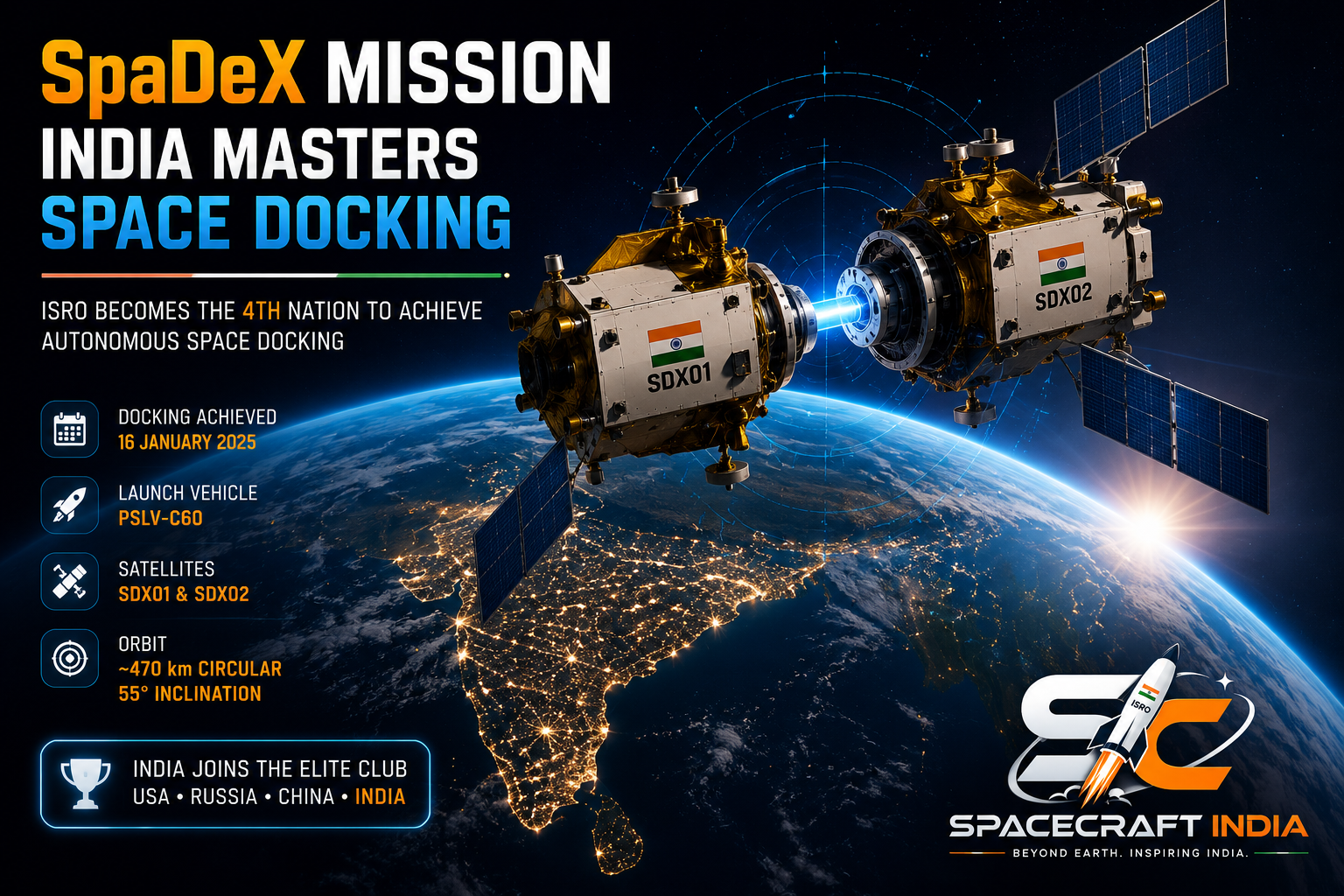
The SpaDeX Mission, Space Docking Experiment, is one of ISRO’s most significant achievements in recent years. The SpaDeX Mission demonstrated India’s ability to dock two spacecraft autonomously in orbit, a capability only three other nations had achieved before. Understanding the SpaDeX Mission helps us see why this technology is essential for India’s future ambitions including space stations and crewed lunar missions.
There’s a club with only four members in the entire world. The United States joined in 1966. The Soviet Union in 1967. China in 2011. And on 16 January 2025, India walked in.
The SpaDeX mission, Space Docking Experiment, made India only the fourth country in human history to successfully dock two spacecraft in orbit. It didn’t make as many headlines as Chandrayaan-3. There was no viral moment, no image of a rover on lunar soil. But among space engineers and scientists, this achievement is arguably more significant.
Because docking isn’t just a technical party trick. It is the foundational capability that makes everything else in ambitious space exploration possible, space stations, crewed lunar missions, satellite refuelling, and eventually, humans on Mars.
India now has it. Here’s the full story.
What is Space Docking? (And Why Is It So Difficult?)
Before we get into what ISRO achieved, it helps to understand what space docking actually is, because it sounds simpler than it is.
Space docking is the process of joining two spacecraft together while both are moving at approximately 28,000 kilometres per hour in orbit around the Earth.
Think about that for a moment. You’re trying to connect two objects moving at roughly 8 kilometers every second, in a vacuum, with no atmosphere, no GPS signal precise enough for fine positioning, and no room for error. If you’re off by even a fraction, too fast, too slow, wrong angle, the spacecraft collide and both are destroyed.
The approach sequence alone takes hours. The two spacecraft must find each other across tens of kilometres, gradually reduce the distance, align their docking ports to millimeter precision, and connect mechanically and electrically, all while orbiting the Earth at speeds that would take you from Bengaluru to Mumbai in under two minutes.
This is why only three countries managed it before India: the United States, Russia (then the Soviet Union), and China. The successful docking on 16 January 2025 was the first by any new spacefaring nation in more than a decade.
SpaDeX Quick Facts
| Full Name | Space Docking Experiment |
| Launch Date | 30 December 2024 |
| Launch Vehicle | PSLV-C60 |
| Launch Site | Satish Dhawan Space Centre, Sriharikota |
| Docking Achieved | 16 January 2025 |
| Orbit | ~470 km circular, 55° inclination |
| Satellites | SDX01 (Chaser) + SDX02 (Target) |
| Weight of each | ~220 kg |
| India’s ranking | 4th country to achieve space docking |
The Two Satellites: Chaser and Target
The SpaDeX mission used two small satellites, each weighing approximately 220 kilograms — about the weight of a large motorcycle.
SDX01 — The Chaser. This is the active satellite. It’s the one that does the manoeuvring, fires its thrusters, and actively approaches the target. Think of it as the car that’s parking.
SDX02 — The Target. This is the passive satellite. It holds its position and waits for the Chaser to come to it. Think of it as the parking spot.
Both spacecraft were launched into a circular orbit at roughly 470 kilometres altitude with a 55-degree inclination, initially separated by about 20 kilometres. From that starting point, SDX01 had to close the gap to zero — precisely and safely.
The Timeline: What Happened and When
30 December 2024 — Launch
ISRO launched the SpaDeX Mission spacecraft using PSLV-C60 from the Satish Dhawan Space Centre, Sriharikota. The launch went perfectly. Both satellites separated from the rocket and settled into their orbits, 20 kilometres apart.
The PSLV-C60 also carried the POEM-4 orbital platform — a bonus science platform with 24 different experiments developed by ISRO and other agencies, riding along for free on the same mission.
12 January 2025 — First Attempt Paused
The first docking attempt on 12 January was paused after sensor anomalies. ISRO took no chances. The team stopped, analysed, refined the approach trajectory, and tried again.
This is actually a sign of maturity — knowing when to stop and reassess rather than pushing forward and risking the mission.
16 January 2025 — Docking Confirmed
At the ISRO Telemetry, Tracking and Command Network’s Mission Operations Complex in Bengaluru, the confirmation came through. The docking process was executed with exceptional precision. India was now the fourth country on Earth with this capability.
13 March 2025 — Undocking
On 13 March, ISRO successfully undocked and separated the SpaDeX satellites. The process was equally controlled and precise. Both satellites then orbited independently.
20 April 2025 — Second Docking
On 20 April 2025, ISRO successfully demonstrated the docking of SDX01 and SDX02 spacecraft for the second time. This proved it wasn’t a one-time fluke — ISRO could repeat the process reliably.
By this point, ISRO had demonstrated rendezvous, docking, undocking, power transfer between docked spacecraft, and re-docking. All the capabilities needed for rendezvous, docking and undocking operations in a circular orbit had been successfully proven.
For official mission details, visit the ISRO SpaDeX mission page.
The Bharatiya Docking System — India’s Own Technology
This is the part that doesn’t get enough attention.
India didn’t license docking technology from anyone. It wasn’t borrowed from Russia or copied from NASA blueprints. The Bharatiya Docking System — the indigenous docking port designed by VSSC (Vikram Sarabhai Space Centre) for SpaDeX — is the piece of hardware that makes the rest of India’s docking-dependent missions possible.
The system is androgynous — meaning both satellites use identical docking ports. Either satellite can be the Chaser or the Target. This is the same design philosophy used in modern international docking systems and is far more flexible than older designs where one port is always “male” and one is always “female.”
Building this from scratch — the sensors, the autonomous navigation software, the mechanical capture mechanism, the electrical power transfer connectors — is a significant engineering achievement. Every component was developed in India, by Indian engineers.
Why SpaDeX Matters More Than You Think
Let’s be direct: SpaDeX is not just a science experiment. It is infrastructure for India’s entire future in space.
Without docking, the Bharatiya Antariksh Station planned for the 2030s cannot be assembled, the Chandrayaan-4 lunar sample return cannot be executed, and several proposed in-orbit servicing and propellant transfer missions remain on paper.
Here’s why each of those depends on docking:
Chandrayaan-4 — Lunar Sample Return ISRO’s next major Moon mission aims to bring back up to 3 kg of lunar soil from the surface. To do this, a lander touches down, collects samples, and launches an ascent vehicle back into lunar orbit. That ascent vehicle then has to dock with an orbiter — in lunar orbit — before flying back to Earth. Without SpaDeX proving ISRO can do this, Chandrayaan-4 cannot happen.
Bharatiya Antariksh Station — India’s Own Space Station India plans to have its own space station operational by the 2030s. A space station cannot be launched in one piece — it must be built module by module, with each module docking to the previous one in orbit. Every module requires docking. SpaDeX is the foundation of this entire programme.
Gaganyaan and Beyond India’s crewed spaceflight programme needs docking capability for crew rescue missions, cargo resupply, and eventually rotating crews. An astronaut stranded in orbit with a broken spacecraft needs a rescue vehicle that can dock with their capsule.
Satellite Servicing Many satellites fail not because they stop working but because they run out of fuel. Space docking makes it possible to refuel or repair satellites in orbit — extending their operational lives and saving billions of rupees.
How SpaDeX Compares Globally
To appreciate what India achieved, it helps to know the history:
United States (1966) — Gemini 8, crewed mission, Neil Armstrong at the controls. First-ever space docking. Manual docking by a human pilot.
Soviet Union (1967) — Cosmos 186 and 188. First automated (uncrewed) docking — actually achieved before the USA managed it automatically.
China (2011) — Shenzhou-8 and Tiangong-1. China’s first docking, decades after the US and USSR, but establishing the capability needed for their Tiangong space station.
India (2025) — SpaDeX. Fully autonomous, indigenous technology, developed from scratch.
What makes India’s achievement particularly notable is the cost. True to ISRO’s tradition of doing more with less, SpaDeX was a remarkably budget-conscious mission. Two small satellites, each 220 kg, launched on a single PSLV — compact, efficient, and purpose-built for exactly this demonstration.
What Comes Next: SpaDeX 2 and SpaDeX 3
ISRO isn’t done. ISRO intends to launch SpaDeX-2, pending government approval, with the goal of docking two satellites in an elliptical orbit rather than a circular one.
Why does that matter? In a circular orbit, satellites move at a constant speed and altitude. In an elliptical orbit — the kind used for deep space missions and lunar trajectories — speed and altitude constantly change. Docking in an elliptical orbit is significantly harder and is essential for the Chandrayaan-4 lunar sample return mission.
SpaDeX-3 would also demonstrate sample transfer and remote robotic operations using scaled-up hardware, paving the way for Bharatiya Antariksh Station and Chandrayaan-4.
Each mission builds on the last. SpaDeX was step one. The destination is an Indian space station and an Indian on the Moon.
The Underrated Achievement
There’s a reason SpaDeX didn’t get the same celebration as Chandrayaan-3. There was no dramatic visual — no image of a lander on a crater, no rover wheel tracks on lunar dust. Space docking is invisible from Earth. Two small satellites joined together 470 kilometres above us, and then separated again, and the casual observer would have no idea it even happened.
But in the space community, the reaction was clear. A country that achieved its first orbital launch in 1980 had now joined a club that includes only the United States, Russia, and China. That’s a significant statement about where Indian space technology stands in 2025.
For every ISRO mission that makes headlines — the Chandrayaan moonshots, the Mangalyaan Mars mission, the Gaganyaan astronaut programme — there are enabling technologies that make those missions possible. SpaDeX is one of the most important of those enabling technologies.
India is not just launching satellites for other countries anymore. It is building the capabilities to assemble space stations, return samples from the Moon, and eventually send humans beyond Earth orbit.
SpaDeX was the quiet, technical proof that India can do all of those things.
Frequently Asked Questions About SpaDeX
What is the SpaDeX mission?
SpaDeX, Space Docking Experiment, is ISRO’s technology demonstration mission to prove that India can dock two spacecraft together in orbit. It launched on 30 December 2024 and achieved successful docking on 16 January 2025.
What does SpaDeX stand for?
SpaDeX stands for Space Docking Experiment. The mission used two small satellites — SDX01 (Chaser) and SDX02 (Target) — launched together on a single PSLV-C60 rocket.
When did India’s SpaDeX docking happen?
India successfully completed its first space docking on 16 January 2025, making it the fourth country in the world to achieve this capability after the USA, Russia, and China.
Which rocket launched SpaDeX?
SpaDeX was launched by PSLV-C60 from the Satish Dhawan Space Centre at Sriharikota on 30 December 2024.
Why is space docking important for India?
Space docking is essential for India’s planned Bharatiya Antariksh Station (space station), Chandrayaan-4 lunar sample return mission, Gaganyaan crew rescue operations, and future satellite servicing missions. Without docking capability, none of these are possible.
Did India develop its own docking technology?
Yes. ISRO developed the Bharatiya Docking System entirely indigenously at the Vikram Sarabhai Space Centre. No foreign technology was used. This makes India’s achievement particularly significant.
How many times did ISRO dock the SpaDeX satellites?
ISRO docked the satellites twice — first on 16 January 2025, and a second time on 20 April 2025. This proved the technology was repeatable and reliable, not a one-time achievement.
What is the connection between SpaDeX and Gaganyaan?
Gaganyaan — India’s crewed spaceflight mission — will require docking capability for crew rescue missions, cargo resupply, and crew rotation. SpaDeX proved ISRO has the foundational technology to support a crewed space programme.
The Bottom Line
Space docking is one of the hardest things a space agency can do. The physics are unforgiving, the margins for error are microscopic, and the stakes — both technical and financial — are enormous.
On 16 January 2025, ISRO pulled it off. Autonomously. With indigenous technology. On a budget that would make most other space agencies raise an eyebrow.
India is now one of four countries on Earth that can join spacecraft in orbit. That’s not just a technical milestone — it’s a strategic capability that will define what India can do in space for the next several decades.
The Bharatiya Antariksh Station needs it. Chandrayaan-4 needs it. Gaganyaan needs it. And now India has it.
We’ll be tracking every step of what comes next, right here on SpaceCraft India.
Which upcoming ISRO mission are you most excited about? Drop a comment below.
Also Read:
- What is ISRO? A Complete Beginner’s Guide to India’s Space Agency
- Gaganyaan Mission: Everything You Need to Know About India’s First Crewed Spaceflight (Coming Soon)
- Chandrayaan-4: India’s Mission to Bring Moon Rocks Back to Earth (Coming Soon)