
- Agency
- ISRO
- Height
- ~43.5 metres
- Lift-off weight
- ~640 tonnes
- Stages
- 3
- Payload to LEO
- ~8 tonnes
- Payload to GTO
- ~4 tonnes
- Notable payloads
- Chandrayaan-2, -3, Gaganyaan
What is LVM3?
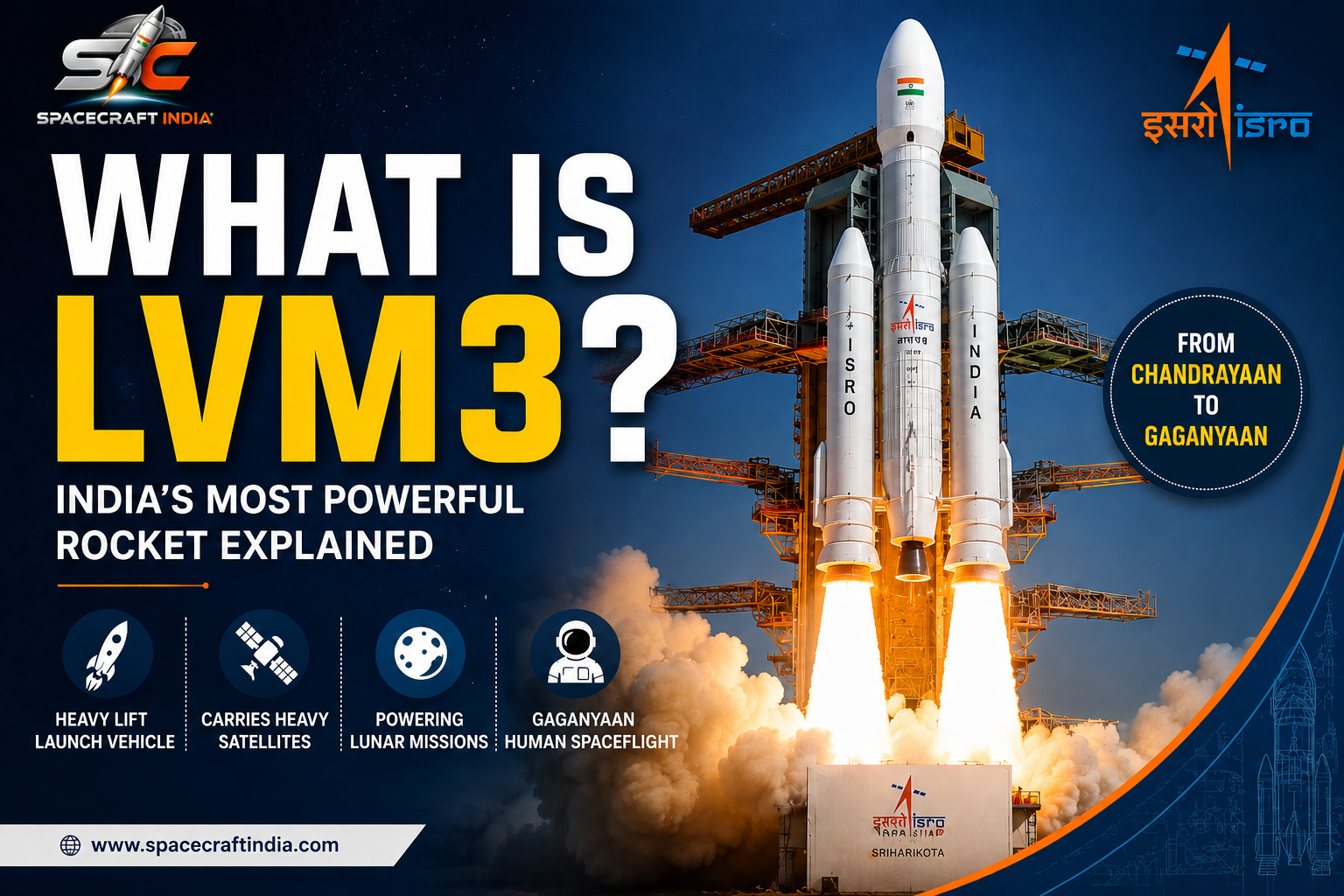
What is LVM3? The LVM3 — Launch Vehicle Mark 3 — is India’s heaviest and most powerful rocket. Previously known as GSLV Mk III, understanding what LVM3 is helps us see how far ISRO has come. The LVM3 can carry up to 8,000 kg to low Earth orbit, making it capable of launching India’s future space station modules and crewed missions.
Previously known as GSLV Mk III, the rocket was officially renamed LVM3 as part of ISRO’s updated naming convention. Today, it serves as India’s flagship heavy-lift launch vehicle and has successfully launched landmark missions such as Chandrayaan-2, Chandrayaan-3, and multiple commercial satellite missions.
As India prepares for the ambitious Gaganyaan Human Spaceflight Mission, LVM3 is expected to play an even more significant role in the country’s future space exploration efforts.
What Does LVM3 Stand For?
LVM3 stands for:
- L – Launch
- V – Vehicle
- M3 – Mark-3
Unlike the earlier naming system that emphasized Geosynchronous Satellite Launch Vehicles (GSLV), ISRO now uses a simpler naming convention based on the rocket’s role rather than its destination.
Although the name changed, the rocket itself remains the same powerful vehicle that was earlier called GSLV Mk III.
Why Was LVM3 Developed?
As India’s space ambitions grew, ISRO needed a rocket capable of carrying much heavier payloads than PSLV and earlier GSLV variants.
LVM3 was developed to:
- Launch heavy communication satellites
- Reduce dependence on foreign launch providers
- Support deep-space exploration missions
- Carry astronauts during the Gaganyaan mission
- Strengthen India’s commercial launch services
Its development marked an important milestone in making India self-reliant in launching large satellites.
How Does LVM3 Work?
LVM3 is a three-stage launch vehicle, with each stage performing a specific task during launch.
Stage 1: Solid Rocket Boosters
The rocket uses two massive S200 Solid Rocket Boosters attached to its sides.
These boosters provide enormous thrust during liftoff, helping the rocket escape Earth’s gravity in the first few minutes.
Each booster is among the largest solid rocket boosters ever built in the world.
Stage 2: Liquid Core Stage
Once the boosters separate, the L110 Liquid Stage takes over.
Powered by two proven Vikas engines, this stage continues accelerating the rocket toward space while maintaining the correct trajectory.
Stage 3: Cryogenic Upper Stage
The final stage uses the advanced CE-20 Cryogenic Engine.
It burns liquid hydrogen and liquid oxygen stored at extremely low temperatures, making it one of the most efficient rocket propulsion systems developed by ISRO.
This stage precisely injects satellites or spacecraft into their intended orbit.
LVM3 Specifications
Some key specifications of LVM3 include:
- Height: Approximately 43.5 metres
- Lift-off Weight: Around 640 tonnes
- Stages: Three
- Boosters: Two S200 Solid Rocket Boosters
- Liquid Stage: L110 with two Vikas engines
- Upper Stage: C25 Cryogenic Stage with CE-20 engine
Its combination of solid, liquid, and cryogenic propulsion makes it India’s most capable launch vehicle to date.
Payload Capacity
LVM3 is designed for heavy-lift missions.
It can carry approximately:
- Up to 8 tonnes to Low Earth Orbit (LEO)
- Around 4 tonnes to Geosynchronous Transfer Orbit (GTO)
This allows ISRO to launch heavier communication satellites and complex scientific missions without relying on foreign rockets.
Major Missions Launched by LVM3
Chandrayaan-2
In 2019, LVM3 successfully launched Chandrayaan-2, India’s second mission to the Moon.
Although the Vikram lander experienced a hard landing, the orbiter continues to provide valuable scientific data.
Chandrayaan-3
One of LVM3’s greatest achievements came in 2023 when it launched Chandrayaan-3.
The mission successfully achieved a historic soft landing near the Moon’s south pole, making India the first country to accomplish this feat and only the fourth nation to achieve a soft lunar landing.
This mission brought global recognition to both ISRO and LVM3.
OneWeb Commercial Missions
LVM3 has also entered the commercial launch market.
It successfully launched multiple batches of OneWeb broadband satellites, demonstrating its reliability for international customers.
These missions strengthened India’s position in the growing global space economy.
LVM3 and the Gaganyaan Mission
LVM3 has been selected as the launch vehicle for Gaganyaan, India’s first human spaceflight mission.
For this mission, the rocket is undergoing additional upgrades known as Human Rating, which includes:
- Improved reliability
- Additional safety checks
- Enhanced quality control
- Crew Escape System compatibility
These upgrades ensure the rocket meets the strict safety standards required for carrying astronauts.
Why Is LVM3 Important?
LVM3 is more than just a rocket—it is a symbol of India’s technological progress.
It enables India to:
- Launch heavy satellites independently
- Conduct advanced lunar and planetary missions
- Support future human spaceflight
- Compete in the international commercial launch market
- Develop next-generation space technologies
Its success also reduces dependence on foreign launch providers, strengthening India’s strategic capabilities.
The LVM3 is the most powerful rocket in ISRO’s fleet. While the GSLV handles medium payloads, LVM3 is designed for India’s most ambitious missions.
What Is the Future of LVM3?
Although ISRO is developing the Next Generation Launch Vehicle (NGLV), LVM3 will continue to remain India’s primary heavy-lift rocket for the foreseeable future.
Upcoming missions expected to use LVM3 include:
- Gaganyaan Human Spaceflight Mission
- Advanced communication satellites
- Scientific research missions
- International commercial launches
As India’s space programme expands, LVM3 will continue to play a central role in achieving ambitious national and international space goals.
Conclusion
LVM3 has transformed India’s space capabilities by enabling the launch of heavier satellites, ambitious lunar missions, and future human spaceflight. From Chandrayaan-3’s historic Moon landing to the upcoming Gaganyaan mission, this remarkable rocket has become the backbone of ISRO’s heavy-lift launch programme.
As India continues its journey toward becoming a global space power, LVM3 stands as a symbol of innovation, engineering excellence, and self-reliance. Its achievements have not only strengthened India’s space programme but have also earned worldwide recognition for ISRO’s technological capabilities.
For full technical details, visit ISRO’s official LVM3 page
FAQ’s
What is LVM3?
LVM3 (Launch Vehicle Mark-3) is ISRO’s most powerful launch vehicle. It is designed to carry heavy satellites, lunar spacecraft, and future astronaut missions such as Gaganyaan. Previously known as GSLV Mk III, it is India’s flagship heavy-lift rocket.
Is LVM3 the same as GSLV Mk III?
Yes. LVM3 and GSLV Mk III are the same rocket. ISRO officially renamed GSLV Mk III to LVM3 under its new naming convention. The rocket’s design and capabilities remain unchanged.
Which famous missions have been launched using LVM3?
LVM3 has successfully launched Chandrayaan-2, Chandrayaan-3, multiple OneWeb satellite missions, and is scheduled to launch India’s first human spaceflight mission, Gaganyaan.
2 thoughts on “What is LVM3? India’s Most Powerful Rocket Explained for Beginners (2026)”