
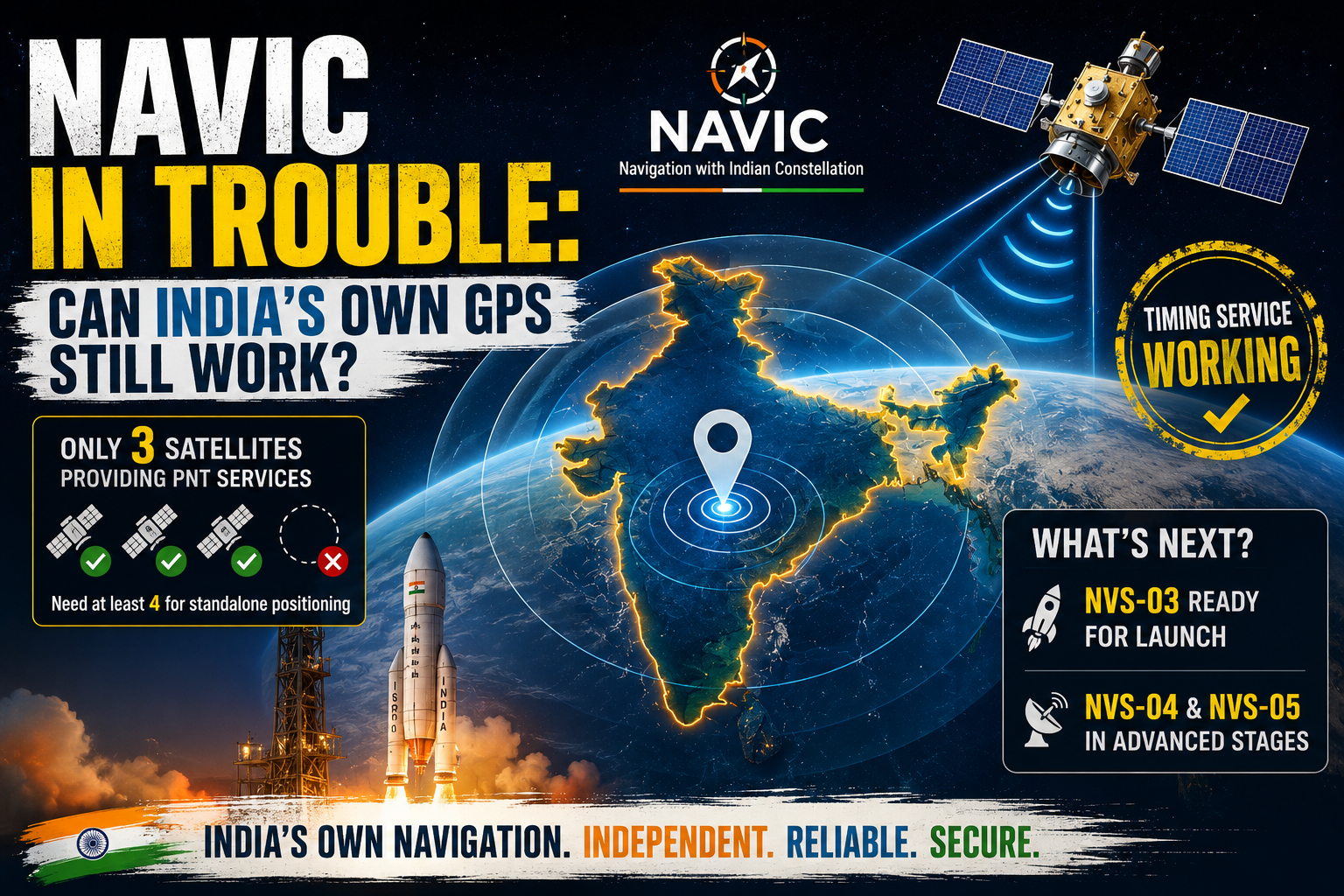
- System
- NavIC
- Agency
- ISRO
- Operational sats
- 3
- Needed for standalone
- 4
- Timing service
- Working
- Next launch
- NVS-03
- In development
- NVS-04, NVS-05
- What Exactly Has Happened to NavIC?
- Why Does NavIC Need At Least Four Satellites?
- What Happened to the Other NavIC Satellites?
- The NVS-02 Problem Made Things Worse
- Did the GSLV Rocket Fail?
- What Did ISRO Do After the NVS-02 Failure?
- Is NavIC Completely Dead?
- Why Is NavIC Still Important If GPS Already Works?
- What Is NVS-03?
- Why Are the New NVS Satellites Better?
- Will NVS-03 Fix NavIC?
- What About India’s Existing NavIC Users?
- Is GAGAN Affected by the NavIC Problem?
- What Does This Mean for India’s Space Programme?
- Can India Restore NavIC?
- Conclusion
- Frequently Asked Questions (FAQs)
Last Updated: August 2026
India built NavIC so that the country would have its own independent satellite navigation capability instead of depending entirely on foreign systems such as GPS. But in 2026, the NavIC satellite system is facing its most serious operational challenge yet.
The Government has confirmed that only three NavIC satellites are currently providing Position, Navigation and Timing (PNT) services.
There is one major problem.
A navigation receiver needs signals from at least four operational satellites to calculate a standalone position.
That means NavIC, in its present state, cannot provide standalone positioning services.
Does that mean India’s own GPS has stopped working completely?
No.
But it does mean that NavIC urgently needs new satellites in orbit.
Here is what happened, why NavIC reached this situation, what still works, and how ISRO plans to rebuild the constellation.
What Exactly Has Happened to NavIC?
NavIC stands for Navigation with Indian Constellation.
It was originally called the Indian Regional Navigation Satellite System or IRNSS.
The system was designed to provide Position, Navigation and Timing services across India and approximately 1,500 km beyond the Indian landmass.
NavIC’s original constellation was built around seven satellites.
Over time, however, several satellites developed problems or reached the end of their operational lives.
By August 2025, four satellites were still providing PNT services.
That number has now fallen to three.
The three satellites currently providing PNT services are:
- IRNSS-1B
- IRNSS-1I
- NVS-01
The Government told Parliament on July 29, 2026 that after IRNSS-1F completed its 10-year mission life, only these three satellites remained available for PNT services.
Why Does NavIC Need At Least Four Satellites?
Satellite navigation works by measuring extremely precise timing signals transmitted by satellites.
Your navigation receiver uses those signals to calculate:
- Latitude
- Longitude
- Altitude
- Time
To determine a complete standalone position reliably, the receiver needs signals from at least four navigation satellites.
Three satellites are not enough for normal standalone satellite positioning.
That is why the Government has now officially stated that:
NavIC cannot currently provide standalone positioning service.
However, NavIC’s timing service remains functional.
That distinction is important.
NavIC has not disappeared, and its satellites have not all stopped working. The constellation simply does not currently have enough PNT-capable satellites for standalone positioning.
What Happened to the Other NavIC Satellites?
There is no single reason behind NavIC’s current situation.
It is the result of several problems accumulating over the years.
One of the biggest challenges has been the failure of atomic clocks onboard some first-generation IRNSS satellites.
Atomic clocks are essential to satellite navigation because the entire system depends on extraordinarily accurate measurements of time.
Even tiny timing errors can produce significant positioning errors on Earth.
Several older NavIC satellites experienced atomic-clock problems, reducing their ability to provide navigation services.
Other satellites reached the end of their planned mission lives.
And replacement launches did not arrive quickly enough to maintain the constellation at full strength.
The NVS-02 Problem Made Things Worse
ISRO attempted to strengthen NavIC by launching NVS-02 aboard GSLV-F15 on January 29, 2025.
The rocket performed correctly and placed NVS-02 into its intended Geosynchronous Transfer Orbit.
The satellite then had to use its own propulsion system to raise itself into its final operational orbit.
That did not happen.
The valves required to allow oxidiser into the orbit-raising propulsion system failed to operate.
ISRO later conducted a detailed investigation.
The investigation concluded that the primary problem was that the drive signal did not reach the pyro valve of the oxidiser line. The most likely cause was disengagement of connector contacts in the electrical path.
Without the ability to perform the required orbit-raising manoeuvres, NVS-02 remained in an elliptical transfer orbit.
ISRO currently lists NVS-02 as not operational.
This was particularly damaging because NVS-02 was supposed to strengthen an already ageing NavIC constellation.
Did the GSLV Rocket Fail?
No.
This is an important distinction.
The GSLV-F15 launch vehicle successfully placed NVS-02 into the planned transfer orbit.
The problem occurred after the satellite separated from the rocket, when the spacecraft attempted to perform its own orbit-raising manoeuvres.
Therefore, describing NVS-02 as a GSLV launch failure would be incorrect.
The rocket did its job.
The spacecraft’s propulsion-related system experienced the problem.
What Did ISRO Do After the NVS-02 Failure?
ISRO formed an Apex Committee to investigate the anomaly.
The committee recommended changes designed to improve the redundancy and reliability of future spacecraft pyro systems.
Those corrective measures were subsequently implemented.
ISRO says the changes were successfully used on the CMS-03 spacecraft launched aboard LVM3-M5 in November 2025.
The agency also plans to apply the recommendations to future missions where relevant.
This means the NVS-02 failure has already resulted in engineering changes for upcoming satellites.
Is NavIC Completely Dead?
No.
Calling NavIC “dead” would be inaccurate.
The Government says its timing service remains functional.
NavIC is also commonly used alongside other Global Navigation Satellite Systems rather than completely independently.
Modern navigation receivers can combine signals from multiple satellite constellations, including:
- GPS
- NavIC
- Galileo
- GLONASS
- BeiDou
This is called multi-constellation GNSS.
The Government says that because most NavIC applications operate in a multi-constellation environment, users do not face the same vulnerability that would exist if they depended exclusively on NavIC.
India’s Armed Forces are also using multi-constellation GNSS, including NavIC.
So your smartphone navigation is not suddenly going to stop because NavIC has only three PNT satellites.
Why Is NavIC Still Important If GPS Already Works?
This raises an obvious question.
If India can simply use GPS alongside other navigation systems, why spend money maintaining NavIC?
The answer is strategic independence.
GPS belongs to the United States.
GLONASS belongs to Russia.
Galileo belongs to the European Union.
BeiDou belongs to China.
NavIC belongs to India.
For ordinary smartphone users, depending on multiple global navigation systems is convenient.
For a country, however, independent access to Position, Navigation and Timing infrastructure is strategically important.
Navigation satellites support far more than Google Maps.
They can support:
- Military navigation
- Ships and aircraft
- Railways
- Emergency services
- Telecommunications
- Financial networks
- Disaster management
- Fishing vessels
- Vehicle tracking
- Precise national timing
That makes NavIC part of India’s critical technological infrastructure.
What Is NVS-03?
The immediate hope for restoring NavIC’s standalone positioning capability is NVS-03.
NVS-03 belongs to India’s second generation of NavIC satellites.
The Government confirmed in July 2026 that NVS-03 is ready for launch.
Two additional satellites — NVS-04 and NVS-05 — are in advanced stages of realisation.
These satellites are intended to strengthen and replenish the ageing NavIC constellation.
Why Are the New NVS Satellites Better?
The NVS series represents an important upgrade over India’s original IRNSS satellites.
One major improvement is support for the L1 navigation band.
L1 is widely used by civilian satellite-navigation receivers around the world.
Adding L1 makes it easier for NavIC to be integrated into mass-market devices such as smartphones, wearables and vehicle-navigation systems.
NVS satellites also carry navigation payloads using multiple frequency bands.
Another important development is India’s work on indigenous atomic clocks.
NVS-01, launched in May 2023, became the first second-generation NavIC satellite and carried an indigenous atomic clock.
Reducing dependence on imported atomic-clock technology is an important part of making NavIC more self-reliant.
Will NVS-03 Fix NavIC?
NVS-03 could make an enormous difference.
If NVS-03 reaches its intended orbit and begins providing navigation signals successfully, the number of PNT-capable NavIC satellites would increase from three to at least four.
Four is the minimum required for basic standalone positioning.
But there is an important difference between minimum capability and a healthy constellation.
Operating with exactly four satellites provides very little redundancy.
If another satellite or atomic clock develops a problem, the system could again fall below the minimum.
That is why NVS-04 and NVS-05 are also important.
NavIC needs not just one successful replacement satellite but a sustainable replenishment programme.
What About India’s Existing NavIC Users?
NavIC technology is already being used in several sectors.
Government disclosures have previously highlighted its use for real-time train tracking, fishing-vessel communication, vehicle tracking, disaster messaging and dissemination of Indian Standard Time.
Thousands of Indian trains have also been equipped with systems that use NavIC together with other GNSS constellations.
This multi-constellation approach is important during the current shortage.
Instead of asking a device to depend only on NavIC, it can combine NavIC signals with signals from GPS and other satellite systems.
Is GAGAN Affected by the NavIC Problem?
No.
NavIC should not be confused with GAGAN.
GAGAN stands for GPS Aided GEO Augmented Navigation and is India’s Satellite-Based Augmentation System developed by ISRO and the Airports Authority of India for aviation.
The Government specifically stated in March 2026 that GAGAN remains operational and provides services for air navigation.
NavIC and GAGAN are separate systems with different roles.
What Does This Mean for India’s Space Programme?
NavIC’s present difficulties offer an important lesson about satellite constellations.
Building a navigation system is only the first step.
Keeping it operational requires:
- Reliable satellites
- Reliable atomic clocks
- Replacement spacecraft
- Regular launches
- Ground infrastructure
- Long-term funding
- Redundancy
Navigation satellites eventually age.
Components fail.
Atomic clocks can malfunction.
Replacement missions can encounter technical problems.
A strategically important constellation therefore needs spare capacity and a steady replenishment programme.
The NavIC story is now moving from building India’s own navigation system to the equally difficult challenge of keeping that system continuously operational.
Can India Restore NavIC?
Yes.
The current problem is serious, but it is technically recoverable.
India already has NVS-01 operating successfully, and NVS-03 is ready for launch.
NVS-04 and NVS-05 are also progressing.
The engineering lessons from the NVS-02 anomaly have been investigated, and ISRO says corrective measures have already been implemented successfully on a subsequent spacecraft.
If the upcoming NVS satellites are launched and commissioned successfully, NavIC can regain standalone positioning capability and rebuild redundancy.
The bigger challenge will be ensuring that India never again allows such a strategically important constellation to fall below its minimum operational strength.
Conclusion
NavIC is in trouble, but India’s own navigation system is not dead.
As of July 2026, only three satellites — IRNSS-1B, IRNSS-1I and NVS-01 — are providing PNT services. Since at least four operational satellites are required for basic standalone positioning, NavIC cannot currently provide standalone positioning.
Its timing service remains functional, and multi-constellation receivers can continue combining NavIC with GPS and other GNSS systems.
The next critical step is NVS-03.
With NVS-03 ready for launch and NVS-04 and NVS-05 in advanced stages of development, India has a clear path to restoring the constellation.
NavIC’s present difficulties do not prove that India does not need its own GPS.
They demonstrate exactly why a country that wants independent navigation capability must maintain enough satellites, replacements and redundancy to keep that system available when it matters most.
Frequently Asked Questions (FAQs)
Is NavIC working in 2026?
NavIC is only partially operational. As of July 2026, three satellites are providing Position, Navigation and Timing services, while at least four are needed for standalone positioning. The Government says standalone positioning is therefore currently unavailable, although NavIC’s timing service remains functional.
Why does NavIC have only three navigation satellites?
Several first-generation NavIC satellites suffered atomic-clock problems or reached the end of their mission lives. NVS-02, launched as a replacement in January 2025, also failed to reach its operational orbit because its orbit-raising propulsion system could not be activated.
When will NavIC work independently again?
NVS-03 is ready for launch, while NVS-04 and NVS-05 are in advanced stages of realisation. A successfully commissioned additional navigation satellite could restore the minimum four-satellite requirement, although a healthy NavIC constellation needs greater redundancy than the bare minimum.