
- Satellite
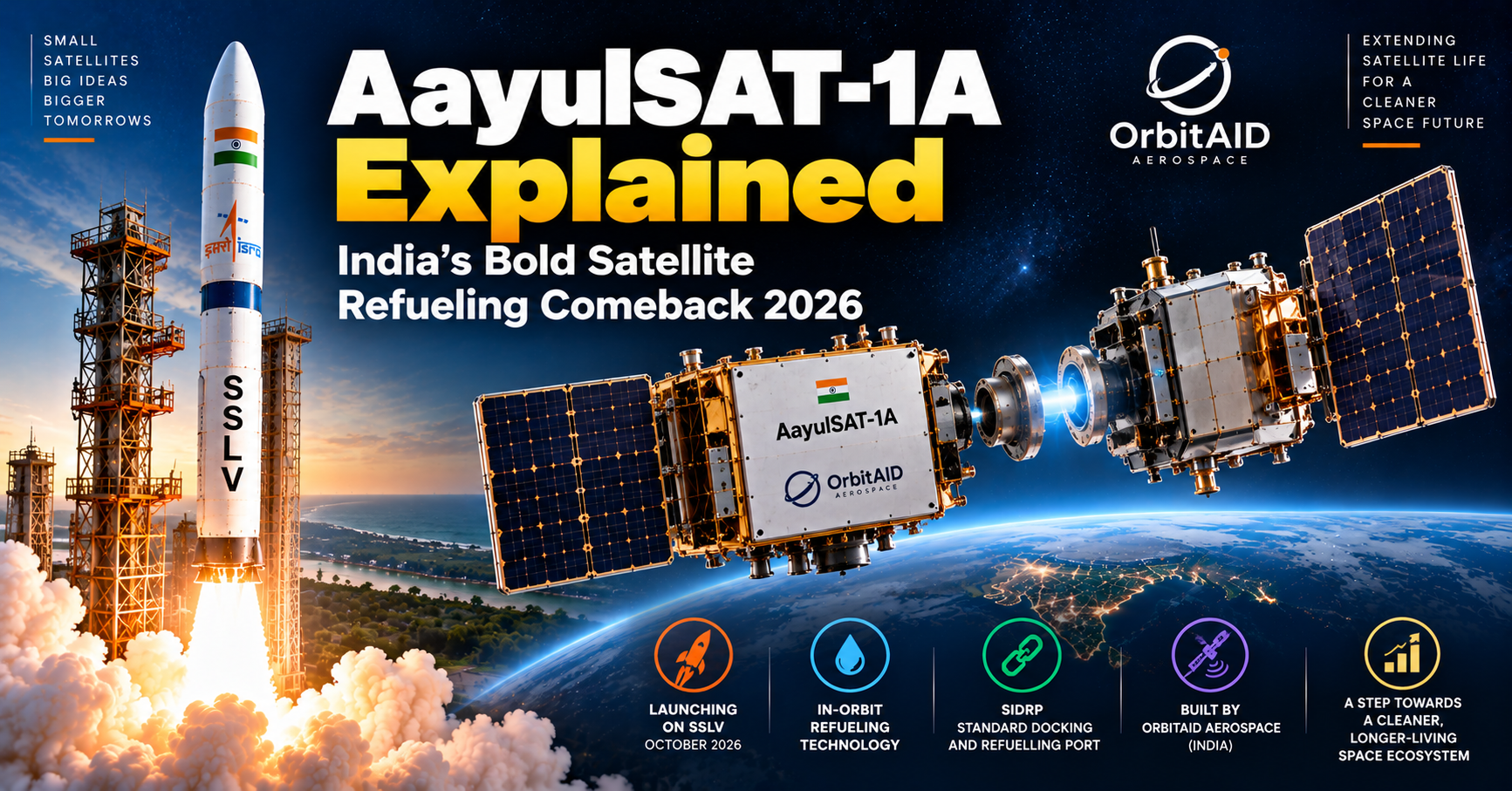
- AayulSAT-1A
- Operator
- OrbitAID Aerospace
- Mission Type
- In-orbit refuelling technology demonstrator (internal propellant, power & data transfer)
- Mass
- ~25 kg tanker-class demonstrator
- Launch Vehicle
- SSLV (rideshare)
- Launch Site
- First Launch Pad, Satish Dhawan Space Centre, Sriharikota
- Target Window
- NET October 2026
- Status
- Rebuild – original lost on PSLV-C62 (January 12, 2026)
- Next Step
- A separate “chaser” satellite planned for later in 2026 to attempt real docking
- Why AayulSAT-1A Matters
- What Is AayulSAT-1A?
- The Redo: What Happened on PSLV-C62
- Who Is OrbitAID Aerospace?
- What the October 2026 Demo Will Actually Prove
- The Next Step: A Chaser Satellite and Real Docking
- Why It Matters: India’s Debris-Free Space Mission 2030
- How India Compares Globally
- Frequently Asked Questions
- The Bottom Line
Why AayulSAT-1A Matters
Sometime in October 2026, an SSLV rocket will lift off from Sriharikota carrying a roughly 25-kilogram satellite called AayulSAT-1A. On paper it’s a modest technology demonstrator. In practice, it’s a second attempt at something no private Indian company has pulled off: proving that a satellite can refuel and power itself through a standardized docking port, in orbit.
This is a comeback story before it’s even a success story. The original AayulSAT was lost in January 2026 when its ride to orbit, ISRO’s PSLV-C62 mission, failed. Rather than shelve the idea, Bengaluru-based startup OrbitAID Aerospace rebuilt the satellite from scratch – hence the “1A” in its name – and is flying it again less than a year later.
If the October demo works, and a follow-up docking mission later in 2026 goes to plan, India would join a very short list of countries and companies that have actually demonstrated satellite refuelling in orbit – a capability that could extend the working life of satellites by years and chip away at one of spaceflight’s most stubborn problems: space debris.
What Is AayulSAT-1A?
AayulSAT-1A is a dedicated tanker-and-technology-demonstrator satellite, weighing in at around 25 kg, built by OrbitAID Aerospace specifically to test its proprietary docking hardware in the vacuum of space.
That hardware is called SIDRP – short for Standard Interface for Docking and Refuelling Port. Think of it as a universal plug: a standardized connector that OrbitAID wants to see fitted on future satellites, so that any compatible “chaser” craft can dock with them and transfer propellant, power, and data on demand, rather than every mission needing a custom-built docking solution.
For this particular mission, though, AayulSAT-1A isn’t docking with anything else. It’s testing SIDRP on itself – moving propellant, power, and data between its own internal tanks and subsystems to prove the plumbing works before anyone trusts it to touch a second spacecraft. That distinction matters, and we’ll come back to it.
The Redo: What Happened on PSLV-C62
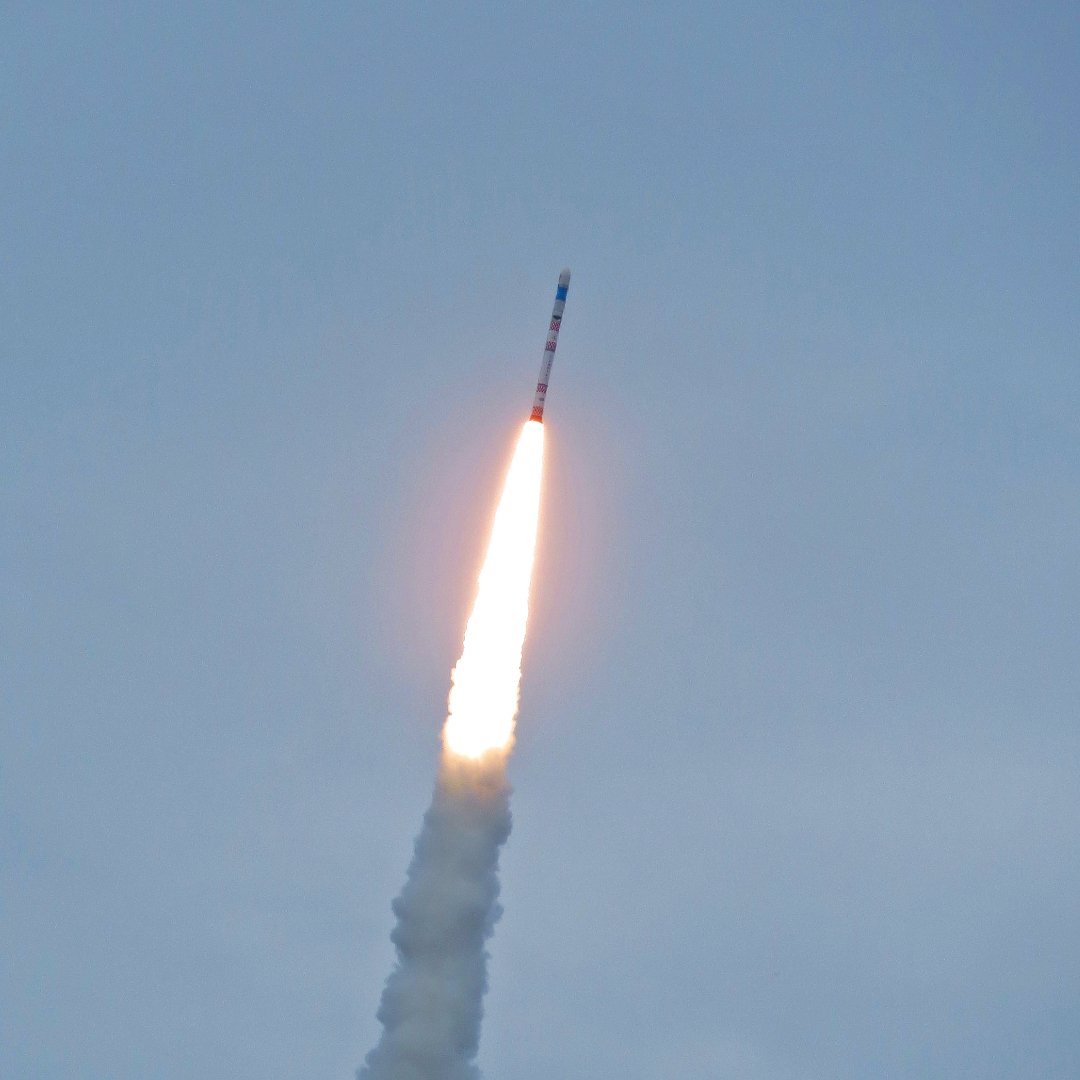
On January 12, 2026, ISRO’s PSLV-C62 lifted off from Sriharikota carrying sixteen satellites on a rideshare mission – including the original AayulSAT. A third-stage anomaly meant the rocket never completed its intended trajectory, and every payload on board, AayulSAT included, was lost. You can read our full breakdown of what went wrong on PSLV-C62 for the technical details.
For an early-stage startup, losing your flagship hardware on its very first flight is the kind of setback that ends companies. OrbitAID’s response was to rebuild the satellite essentially to the same specification and get it back on a launch manifest within the year – a turnaround reflected in the “1A” suffix, signalling this is the second build of the same mission, not an all-new design.
That’s the real headline here: not just a satellite that transfers fuel between its own tanks, but a young space-hardware company that lost its first satellite before it ever reached orbit, and decided to fly again anyway.
Who Is OrbitAID Aerospace?
OrbitAID Aerospace was founded in 2021 by Sakthikumar Ramachandran and Nikhil Balasubramanian, who developed the company’s core refuelling technology while working out of the satellite propulsion ecosystem at the Indian Institute of Science (IISc), Bengaluru.
Sakthikumar, now the company’s CEO, trained in aeronautical engineering before earning a postgraduate degree in space engineering and rocketry, and joined IISc as a researcher in its satellite propulsion department back in 2011. Nikhil came up through mechanical engineering, interned at IISc in 2014, and went on to a master’s at Technion in Israel and a doctorate in aerospace from the Technical University of Munich.
The company is often described as Chennai-based – it draws significant backing from the Tamil Nadu government’s startup mission, reportedly around ₹4.5 crore, on top of roughly ₹50 lakh the founders put in themselves – even though its technical home base sits inside IISc Bengaluru.
That Bengaluru presence grew considerably in September 2025, when OrbitAID opened a new 6,500 sq. ft. R&D facility described as India’s largest private satellite-servicing lab, backed by more than $2 million in investment. ISRO Chairman V Narayanan inaugurated it in person, and pointed directly at ISRO’s own SpaDeX docking mission as the proof-of-concept that opened the door for private companies like OrbitAID to take on in-orbit servicing.
OrbitAID’s business model rests on four legs: selling the SIDRP hardware itself, offering refuelling as a paid service, selling satellite life-extension subscriptions, and taking a success-based share of value created through its refuelling missions. It’s part of a broader wave of Indian space startups tackling hard, unglamorous infrastructure problems – alongside companies like Dhruva Space, Pixxel, Agnikul Cosmos, and Bellatrix Aerospace, all profiled in our Space Startup Directory.
What the October 2026 Demo Will Actually Prove
It’s worth being precise here, because headlines about “India’s satellite refuelling mission” can make this sound bigger than it currently is. AayulSAT-1A will not dock with, or transfer fuel to, another spacecraft on this flight.
What it will do is transfer propellant, power, and data between its own internal tanks and subsystems, through the SIDRP interface, while sitting in orbit. That sounds modest, but it’s the foundational plumbing problem: proving propellant can move through a standardized port without leaking, without pressure faults, and without data loss, in the vacuum of space, before anyone risks that hardware on a second, independent satellite.
OrbitAID is targeting TRL-9 qualification for SIDRP with this flight – the highest technology readiness level, meaning the system has flown and proven itself in its actual operating environment, not just in a lab. Clear that bar, and the company has a flight-proven product it can sell and build future missions around.
The Next Step: A Chaser Satellite and Real Docking
OrbitAID has said it plans to follow up later in 2026 with a separate “chaser” satellite – one that will actually rendezvous with, approach, and dock with AayulSAT-1A, attempting the real transfer of propellant between two independent spacecraft for the first time.
That’s the mission that would actually put India in the small club of countries and companies that have demonstrated true in-orbit satellite servicing, rather than just proving the plumbing works on a single satellite. It’s also an ambitious back-to-back schedule for a company that lost its first satellite to a launch failure less than a year earlier – worth watching for slippage, as these timelines so often see.
Why It Matters: India’s Debris-Free Space Mission 2030
Refuelling isn’t just a neat engineering trick – it’s a direct lever on one of spaceflight’s biggest headaches: space debris. A satellite that runs out of propellant usually becomes dead junk long before its other systems actually fail. Give it a way to refuel, and operators can keep using hardware that’s otherwise perfectly healthy, instead of launching a costly replacement and leaving the old one to drift.
That’s exactly the thinking behind ISRO’s own Debris-Free Space Mission 2030 initiative, which commits India to generating no new harmful debris from its missions by the end of the decade. OrbitAID is positioning itself as a direct, private-sector enabler of that national goal – not just a startup chasing a buzzy segment of the space economy.
How India Compares Globally
OrbitAID isn’t working in a vacuum, figuratively speaking – a handful of companies and agencies worldwide are already tackling in-orbit satellite servicing, each with a different approach:
| Player | Country | Approach | Status |
|---|---|---|---|
| OrbitAID (AayulSAT-1A) | India | Standardized SIDRP refuelling port + tanker/chaser docking model | Internal transfer demo NET October 2026; chaser docking demo planned later in 2026 |
| Northrop Grumman (MEV) | USA | Dedicated servicer vehicle grapples a client satellite’s existing hardware – no special port needed | MEV-1 successfully docked with Intelsat 901 in February 2020, extending its service life by about five years |
| Orbit Fab | USA | Standardized refuelling port (RAFTI) – a “gas stations in space” model, and OrbitAID’s self-identified main global competitor | Multiple ports delivered to orbit; building out a refuelling-as-a-service business |
| Astroscale | Japan | Debris removal and satellite-servicing demonstration missions (ELSA-d, ADRAS-J) | Several on-orbit demonstration missions flown |
The Northrop Grumman MEV program remains the clearest real-world proof that satellite life-extension works commercially – its first vehicle grappled an ageing Intelsat satellite and kept it productive for years longer than planned. OrbitAID’s standardized-port approach is closer in spirit to Orbit Fab’s, betting that a common docking interface, rather than a custom grapple for every mission, is the more scalable long-term model.
Frequently Asked Questions
What is AayulSAT-1A?
AayulSAT-1A is a roughly 25 kg tanker and technology-demonstrator satellite built by OrbitAID Aerospace to test in-orbit propellant, power, and data transfer using the company’s SIDRP docking interface. It is set to launch on an SSLV rideshare mission from Sriharikota, targeted for October 2026.
Why is AayulSAT-1A described as a “redo”?
It is a rebuild of the original AayulSAT satellite, which was lost when ISRO’s PSLV-C62 mission suffered a third-stage anomaly on January 12, 2026 and failed to reach orbit, destroying all sixteen satellites it carried.
Does AayulSAT-1A actually refuel another satellite in orbit?
Not yet. The October 2026 mission only tests propellant, power, and data transfer within its own tanks and systems. OrbitAID has said a separate “chaser” satellite, planned for later in 2026, will attempt the first real docking and refuelling between two independent spacecraft.
Who founded OrbitAID Aerospace?
OrbitAID was founded in 2021 by Sakthikumar Ramachandran and Nikhil Balasubramanian, both of whom developed the company’s core refuelling technology while working out of the Indian Institute of Science (IISc), Bengaluru.
Why does this mission matter for India’s space programme?
A working in-orbit refuelling capability would let operators extend the working life of satellites instead of replacing them, directly supporting ISRO’s own Debris-Free Space Mission 2030 goal and giving India a foothold in a satellite-servicing market that only a handful of countries and companies currently compete in.
Who is OrbitAID’s main competitor?
OrbitAID has named Orbit Fab, a US-based company building a similar standardized refuelling-port system, as its principal global competitor. Other players working on adjacent problems include Northrop Grumman, known for satellite life-extension missions, and Japan’s Astroscale, which focuses on debris removal.
The Bottom Line
AayulSAT-1A is a modest-looking 25 kg box with an outsized story behind it: a satellite that was destroyed before it ever reached space, rebuilt by a small Indian startup in under a year, and sent back up to try again. Its October 2026 mission won’t make India a satellite-refuelling power on its own – that burden falls to the chaser mission planned to follow it. But proving the core plumbing works, on the second attempt, after a very public first failure, is exactly the kind of unglamorous resilience that new space industries are built on.