
- Company
- Pixxel
- Founded
- February 2019
- Founders
- Awais Ahmed & Kshitij Khandelwal
- Headquarters
- Bengaluru, India & Los Angeles, USA
- Focus
- Hyperspectral Earth observation
- Latest round
- $100M Series C (Sept 2026)
- Total raised
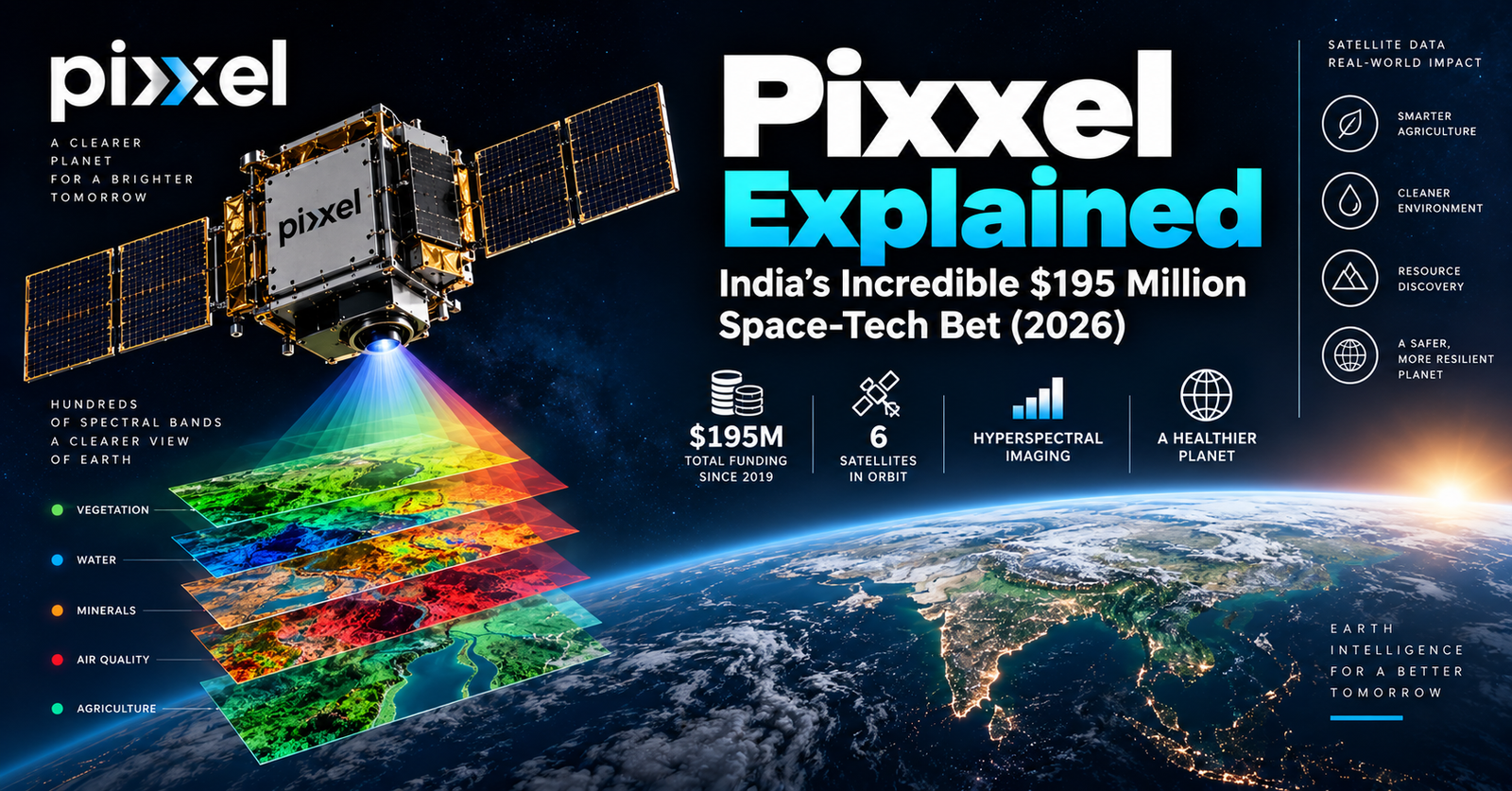
- $195 million since 2019
- Lead investors
- Temasek & Seraphim
- Satellites in orbit
- 6 (Firefly constellation)
- What Is Pixxel?
- The $100 Million Series C, Explained
- From a BITS Pilani Dorm Room to a Global Space Company
- Hyperspectral vs Multispectral: Why Pixxel’s Satellites See More
- Firefly, Honeybee and the Aurora Platform
- Pixxel’s Role in India’s National Earth Observation Constellation
- Who Actually Buys This Data?
- Pixxel vs India’s Other Space-Tech Startups
- Why This Funding Round Matters for India’s Space Economy
- FAQ’s
What Is Pixxel?
Pixxel is a Bengaluru-based space-tech company that designs, builds and operates a constellation of hyperspectral imaging satellites. Instead of photographing Earth in a handful of colours the way most satellites do, its cameras split reflected light into hundreds of narrow spectral bands, many of them invisible to the human eye.
That extra spectral detail lets Pixxel’s data flag things a normal satellite photo cannot: early crop stress before it is visible to the eye, methane leaks from pipelines, or the mineral signature of a rock face. On September 7, 2026, the company announced a $100 million Series C round, describing it as fuel to build what founder Awais Ahmed calls “the infrastructure for a changing planet.”
The round was led by Singapore’s Temasek and London-based Seraphim Space, with new investors 360 ONE Asset and IMM Investment joining existing backers Radical Ventures, growX Ventures and M&G Catalyst. It takes Pixxel’s total funding since 2019 to $195 million, which several Indian business outlets have called the country’s largest space-tech fundraise to date.
The $100 Million Series C, Explained
Pixxel says the new capital is earmarked for four things. First, building out Honeybee, its next-generation hyperspectral constellation that adds shortwave-infrared (SWIR) sensing on top of the existing visible and near-infrared bands. Second, developing synthetic aperture radar (SAR) and ultra-high-resolution optical imaging, which would let it see through cloud cover and at night, something its current optical satellites cannot do.
Third, the company is investing further in Aurora, its software platform that turns raw satellite imagery into usable “Earth intelligence” for customers who are not remote-sensing experts. Fourth, some of the money will expand manufacturing capacity at its facilities in India and the United States, so it can build satellites faster and in greater numbers.
Announcing the round, Ahmed framed it in long-term terms: “Years ago, we set out to build a health monitor for the planet.” The line captures its pitch to investors — that hyperspectral data is not just a niche imaging product, but a way to continuously monitor the planet’s crops, air, water and minerals at a resolution governments and large corporations will pay for.
From a BITS Pilani Dorm Room to a Global Space Company
Pixxel was founded in February 2019 by Awais Ahmed and Kshitij Khandelwal, who were students at BITS Pilani at the time. Ahmed had previously been engineering lead for Hyperloop India, a team that reached the finals of SpaceX’s 2017 Hyperloop Pod Competition, an early sign of the ambition the two would later bring to satellites. Both founders were later named to Forbes’ 30 Under 30 list, and Ahmed has since appeared on MIT’s Innovators Under 35 and Fortune’s 40 Under 40.
The company’s funding history shows a steady climb: an $8 million seed round in August 2020, a $27 million Series A in March 2022 that included an undisclosed investment from Accenture, and a Series B that grew to roughly $60 million by December 2024. Along the way, it was named to TIME’s 100 Best Inventions list in 2023 and designated a World Economic Forum Technology Pioneer in 2024.
Its satellites have flown a similar climb. The first demonstration satellites, Shakuntala and Anand, launched in 2022, one on a SpaceX Falcon 9 from Cape Canaveral, the other on an ISRO PSLV-C54 rocket. The first three operational Firefly satellites followed in January 2025, and three more in August 2025, bringing the constellation to six satellites, which the company describes as the world’s highest-resolution commercial hyperspectral constellation currently in orbit.
Hyperspectral vs Multispectral: Why Pixxel’s Satellites See More
Most Earth-observation satellites, including the majority used for weather and general mapping, are multispectral: they capture somewhere between five and ten broad bands of light, typically red, green, blue and a couple of infrared bands. That is enough to spot obvious changes, such as a field turning from green to brown.
Hyperspectral imaging, its specialty, slices that same light into hundreds of very narrow bands, each just 10 to 20 nanometres wide. That finer resolution can distinguish between materials that look identical in an ordinary photo, different crop species, specific minerals, or the chemical signature of a gas leak, because each material reflects light in its own distinctive pattern across that wider spectrum.
The trade-off is complexity. As remote-sensing specialists note, hyperspectral data is heavier to process, requires more specialised analysis, and has historically been expensive enough that it stayed largely in the hands of governments and research institutions. The company’s bet, backed now by $195 million, is that cheaper satellites and an accessible software layer like Aurora can bring hyperspectral data to a much wider set of commercial and government customers.
Firefly, Honeybee and the Aurora Platform
Firefly is Pixxel’s current constellation: six small satellites launched in two batches in 2025, each carrying a hyperspectral imager. Honeybee is the planned successor, adding shortwave-infrared sensing capable of picking up signals like heat and specific gas absorption that visible-light sensors cannot. It expects the first Honeybee satellite to launch in 2027.
Underneath both constellations sits Aurora, its software platform for turning raw imagery into ready-to-use insights, flagging a stressed crop field or an unusual emissions plume without requiring the customer to process the raw spectral data themselves. To keep pace with satellite demand, the company also runs MegaPixxel, a roughly 30,000-square-foot manufacturing facility built to assemble satellites at a faster rate than one-off builds allow.
Pixxel’s Role in India’s National Earth Observation Constellation
The Series C is not Pixxel’s only headline of 2026. In January, a Pixxel-led consortium, with Dhruva Space, PierSight and SatSure as partners, signed an agreement with IN-SPACe, India’s private-space regulator, to build the country’s first privately-led national Earth observation constellation.
The plan calls for 12 satellites combining very-high-resolution optical, multispectral, SAR and hyperspectral imaging, backed by a planned investment of more than Rs 1,200 crore (roughly $125-130 million at current exchange rates) over a five-year deployment window. The data is meant to serve Indian government users first, while also being sold commercially across agriculture, infrastructure, energy and maritime sectors.
Ahmed described the significance directly: “For the first time, India will control its own Earth intelligence infrastructure, designed and operated by Indian companies.” It is a notable shift from the traditional model, where ISRO builds and operates India’s Earth observation satellites, toward a public-private model where private companies design, finance and run national infrastructure with government backing.
Who Actually Buys This Data?
The company’s customer list spans both governments and private industry. In the United States, it holds a contract under NASA’s Commercial SmallSat Data Acquisition Program, running through November 2028, and a separate five-year hyperspectral imagery contract with the National Reconnaissance Office. In India, the company has won multiple iDEX innovation challenges run by the Ministry of Defence.
On the commercial side, mining group Rio Tinto has used its hyperspectral imagery for mineral exploration, and the company says it now serves more than 50 direct customers through a network of over 90 resellers worldwide. That mix of defence, civil-government and commercial revenue is part of what investors point to when calling its business more diversified than a typical imaging startup.
Pixxel vs India’s Other Space-Tech Startups
Pixxel is often mentioned alongside India’s private rocket makers, but the two are solving different problems. Rocket companies like Agnikul Cosmos and Skyroot Aerospace are trying to get payloads into orbit; it is building what goes into orbit and turning the data it sends back into a product. Together they illustrate how broad India’s private space ecosystem has become in under a decade.
| Company | Focus Area | Founded | Founders | Signature Product |
|---|---|---|---|---|
| Pixxel | Earth observation / hyperspectral imaging | Feb 2019 | Awais Ahmed & Kshitij Khandelwal | Firefly & Honeybee satellite constellations |
| Agnikul Cosmos | Launch vehicles (3D-printed engines) | Dec 2017 | Srinath Ravichandran & Moin SPM | Agnibaan rocket |
| Skyroot Aerospace | Launch vehicles (solid-fuel) | 2018 | Pawan Kumar Chandana & Naga Bharath Daka | Vikram-series rockets |
Why This Funding Round Matters for India’s Space Economy
India’s space-tech sector has been raising money at a pace that would have looked unlikely a few years ago, with reports putting total sector funding in the hundreds of millions of dollars across close to 300 companies. Its $100 million round alone is a meaningful share of that, and industry trackers have already called it the country’s single largest space-tech fundraise.
More importantly for the sector, it signals that large global investors like Temasek are now willing to write big checks into Indian space-tech rather than just early-stage funds. Combined with the IN-SPACe national constellation deal, the company is becoming a test case for whether an Indian-built, privately-run space company can compete for the kind of government and defence contracts that were once reserved for state agencies or established Western contractors.
FAQ’s
What does Pixxel do?
Pixxel is a Bengaluru-based space-tech company that builds and operates hyperspectral imaging satellites, capturing Earth images across hundreds of narrow light bands to detect things like crop stress, mineral deposits and gas leaks that ordinary satellite photos cannot show.
How much funding has Pixxel raised?
Pixxel raised a $100 million Series C round in September 2026, led by Temasek and Seraphim, taking its total funding since 2019 to $195 million, which several Indian business outlets have called the country’s largest space-tech fundraise to date.
Who founded Pixxel and when?
Pixxel was founded in February 2019 by Awais Ahmed and Kshitij Khandelwal, who were students at BITS Pilani at the time. Ahmed serves as CEO and Khandelwal as CTO.
What is the difference between hyperspectral and multispectral imaging?
Multispectral satellites capture around five to ten broad bands of light. Hyperspectral satellites like Pixxel’s split light into hundreds of much narrower bands, which lets them distinguish between materials that look identical in an ordinary photo, such as different crop types or specific minerals.
How many satellites does Pixxel currently operate?
As of this article, Pixxel operates six Firefly satellites in orbit, launched in two batches during 2025. It plans to launch its next-generation Honeybee constellation starting in 2027.
What is Pixxel’s role in India’s national Earth observation constellation?
A Pixxel-led consortium, including Dhruva Space, PierSight and SatSure, signed an agreement with IN-SPACe in January 2026 to build India’s first privately-led national Earth observation constellation: 12 satellites backed by a planned investment of more than Rs 1,200 crore over five years.