
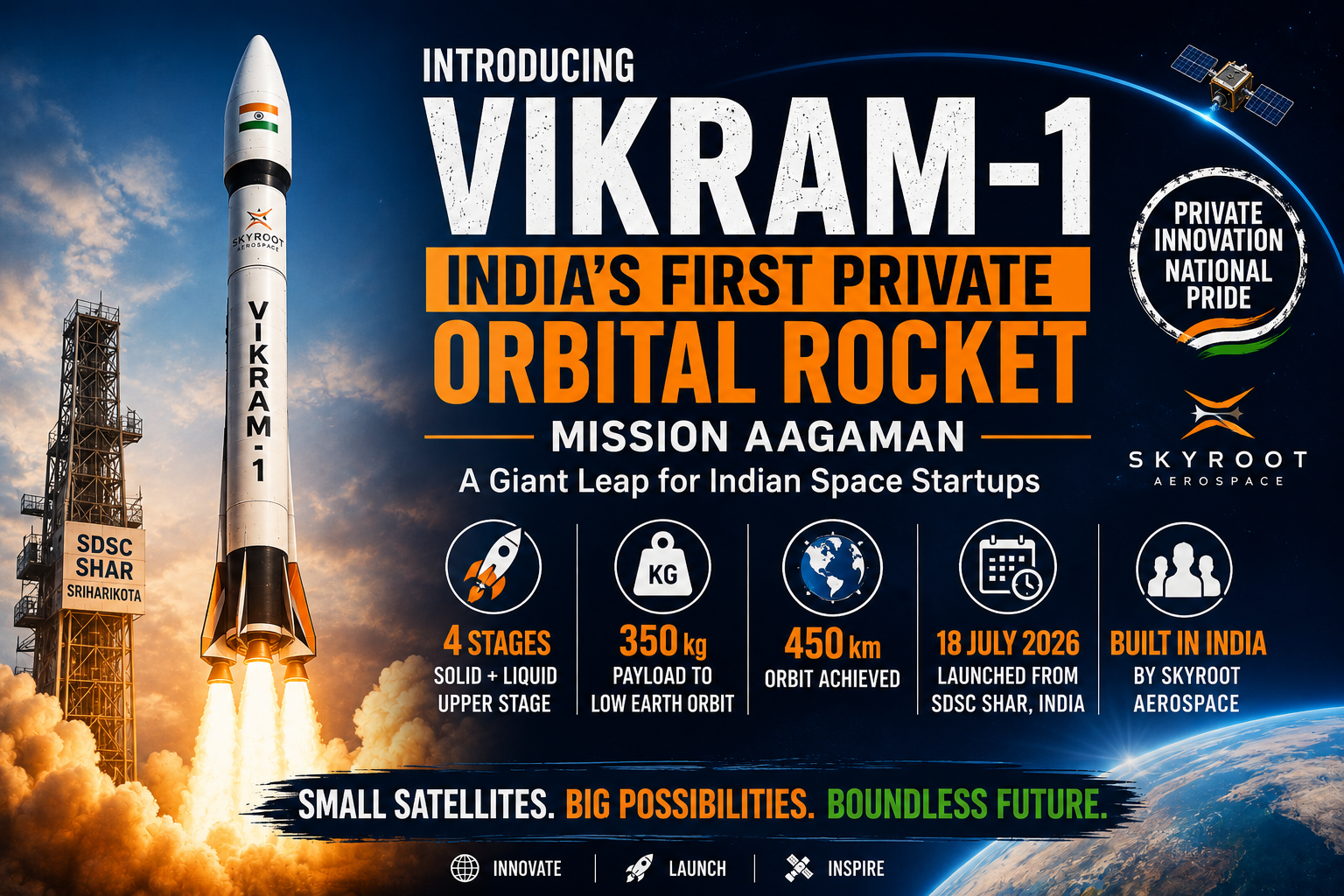
- Developer
- Skyroot Aerospace
- Mission name
- Mission Aagaman
- Launch date
- 18 Jul 2026
- Launch site
- SDSC SHAR, Sriharikota
- Vehicle type
- Small-satellite launcher
- Payload to LEO
- Up to 350 kg
- Structure
- All carbon-composite
Vikram-1 is the first privately developed Indian orbital rocket to reach space from Indian soil. Built by Skyroot Aerospace, it lifted off from the Satish Dhawan Space Centre in Sriharikota on 18 July 2026 and placed payloads into low Earth orbit.[1] The flight, called Mission Aagaman, was more than a launch: it showed that an Indian private company could design, build and fly an orbital-class rocket with support from the country’s space institutions.
What Is Vikram-1?
Vikram-1 is a multi-stage small-satellite launch vehicle developed by Skyroot Aerospace. India Today described it as an all-carbon-composite rocket, nearly seven storeys tall, with a stated capacity of up to 350 kilograms to low Earth orbit.[3] Low Earth orbit is the region relatively close to Earth where many Earth-observation, technology-demonstration and communications spacecraft operate.
The rocket’s name honours Vikram Sarabhai, widely regarded as the father of India’s space programme. Its first orbital flight was a test mission designed to demonstrate that the vehicle’s systems could work together in space.
Why Did Skyroot Develop This Rocket?
Small satellites have changed who wants access to orbit. Startups, universities, research teams and established companies may need to test cameras, sensors, software or communications hardware without waiting for a large spacecraft programme to be ready.
A dedicated private rocket can offer customers another option: a vehicle designed around smaller payloads and commercial scheduling. Vikram-1 is not a replacement for PSLV, GSLV or LVM3; it adds another option for different mission sizes.
How Did Mission Aagaman Work?
Vikram-1 used four stages and carried technology-demonstration payloads from Grahaa Space, Cosmoserve, DCUBED and Skyroot’s SCOPE platform.[2] ISRO reported that two satellites, SCOPE and Grahaa, were injected into low Earth orbit, while other payloads remained on the upper stage for in-orbit experiments.
The launch took place at 12:05:30 pm IST on 18 July 2026 from the Satish Dhawan Space Centre.[1] CNBC-TV18 reported that the vehicle completed its final engine burn and deployed its payloads into an orbit about 450 kilometres above Earth. It also reported a 35-minute hold before liftoff to address a navigation-related issue.
That pause is a useful reminder that a launch is not judged only by liftoff. Navigation, guidance, stage separation, engine performance and payload deployment all have to work in sequence. A test flight also produces engineering data before regular commercial service.
Why Is Vikram-1 Important for India?
The mission marked the entry of Indian private industry into orbital launch operations. ISRO called Skyroot the first private company to successfully launch to orbit from Indian soil, and said it did so on its first attempt.[1] CNBC-TV18 reported that the achievement placed India among countries with private orbital launch capability.
This matters because space activity is becoming a wider industrial ecosystem. Rocket manufacturing, satellite design, testing, ground systems, software and launch operations can all create specialised work. A successful private launch does not automatically create a large market, but it provides a real flight milestone for customers and suppliers.
What Was ISRO’s Role?
Vikram-1 was privately developed, but it did not operate in isolation from India’s public space infrastructure. ISRO said it provided access to solid-motor casting and static-test facilities at Sriharikota, and that the rocket’s liquid upper-stage engine was tested at a Liquid Propulsion Systems Centre facility.
IN-SPACe, the agency responsible for promoting and regulating space activities by non-government entities, helped establish a mechanism for companies such as Skyroot and Agnikul Cosmos to access ISRO facilities, receive technical consultancy, complete mission-readiness reviews and obtain launch clearances.[1] This is the practical meaning of public–private participation: the company develops the vehicle, while national institutions provide regulated facilities, expertise and oversight.
What Are the Challenges Ahead?
Reaching orbit once is a major demonstration, but a commercial launch business needs repeatability. Skyroot must show that Vikram-1 can be produced consistently, meet customer schedules and deploy different payloads safely. The vehicle will also compete with established launch providers and other private rockets in a market where price, reliability and launch availability all matter.
The first flight is a beginning, not a guarantee of future launch frequency or commercial success. Further missions will reveal how the rocket performs with different payloads and conditions.
What Happens Next for Vikram-1?
Skyroot’s immediate task is to use the data from Mission Aagaman to refine the Vikram launch-vehicle family and prepare for future customer missions. India’s space reforms have opened room for private companies to build launch vehicles and satellites, but the pace of growth will depend on technical reliability, regulation, financing and sustained demand.
For SpaceCraft India readers, Vikram-1 is best understood as a test of a new model: ISRO remains central to India’s space programme, while private companies increasingly develop hardware and offer services. The next launches will show how quickly that model can mature.
FAQs
Is Vikram-1 India’s first private orbital rocket?
Yes. ISRO says Vikram-1 was the first rocket from a private Indian company to successfully launch to orbit from Indian soil.
Who built Vikram-1?
Skyroot Aerospace developed Vikram-1. The company was founded in 2018 by former ISRO scientists Pawan Kumar Chandana and Naga Bharath Daka, according to India Today.
What was Mission Aagaman?
Mission Aagaman was the name of Vikram-1’s first orbital test flight, launched from Sriharikota on 18 July 2026. It carried several technology-demonstration payloads.
Sources
- https://www.isro.gov.in/First_private_orbital_launch_lifts_from_Sriharikota.html
- https://www.cnbctv18.com/india/science/skyroot-vikram-1-launch-mission-aagaman-indias-first-private-orbital-rocket-lifts-off-19948640.htm
- https://www.indiatoday.in/science/story/skyroot-vikram-1-launched-first-private-rocket-isro-satellite-deployment-space-mission-2950588-2026-07-18
1 thought on “Vikram-1: India’s First Private Orbital Rocket Explained”