
- Agency
- ISRO
- Full name
- Polar Satellite Launch Vehicle
- Height
- ~44 metres
- Lift-off weight
- ~320 tonnes
- Stages
- 4 (solid/liquid)
- Notable payloads
- Chandrayaan-1, Mangalyaan, Aditya-L1
Last Updated: June 2026
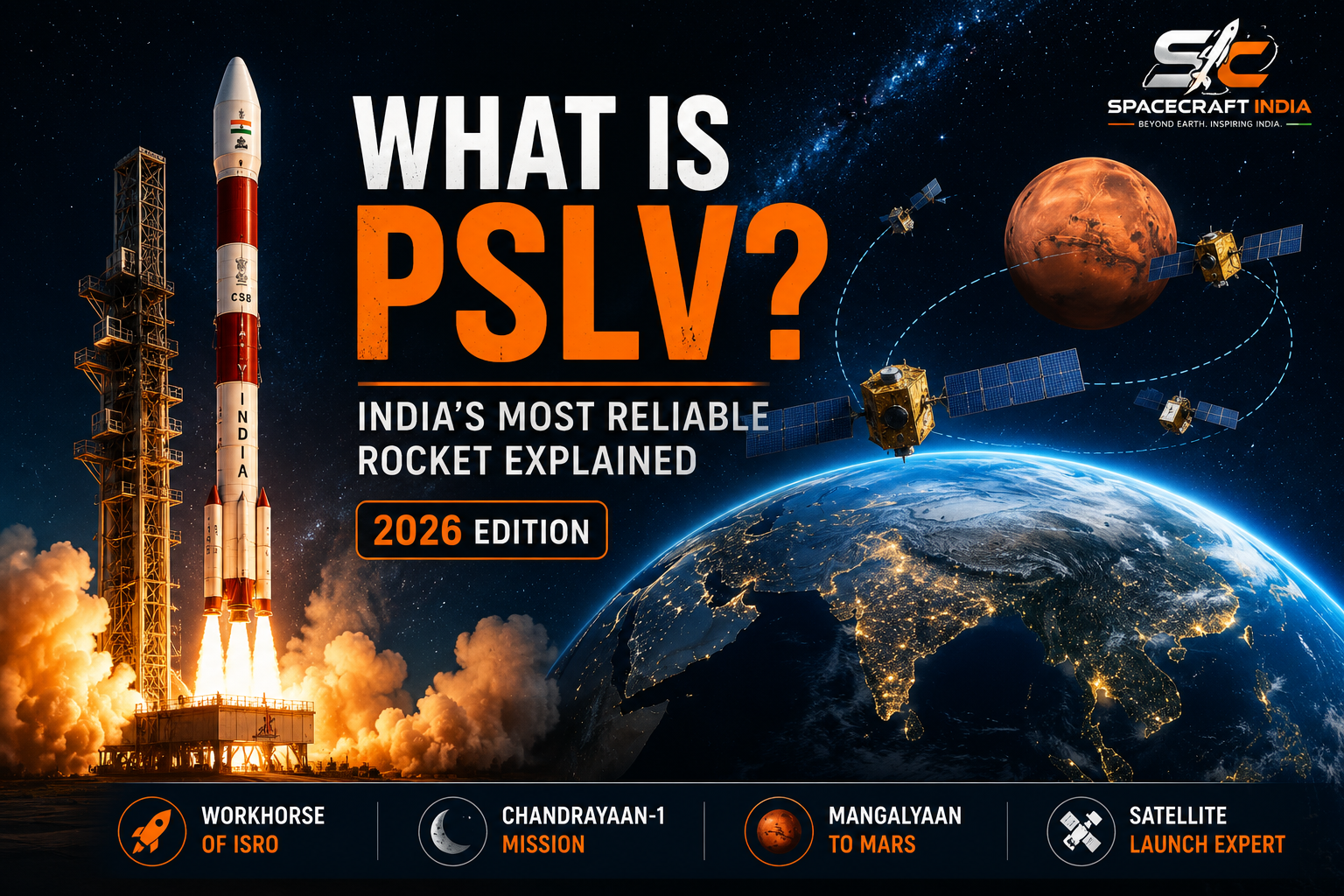
What is PSLV?
When India launched its first mission to Mars in 2013, the world was watching.
Many expected the mission to fail.
Instead, India became the first country in history to reach Mars orbit on its very first attempt.
The spacecraft that carried that dream into space wasn’t launched by a giant American rocket or a European launcher.
It was launched by PSLV — India’s most trusted rocket.
For more than three decades, PSLV has quietly powered some of ISRO’s greatest achievements. From launching satellites for dozens of countries to sending spacecraft to the Moon and Mars, PSLV has become one of the most respected launch vehicles in the world.
But what exactly is PSLV, and why is it so important to India’s space programme?
Let’s explore.
What Does PSLV Stand For?
PSLV stands for Polar Satellite Launch Vehicle.
It is a medium-lift rocket developed by the Indian Space Research Organisation (ISRO) to launch satellites into orbit around Earth.
The rocket was originally designed to place satellites into Polar Sun-Synchronous Orbit (SSO), a special orbit commonly used for Earth observation satellites.
Over time, PSLV proved so versatile that it began launching lunar missions, Mars missions, navigation satellites, scientific spacecraft, and even international satellites.
Today, PSLV is considered the backbone of India’s space programme.
Why Was PSLV Developed?
Before PSLV, India depended heavily on foreign launch services.
This meant higher costs and limited control over satellite launches.
ISRO wanted India to become self-reliant in space technology.
Scientists began developing a powerful launch vehicle capable of carrying heavier payloads into orbit.
After years of research, testing, and engineering effort, PSLV was born.
Its first successful mission took place in October 1994.
That launch changed the future of India’s space programme forever.
How Big Is PSLV?
PSLV stands approximately 44 metres tall and weighs around 320 tonnes at liftoff.
That’s roughly the height of a 14-storey building.
The rocket uses a combination of solid and liquid fuel stages.
This hybrid design gives PSLV both power and precision, helping it deliver satellites accurately into their intended orbits.
Why Is PSLV Called ISRO’s Workhorse?
Space missions demand reliability.
A single launch failure can destroy years of research and cost millions of dollars.
PSLV earned the nickname “Workhorse of ISRO“ because of its exceptional success rate.
Whenever India has a critical satellite to launch, PSLV is often the preferred choice.
Its consistent performance over decades has made it one of the most dependable rockets in operation today.
Major Missions Launched by PSLV
Chandrayaan-1
In 2008, PSLV launched India’s first mission to the Moon.
The mission made global headlines after discovering evidence of water molecules on the lunar surface.
This was one of the biggest discoveries in modern lunar science.
Mangalyaan
In 2013, PSLV launched the Mars Orbiter Mission.
India became the first country to successfully reach Mars orbit on its first attempt.
The mission demonstrated ISRO’s engineering capabilities to the entire world.
Aditya-L1
India’s first solar observatory was launched aboard PSLV in 2023.
The spacecraft studies the Sun and helps scientists understand solar storms and space weather.
SpaDeX Mission
PSLV also launched the Space Docking Experiment (SpaDeX).
The mission helped India demonstrate autonomous spacecraft docking technology, a critical capability for future space stations and crewed missions.
How Does PSLV Work?
PSLV uses four stages.
First Stage
Uses solid fuel and provides massive thrust during liftoff.
Second Stage
Uses liquid fuel for greater control.
Third Stage
Returns to solid fuel for additional acceleration.
Fourth Stage
Uses liquid propulsion for precise satellite placement.
This alternating design is one of the reasons PSLV has achieved such remarkable reliability.
Different Versions of PSLV
ISRO has developed several variants of PSLV.
PSLV-G
The original standard version.
PSLV-XL
A more powerful variant equipped with larger strap-on boosters.
This version launched Chandrayaan-1, Mangalyaan, and Aditya-L1.
PSLV-DL
A lighter configuration designed for smaller payloads.
PSLV-QL
A medium-capacity version offering greater mission flexibility.
These variants allow ISRO to match the rocket configuration to mission requirements.
PSLV vs GSLV: What’s the Difference?
Many people confuse PSLV and GSLV.
While both are Indian rockets, they serve different purposes.
| PSLV | GSLV |
|---|---|
| Medium-lift rocket | Heavy-lift rocket |
| Launches Earth observation satellites | Launches heavier communication satellites |
| Used for Moon and Mars missions | Used for geostationary missions |
| Extremely reliable | Designed for heavier payloads |
Think of PSLV as ISRO’s dependable all-rounder and GSLV as the heavy lifter.
Why PSLV Matters to India
PSLV represents far more than a rocket.
It represents India’s journey toward technological independence.
The rocket has helped India:
- Launch hundreds of satellites
- Support weather forecasting
- Improve communications
- Enable navigation services
- Conduct scientific research
- Earn international launch contracts
Its success has strengthened India’s position as a leading spacefaring nation.
Frequently Asked Questions
What is PSLV?
PSLV stands for Polar Satellite Launch Vehicle. It is ISRO’s most successful rocket and is used to launch satellites and space missions into orbit.
Who developed PSLV?
PSLV was developed by the Indian Space Research Organisation (ISRO).
When was PSLV first launched?
Its first successful launch took place in October 1994.
Which famous missions used PSLV?
Chandrayaan-1, Mangalyaan, Aditya-L1, and SpaDeX were all launched using PSLV.
Why is PSLV called the Workhorse of ISRO?
Because of its exceptional reliability and long history of successful missions.
The Bottom Line
Every great space agency has a rocket that defines an era.
For NASA, it was Saturn V.
For SpaceX, it is Falcon 9.
For India, that rocket is PSLV.
For more than 30 years, PSLV has carried India’s ambitions beyond Earth, helping transform the country into one of the world’s most respected space powers.
And even today, it continues to launch missions that inspire millions of Indians to look toward the stars.
2 thoughts on “What is PSLV? India’s Most Reliable Rocket Explained (2026)”