
- Agency
- ISRO
- Full name
- Geosynchronous Satellite Launch Vehicle
- Height
- ~51 metres
- Lift-off weight
- 400+ tonnes
- Stages
- 3
- Target orbit
- GTO, ~36,000 km
- Key tech
- Cryogenic upper stage
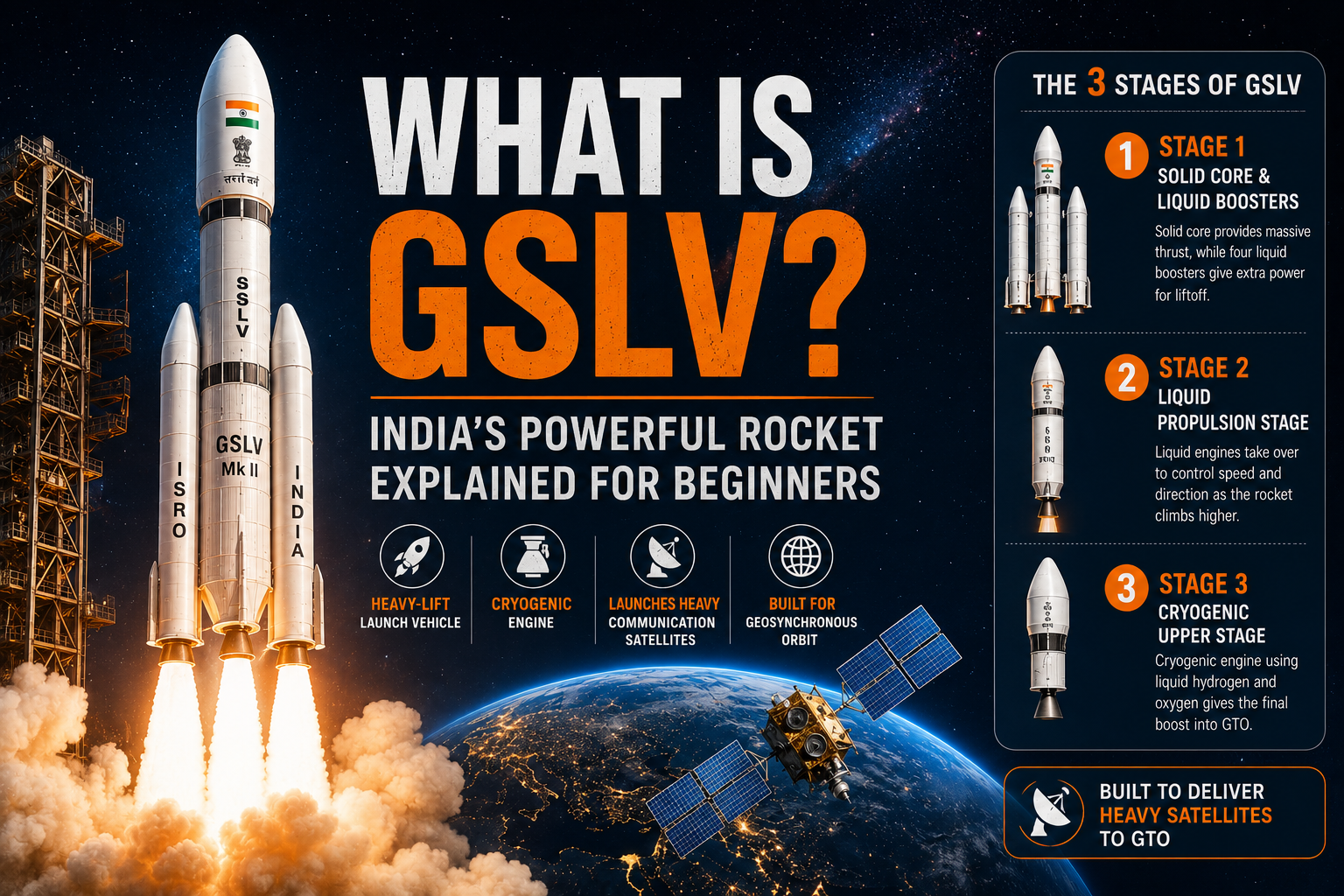
Imagine trying to send a heavy truck to the top of a mountain. A small vehicle simply wouldn’t have enough power to carry it. The same idea applies in space.
Some satellites are light enough to be launched by the Polar Satellite Launch Vehicle (PSLV), but many modern communication satellites weigh several tonnes. These massive satellites need a much more powerful rocket to escape Earth’s gravity and reach their destination.
That’s where the Geosynchronous Satellite Launch Vehicle (GSLV) comes in.
Developed by the Indian Space Research Organisation (ISRO), GSLV is one of India’s most important launch vehicles. It was designed to carry heavier satellites into Geosynchronous Transfer Orbit (GTO), an orbit nearly 36,000 kilometres above Earth that is widely used for communication, weather forecasting, television broadcasting, and navigation services.
One of the biggest achievements behind GSLV is India’s successful development of a cryogenic engine, an advanced rocket engine that operates using super-cooled liquid hydrogen and liquid oxygen. Mastering this technology took decades of research and made India one of only a handful of nations capable of building cryogenic rocket engines independently.
Today, GSLV has become an essential part of India’s growing space programme. It has launched several important satellites and paved the way for even more powerful rockets such as LVM3.
In this guide, you’ll learn:
- What GSLV stands for
- Why ISRO developed it
- How GSLV works
- The three stages of the rocket
- What makes cryogenic engines special
- Major GSLV missions
- GSLV vs PSLV
- Frequently asked questions
Whether you’re a student, a space enthusiast, or simply curious about India’s achievements in space technology, this guide explains everything in simple language.
What is GSLV?
GSLV, or Geosynchronous Satellite Launch Vehicle, is a medium-to-heavy lift rocket developed by ISRO to place satellites into Geosynchronous Transfer Orbit (GTO).
Unlike PSLV, which mainly launches Earth observation satellites into Polar Sun-Synchronous Orbit, GSLV is built to carry heavier communication satellites much farther from Earth.
A typical GSLV rocket stands about 51 metres tall, weighs over 400 tonnes at lift-off, and consists of three stages, each using different types of propellants to maximise efficiency during different phases of the flight.
Its most distinctive feature is the cryogenic upper stage, which provides the additional thrust required to send heavy payloads into high-altitude transfer orbits.
Over the years, GSLV has become one of the key launch vehicles supporting India’s communication, meteorology, and strategic satellite programmes.
What Does GSLV Stand For?
GSLV stands for Geosynchronous Satellite Launch Vehicle.
Let’s understand each word.
Geosynchronous
A geosynchronous orbit is located about 35,786 kilometres above Earth. A satellite placed here revolves around Earth in exactly 24 hours, the same time Earth takes to rotate once on its axis.
Because of this, the satellite appears to remain almost fixed relative to the Earth’s surface, making it ideal for communication, television broadcasting, weather monitoring, and navigation.
Satellite
A satellite is an object that revolves around a planet. In this case, GSLV carries artificial satellites built by engineers for various purposes.
Launch Vehicle
A launch vehicle is simply another name for a rocket designed to carry satellites or spacecraft into space.
Putting it all together:
Geosynchronous Satellite Launch Vehicle means a rocket designed to place satellites into geosynchronous orbits.
Why Did ISRO Develop GSLV?
During the early years of India’s space programme, ISRO depended on foreign launch services for sending heavy communication satellites into space.
While PSLV proved highly successful, it was never designed to carry very heavy satellites into Geosynchronous Transfer Orbit.
This dependence created several challenges:
- High launch costs
- Limited launch opportunities
- Dependence on other countries
- Restrictions on advanced technologies
To overcome these challenges, ISRO began developing GSLV during the 1990s.
The goal was simple:
Build an Indian rocket capable of launching India’s own heavy satellites without relying on other countries.
Although the journey involved many technical setbacks, especially in developing cryogenic engine technology, ISRO continued improving the rocket through years of testing and innovation.
Today, GSLV represents India’s growing self-reliance in space technology and has significantly strengthened the country’s ability to launch critical satellites independently.
2 thoughts on “What is GSLV? India’s Powerful Rocket Explained for Beginners (2026)”