
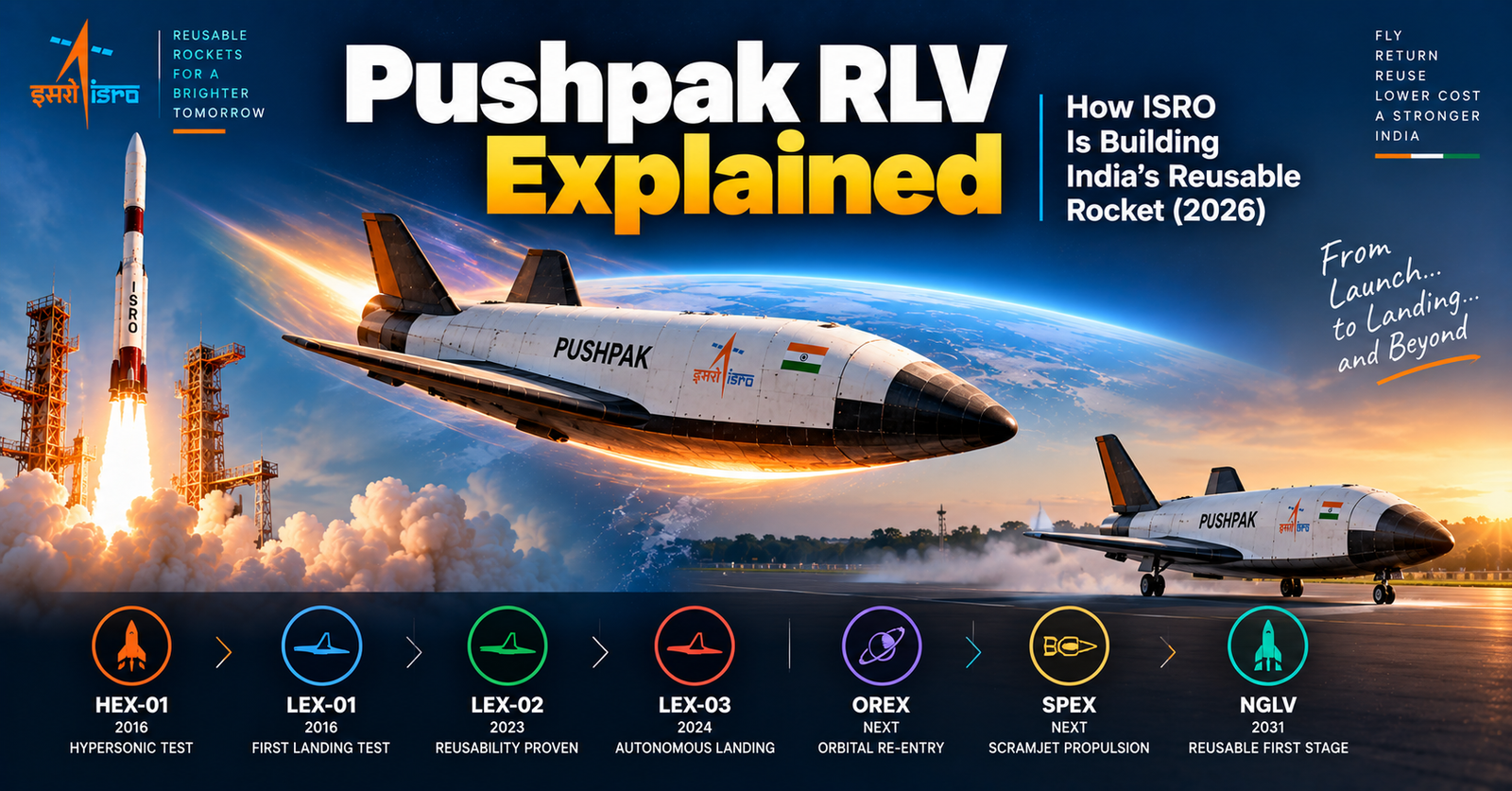
- Programme
- RLV Technology Demonstration Programme (RLV-TD)
- Vehicle Name
- Pushpak
- Developed By
- ISRO – Vikram Sarabhai Space Centre (VSSC)
- First Flight
- HEX-01, May 23, 2016 (suborbital hypersonic test)
- Landing Tests Completed
- 3 of 3 – LEX-01, LEX-02, LEX-03
- Latest Milestone
- LEX-03 autonomous landing, June 23, 2024
- Next Phase
- OREX (orbital re-entry) and SPEX (scramjet propulsion)
- Long-Term Goal
- Next Generation Launch Vehicle (NGLV), reusable first stage, targeted 2031
- Why ISRO Wants a Reusable Rocket
- Meet Pushpak: India’s Winged Test Vehicle
- The Four Flights: HEX-01 to LEX-03
- Inside LEX-03: How the Landing Actually Worked
- What’s Next: OREX and SPEX
- From Pushpak to NGLV: India’s Real Reusable Rocket
- How This Compares to SpaceX and the Rest of the World
- Why It Matters for India’s Space Ambitions
- Frequently Asked Questions
- The Bottom Line
Why ISRO Wants a Reusable Rocket
Every rocket ISRO flies today is expendable. Once a launch vehicle delivers its payload, the stages either burn up on re-entry or fall into the sea, and years of precision manufacturing sink with them. That throwaway model is the same problem SpaceX spent the 2010s solving with Falcon 9, and it is the exact problem ISRO’s Reusable Launch Vehicle (RLV) programme has spent over a decade quietly working through with a small winged test vehicle named Pushpak RLV.
India’s current rocket fleet – from the workhorse PSLV to the smaller SSLV, and from the outgoing GSLV to its heavier replacement LVM3 – recovers none of itself. Building a booster or first stage that can fly, land, and fly again is widely seen as the single biggest lever for cutting the cost of reaching orbit, which is exactly why reusability has become ISRO’s long-game bet.
The payoff isn’t just cheaper rockets for their own sake. A reusable first stage would make it far less expensive to assemble and resupply the planned Bharatiya Antariksh Station, replenish NavIC satellites, and fly the kind of frequent, high-cadence missions India’s growing satellite and human spaceflight ambitions will eventually demand.
Meet Pushpak: India’s Winged Test Vehicle
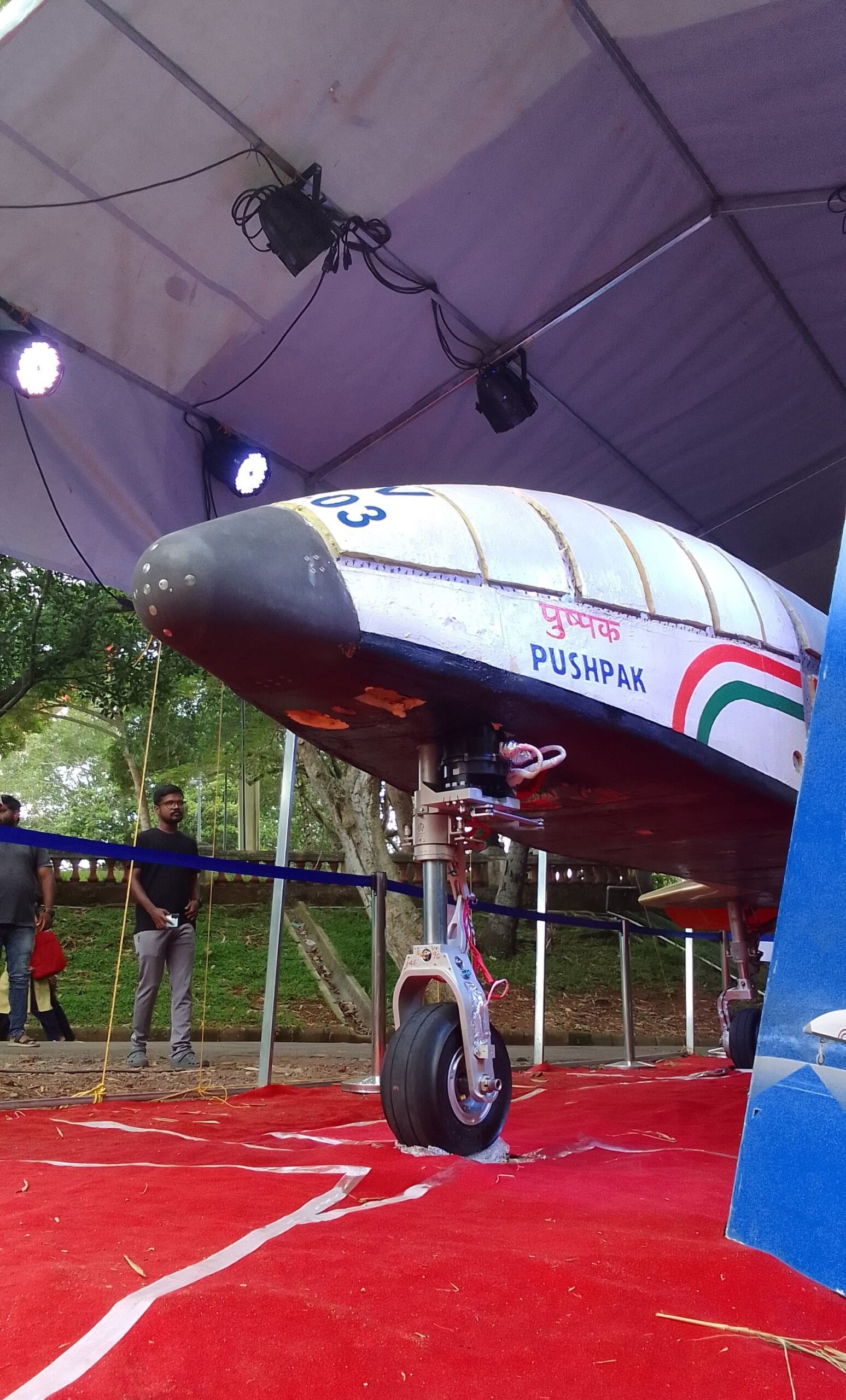
Pushpak – formally the RLV Technology Demonstrator, or RLV-TD – looks less like a rocket and more like a small, unpiloted space shuttle. It’s a stubby, delta-winged lifting body a little over 6 metres long, built by ISRO’s Vikram Sarabhai Space Centre with a shape derived from the aerodynamics of vehicles returning from orbit at hypersonic speed.
What makes the programme unusual is how ISRO has tested it: the same physical airframe has flown multiple missions. After the LEX-01 landing test, engineers recertified and reflew the very same vehicle for LEX-02, and again for LEX-03 – a small-scale demonstration of the reusability the whole programme is trying to prove, before a single orbital flight has happened.
The Four Flights: HEX-01 to LEX-03
ISRO has flown Pushpak four times so far, each mission adding a harder version of the last. Here’s how the test campaign has progressed:
| Test | Date | How It Flew | What It Proved |
|---|---|---|---|
| HEX-01 | May 23, 2016 | Suborbital hypersonic flight on a solid rocket booster, splashdown in the Bay of Bengal | Hypersonic re-entry loads, a carbon-composite nose cone, and autonomous navigation through Mach 5 conditions |
| LEX-01 | April 2, 2023 | Dropped from an Indian Air Force Chinook helicopter at 4.6 km altitude | First fully autonomous runway landing, using a drogue chute and nose-wheel brakes |
| LEX-02 | March 22, 2024 | Helicopter release at 4.5 km, released off-centre from the runway | Autonomous cross-range correction back onto the centreline, and hardware reusability – the same LEX-01 airframe, recertified and reflown |
| LEX-03 | June 23, 2024 | Helicopter release with a 500-metre lateral offset and stronger winds | A touchdown above 320 km/h – faster than a commercial airliner – using NavIC-aided multi-sensor navigation |
Inside LEX-03: How the Landing Actually Worked
LEX-03 was the most demanding of the three landing tests, and it doubled as a rehearsal for the kind of off-nominal approach a vehicle returning from actual orbit might face. A helicopter carried Pushpak to 4.5 km and released it 500 metres off the runway’s centreline – more than three times the offset used in LEX-02 – and into rougher wind conditions.
From that point, everything happened without a human in the loop. Pushpak fused data from inertial sensors, radar altimeters, and India’s own NavIC satellite navigation system to work out exactly where it was, corrected its flight path back toward the runway, and touched down aligned with the centreline at over 320 km/h. A brake parachute and landing-gear brakes then brought it to a stop, with autonomous rudder and nose-wheel steering keeping it running straight.
ISRO’s own description of the mission called it validation of the “advanced guidance algorithm catering to longitudinal and lateral plane error corrections” that the agency says is essential groundwork for a future orbital re-entry mission – in other words, everything after this test is about doing the same thing, but from space.
What’s Next: OREX and SPEX
LEX-03 closed out the landing-test campaign, but it was only ever the easier half of the problem – a helicopter drop from 4.5 km is nothing like surviving a real return from orbit. Two more demonstrators are meant to close that gap.
- OREX (Orbital Re-entry Experiment): a vehicle roughly 1.6 times larger than Pushpak, built with retractable landing gear, designed to actually go to orbital velocity and survive genuine atmospheric re-entry heating before attempting an autonomous landing.
- SPEX (Scramjet Propulsion Experiment): a test of air-breathing scramjet propulsion, aimed at technology that could eventually power a fully reusable first stage through the atmosphere rather than relying purely on conventional rocket engines.
ISRO has not published a confirmed launch date for either mission. Given how the LEX series stretched from 2016’s HEX-01 to 2024’s LEX-03, a realistic expectation is that OREX and SPEX are still several years out.
From Pushpak to NGLV: India’s Real Reusable Rocket
It’s worth being precise about what Pushpak actually is: a small-scale technology demonstrator, not a scaled-down version of an operational rocket. The vehicle that will actually put reusability to work is a separate, government-approved programme called the Next Generation Launch Vehicle (NGLV) – a full three-stage orbital rocket designed from the outset with a recoverable first stage, drawing on the navigation and landing know-how Pushpak has been busy proving.
NGLV is planned in two sizes. The standard version is rated for 14–20 tonnes to Low Earth Orbit and 5–9 tonnes to Geostationary Transfer Orbit; a heavier NGLV-H variant scales that up to roughly 30 tonnes to LEO and 12 tonnes to GTO. Recovery follows the now-familiar SpaceX playbook – vertical takeoff, vertical landing, using steerable grid fins and deployable landing legs – with ISRO planning to prove out landings on solid ground before attempting the harder job of landing at sea.
Former ISRO Chairman S. Somanath has put a number on the payoff: launch costs of roughly $1,900 per kilogram in reusable mode, against about $3,000 per kilogram if the same rocket flies expendable – both a steep drop from what India’s current fleet costs to fly. The maiden NGLV flight is targeted for 2031, with follow-up development flights in 2032 and the heavier NGLV-H variant expected by 2033–34, so this is a long runway rather than a next-launch story.
How This Compares to SpaceX and the Rest of the World
It’s worth being honest about where ISRO actually stands. SpaceX has been landing and reflying Falcon 9 boosters routinely since 2015, with individual boosters now flying dozens of times, and that reuse is a big part of why a Falcon 9 launch costs a fraction of what an expendable rocket of similar size once did. China, Europe, and several private US companies are chasing similar capability. Against that, Pushpak’s helicopter-drop landing tests are early-stage precursor work – closer to where reusable-rocket research stood in the 1990s and 2000s than to an operational system.
That gap is exactly why the LEX series exists: ISRO is deliberately proving the hardest individual pieces – autonomous navigation, precision landing, hardware that survives and reflies – on a small, cheap test vehicle before betting them on a full-size orbital rocket. It’s a slower path than SpaceX’s iterate-in-public approach, but a lower-risk one for a government space agency with a fixed budget.
ISRO isn’t the only Indian organisation working the reusability angle, either. Private players are approaching the same cost problem from different directions – Agnikul Cosmos is 3D-printing entire rocket engines to cut manufacturing cost and time, while Skyroot’s Vikram-1 became India’s first privately built orbital-class rocket. None of them are building a reusable first stage yet, but a cheaper, more competitive Indian launch industry benefits from ISRO’s reusability research either way.
Why It Matters for India’s Space Ambitions
A cheaper, reusable way to reach orbit changes what India can afford to do in space, not just how it gets there. Assembling and resupplying the Bharatiya Antariksh Station will require many more launches than any single crewed mission does today; replenishing and expanding the NavIC constellation – the kind of mission you can watch live from Sriharikota – becomes cheaper and more frequent if the rocket underneath it doesn’t need to be rebuilt from scratch each time.
There’s also a straightforward budget argument. Every rupee ISRO doesn’t spend re-manufacturing a first stage is a rupee available for the next mission, the next satellite, or the next crewed flight – which is part of why a technology demonstrator as unglamorous as a winged vehicle landing on a runway in Chitradurga has been treated as a genuine national priority rather than a side project.
Frequently Asked Questions
What does RLV stand for?
RLV stands for Reusable Launch Vehicle. It refers to ISRO’s technology demonstration programme, and specifically to Pushpak RLV, the winged test vehicle the agency has used to prove out autonomous landing.
What is Pushpak?
Pushpak is the nickname for the RLV Technology Demonstrator (RLV-TD), a small, unpiloted, delta-winged vehicle built by ISRO’s Vikram Sarabhai Space Centre. It has flown four test missions between 2016 and 2024.
How many RLV landing tests has ISRO conducted?
Three: LEX-01 (April 2023), LEX-02 (March 2024), and LEX-03 (June 2024), each released from a helicopter and landing autonomously on a runway at Chitradurga, Karnataka. An earlier flight, HEX-01 in 2016, tested suborbital hypersonic re-entry rather than landing.
What’s the difference between Pushpak and NGLV?
Pushpak is a small-scale technology demonstrator used purely for research; it has never carried a payload to orbit. The Next Generation Launch Vehicle (NGLV) is the actual operational rocket ISRO is developing with a reusable first stage, using technology proven on Pushpak.
When will India’s reusable rocket actually launch payloads?
ISRO is targeting a maiden NGLV flight in 2031, with development flights in 2032 and a heavier NGLV-H variant by 2033–34. Two more Pushpak-based demonstrators, OREX and SPEX, are expected before then, though ISRO hasn’t announced their dates.
How does Pushpak compare to SpaceX’s rockets?
SpaceX has been routinely landing and reflying Falcon 9 boosters since 2015. Pushpak’s helicopter-drop landing tests are earlier-stage research, aimed at proving the navigation and landing technology a future Indian reusable rocket will need, rather than an operational reusable system today.
What are OREX and SPEX?
OREX (Orbital Re-entry Experiment) is a larger follow-on vehicle designed to survive an actual return from orbital velocity, not just a helicopter drop. SPEX (Scramjet Propulsion Experiment) will test air-breathing propulsion technology. Both are expected to follow the completed LEX landing-test series.
Will Pushpak itself ever fly into orbit?
Not in its current form. Pushpak is a sub-scale test article used to validate technology. The vehicle that will actually reach orbit with reusable hardware is the separate NGLV programme, though a larger OREX vehicle derived from the same research will attempt an orbital re-entry before that.
The Bottom Line
Pushpak isn’t a rocket you’ll see launching a satellite anytime soon – it’s a small winged test vehicle that has spent eight years quietly proving, one harder landing at a time, that ISRO can build the navigation and recovery technology a real reusable rocket will need. LEX-03’s 320 km/h autonomous touchdown was the last of the easy tests; OREX and SPEX will have to prove the same thing works coming back from actual orbit, and the payoff – a reusable NGLV rocket cutting launch costs by more than a third – isn’t expected before 2031. It’s a slow, deliberate bet, but it’s the one that determines how cheaply India reaches space for the next few decades.
Also Read
- GSLV vs LVM3: Why ISRO Is Retiring One Rocket to Bet on the Other
- PSLV vs SSLV: How India’s Two ISRO Rockets Actually Compare
- Bharatiya Antariksh Station: India’s Plan for Its Own Space Station, Explained
- Agnikul Cosmos Explained: India’s Incredible 3D-Printed Rocket Bet
- Vikram-1: India’s First Private Orbital Rocket Explained
- How to Watch ISRO’s Next Launch Live