
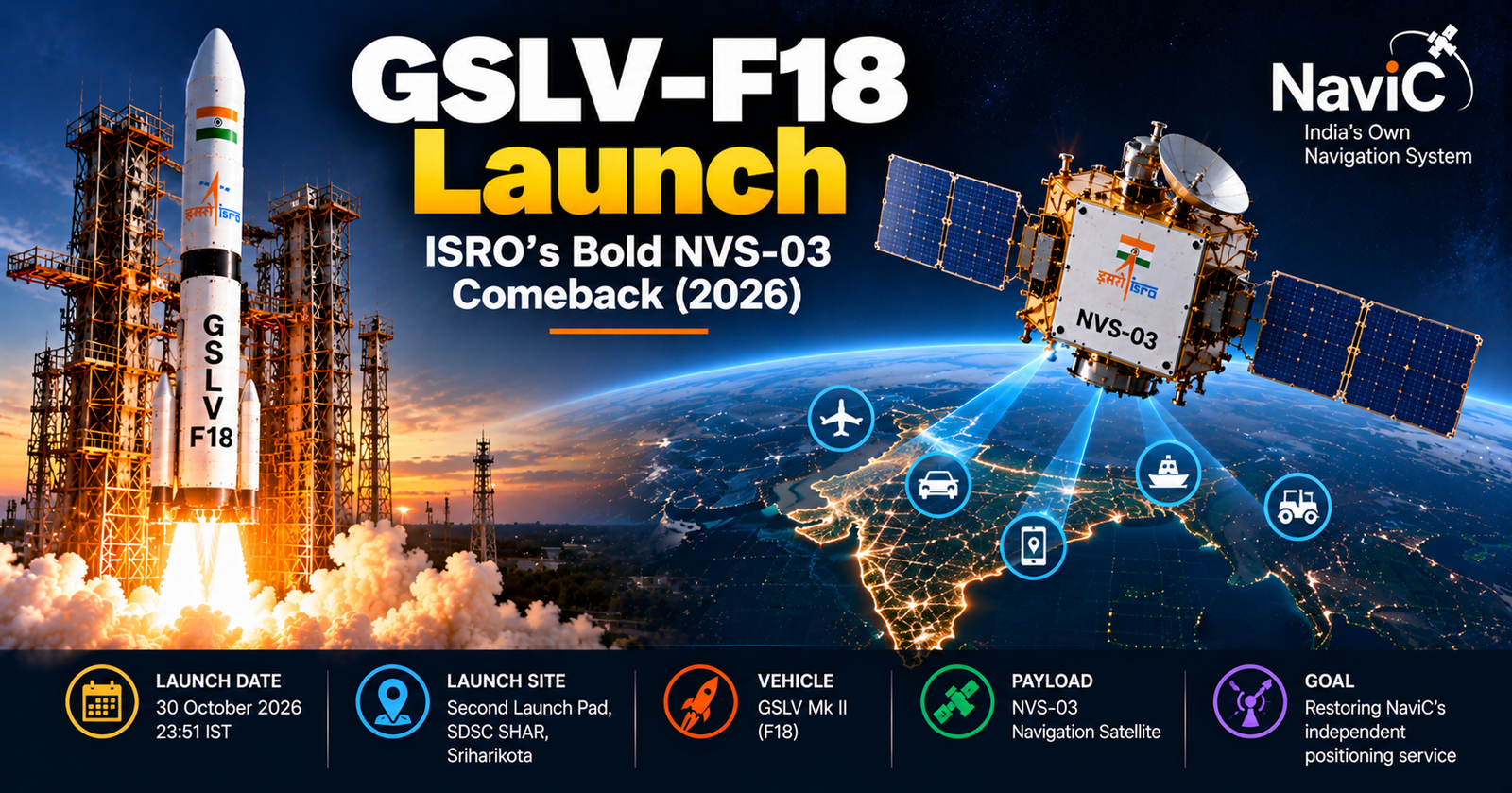
- Mission
- GSLV-F18 / NVS-03
- Vehicle
- GSLV Mk II (20th flight)
- Payload
- NVS-03 navigation satellite
- Launch Date
- October 30, 2026, 23:51 IST
- Launch Site
- Second Launch Pad, Satish Dhawan Space Centre, Sriharikota
- Target Orbit
- Geosynchronous Transfer Orbit (GTO)
- Why It Matters
- Restoring NavIC’s independent positioning service
- Watch Live
- ISRO’s YouTube channel, from 23:20 IST
What GSLV-F18 Is Carrying
ISRO has confirmed the GSLV-F18 launch for October 30, 2026, at 23:51 IST, lifting off from the Second Launch Pad at the Satish Dhawan Space Centre, Sriharikota. The payload is NVS-03, the third satellite in ISRO’s second-generation NavIC constellation, and its job is simple to state but overdue in practice: help restore India’s own satellite navigation system to full, independent strength.
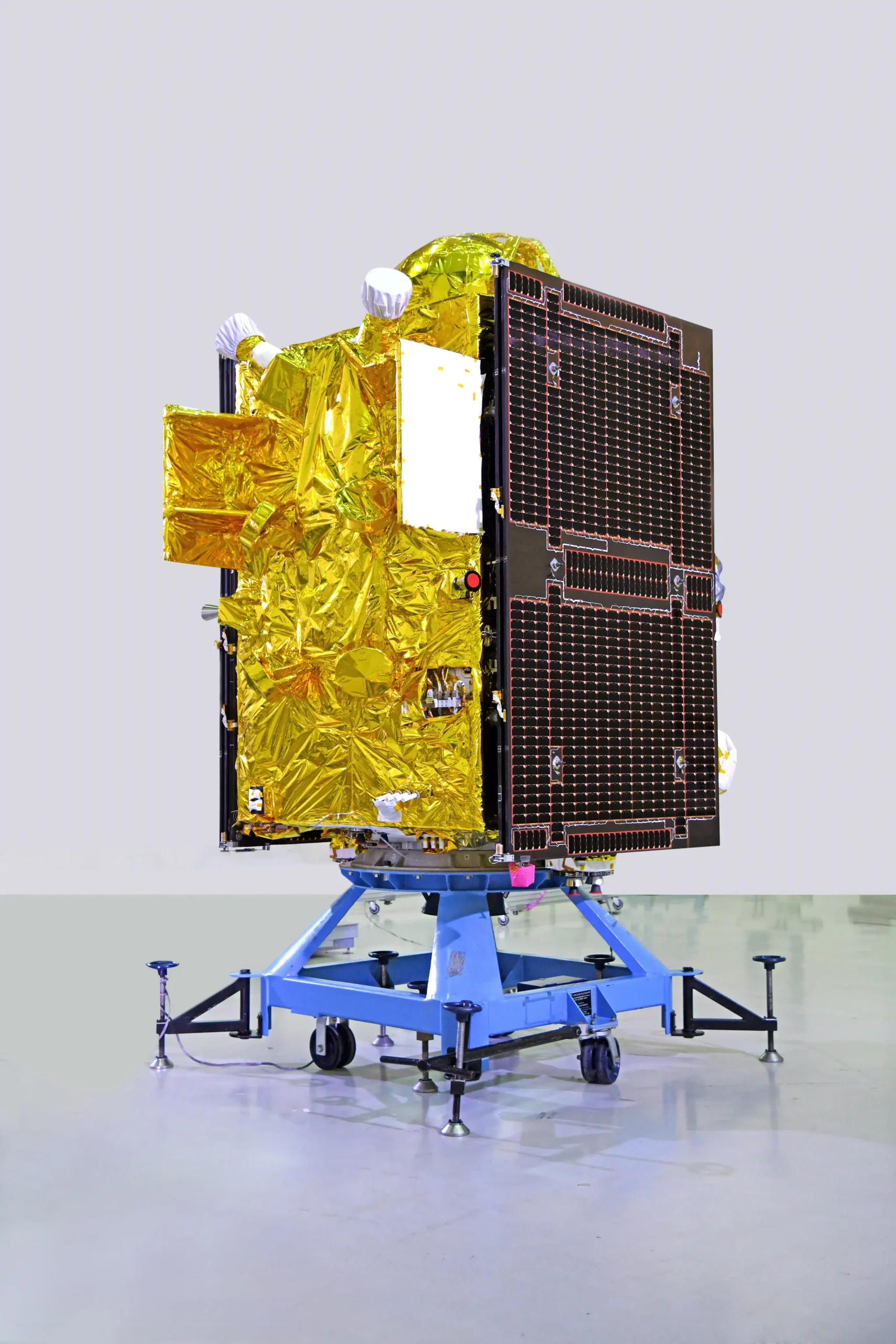
NVS-03 carries an indigenous rubidium atomic clock developed by the Space Applications Centre in Ahmedabad, alongside procured atomic clocks as backup. That’s a meaningful detail, because ISRO’s earlier NavIC satellites relied on imported clocks that proved unreliable in orbit. The satellite transmits across three frequency bands — L5, S, and a newly added L1 band that brings NavIC signals within reach of ordinary smartphone chipsets, not just specialised receivers.
At roughly 2,250 kg, NVS-03 is designed for about 12 years of service, two years longer than the first-generation IRNSS satellites it’s helping replace. It rides to orbit on a GSLV Mk II rocket, the same workhorse vehicle that has carried every second-generation NavIC satellite so far.
Why NavIC Needs This Launch
The honest reason this particular GSLV-F18 launch matters so much: NavIC is currently short-staffed. NVS-02, launched in January 2025, reached its geosynchronous transfer orbit fine, but a propulsion anomaly kept it from manoeuvring into its intended operational slot — leaving it only partially useful. According to a government reply in Parliament, just three satellites were providing proper positioning, navigation, and timing signals this year, well short of the four needed for reliable standalone navigation.
That gap has real consequences. NavIC is India’s answer to relying on GPS, GLONASS, Galileo, or BeiDou for anything security-sensitive — India’s armed forces are among those watching this constellation closely, since defence receives an encrypted signal while transportation, maritime navigation, railways, and agriculture lean on the open civilian signal. A constellation running below strength quietly erodes the “independent” part of independent positioning.
| Satellite | Launched | Outcome |
|---|---|---|
| NVS-01 | May 29, 2023 (GSLV-F12) | Reached orbit successfully; first to carry the new L1 band |
| NVS-02 | January 29, 2025 (GSLV-F15) | Reached GTO, but a propulsion anomaly prevented a full orbit raise |
| NVS-03 | October 30, 2026 (GSLV-F18) | Carries design fixes informed by NVS-02, plus the indigenous atomic clock |
NVS-03 isn’t a clean slate — ISRO has said it incorporates lessons from NVS-02’s shortfall, including improved bi-propellant systems. If it reaches its intended slot and is commissioned successfully, it brings NavIC meaningfully closer to full four-satellite coverage again, with NVS-04 and NVS-05 expected to follow and round the constellation back out.
GSLV-F18: The Vehicle
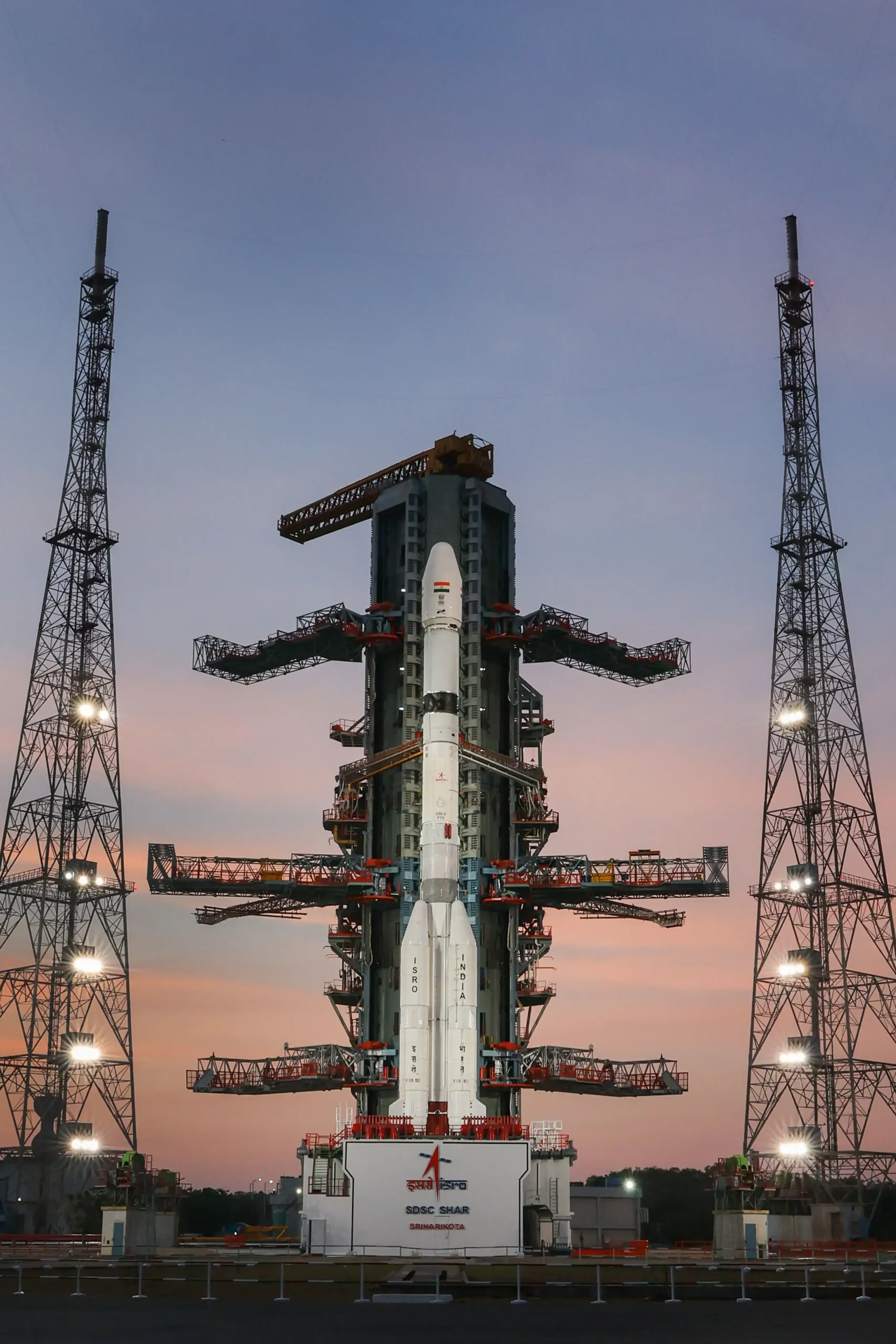
GSLV-F18 is the 20th flight of India’s Geosynchronous Satellite Launch Vehicle — a three-stage rocket that pairs a solid-fuel first stage and liquid-fuel second stage with an indigenous cryogenic upper stage, the engineering milestone that once made GSLV development such a long slog for ISRO. By flight 18, the vehicle has matured into a reliable ride for exactly this kind of payload: a single geosynchronous-orbit satellite in the 2,000-2,500 kg class.
The flight profile is a familiar one: GSLV-F18 will place NVS-03 into a Geosynchronous Transfer Orbit, an elongated ellipse that the satellite’s own onboard propulsion then circularises and raises into its final geosynchronous slot over the following days to weeks. That final orbit-raising phase is exactly where NVS-02 ran into trouble in January 2025 — making it the phase ISRO’s own teams will be watching most closely this time.
NVS-03 launches from the Second Launch Pad (SLP) at Sriharikota, the newer of the Satish Dhawan Space Centre’s two pads, purpose-built to handle GSLV and LVM3-class vehicles.
How to Watch the Launch Live
ISRO’s live coverage of the GSLV-F18 launch begins at 23:20 IST on October 30, 2026 — about 30 minutes before the scheduled 23:51 IST liftoff — on ISRO’s official YouTube channel. Because this is a late-night IST launch, international readers should convert carefully: 23:51 IST on October 30 is still October 30 afternoon in the US (roughly 2:21 pm EDT) and early morning on October 31 across most of East Asia and Australia.
- Official live stream: ISRO’s YouTube channel, from 23:20 IST
- Mission details and updates: isro.gov.in’s GSLV-F18 mission page
- In-person viewing: Sriharikota’s public Launch View Gallery, subject to its own registration process
For the full rundown on registering for in-person viewing, timezone conversions, and what to expect on launch day, our complete guide to watching an ISRO launch live covers it in more depth than fits here.
What’s Next for NavIC
A successful GSLV-F18 launch is only the first milestone. NVS-03 still has to complete its orbit-raising manoeuvres, reach its assigned geosynchronous slot, and pass ISRO’s in-orbit testing and commissioning checks before it actually contributes to live NavIC service — a process that typically takes several weeks. ISRO has not published a firm commissioning date as of this writing.
Beyond NVS-03, two more second-generation satellites, NVS-04 and NVS-05, are expected to follow in the coming launches, eventually giving NavIC a full, modernised constellation with consistent L1/L5/S-band coverage and reliable indigenous atomic clocks across every satellite — rather than the patchwork of ageing first-generation spacecraft and one under-performing second-generation satellite that NavIC has been running on through 2026.
Frequently Asked Questions
When is the GSLV-F18 launch?
ISRO has scheduled the GSLV-F18 launch for October 30, 2026, at 23:51 IST, from the Second Launch Pad at the Satish Dhawan Space Centre, Sriharikota.
What satellite is GSLV-F18 carrying?
GSLV-F18 is carrying NVS-03, the third satellite in ISRO’s second-generation NavIC navigation constellation. It carries an indigenous atomic clock and transmits on the L1, L5, and S frequency bands.
Why does NavIC need NVS-03?
NVS-02, launched in January 2025, suffered a propulsion anomaly that kept it from reaching its intended orbit, leaving NavIC with only three satellites providing full positioning, navigation, and timing signals — short of the four normally needed for reliable independent coverage.
How can I watch the GSLV-F18 launch live?
ISRO’s live stream on its official YouTube channel starts at 23:20 IST, about 30 minutes before liftoff. Sriharikota’s Launch View Gallery also offers in-person viewing with advance registration.
Will NVS-03 fix NavIC immediately after launch?
No. Reaching orbit is just the first step. NVS-03 still needs to complete its orbit-raising manoeuvres and pass in-orbit testing and commissioning before it contributes to live NavIC service, a process that typically takes several weeks.
What comes after NVS-03?
ISRO plans to follow NVS-03 with two more second-generation satellites, NVS-04 and NVS-05, to bring the modernised NavIC constellation to full strength.
The Bottom Line
The GSLV-F18 launch is ISRO’s most direct answer yet to a problem it has been quietly managing since NVS-02’s propulsion anomaly in January 2025: a NavIC constellation running under strength. NVS-03 doesn’t fix that the moment it reaches orbit — there’s a real commissioning process still ahead — but a clean launch and a successful orbit-raise would put India’s independent navigation system back on track, with NVS-04 and NVS-05 still to come. For now, all eyes turn to the night of October 30.