
- Mission
- Test Vehicle Abort Mission-2 (TV-D2)
- Programme
- Gaganyaan Crew Escape System validation
- Vehicle
- Gaganyaan Abort Test Booster (modified GSLV L40 stage)
- Launch Site
- First Launch Pad, Satish Dhawan Space Centre, Sriharikota
- Target Window
- Q4 2026 (per ISRO’s latest public statements)
- Crew Aboard
- None – uncrewed boilerplate crew module
- Precedes
- Gaganyaan-G1, the first uncrewed orbital test flight
- Recovery
- Bay of Bengal, by the Indian Navy
Why This Test Matters
Before any Indian astronaut climbs into a Gaganyaan capsule, ISRO has to prove one thing beyond any doubt: that if a launch goes wrong, the crew can get out alive. TV-D2 – short for Test Vehicle Abort Mission-2 – is the next uncrewed flight built to prove exactly that, and ISRO has it targeted for this quarter.
This isn’t a hypothetical worry. In October 2018, a Soyuz booster carrying cosmonaut Aleksey Ovchinin and NASA astronaut Nick Hague failed during stage separation about 50 km up – and their capsule’s own abort system pulled them clear, put them through a rough ballistic descent at 6–7 times Earth’s gravity, and landed them safely in Kazakhstan. Both flew again. That’s the exact capability TV-D2 is built to prove India has, before it ever needs it for real.
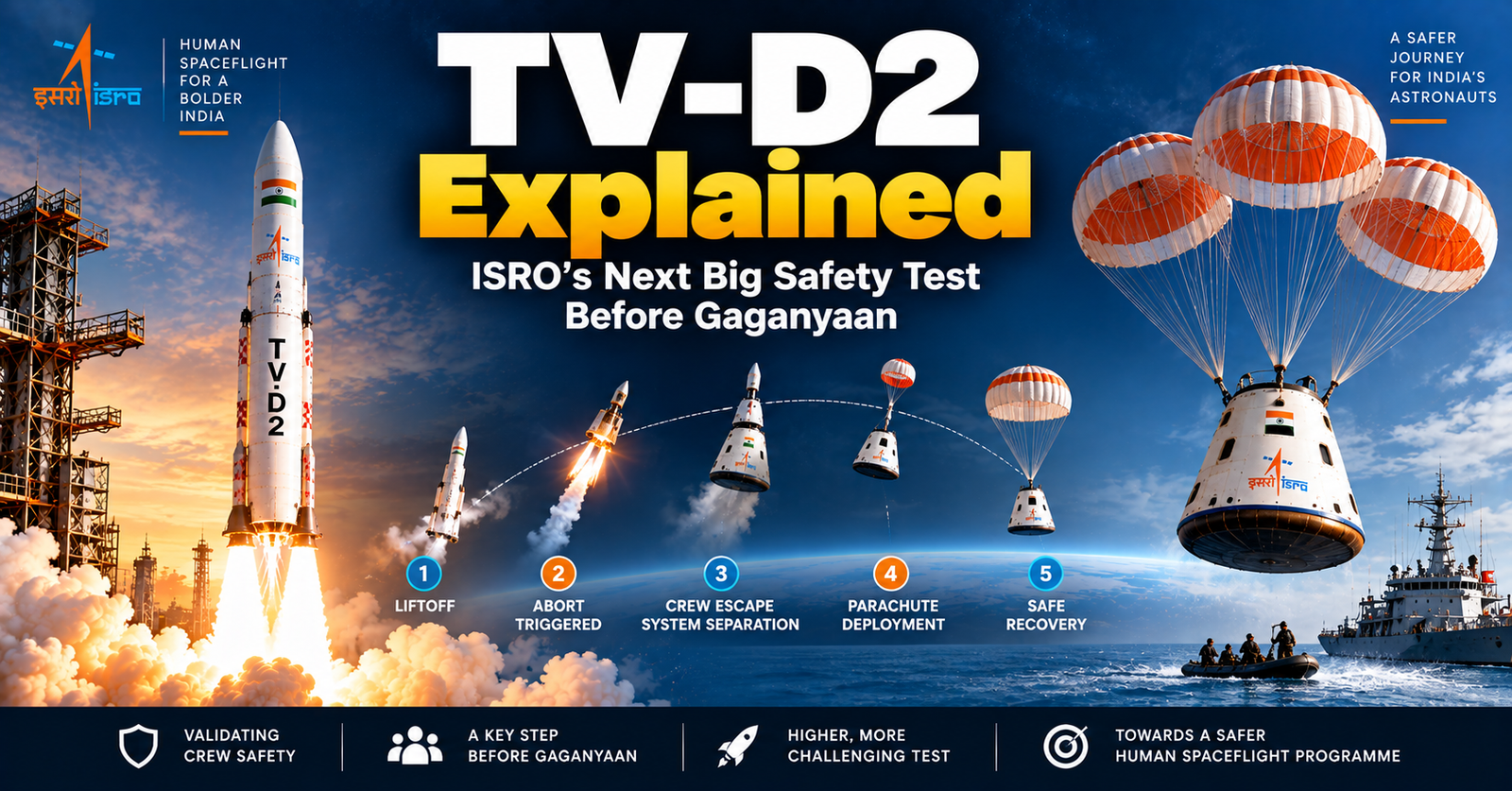
It is not a rocket launch in the usual sense. TV-D2 carries no satellite and reaches no orbit. Its entire job is to fling a boilerplate crew module into the sky, deliberately trigger an emergency, and prove that the Crew Escape System can pull it clear, slow it down, and land it safely – this time at a higher, more punishing speed than the first attempt managed.
That makes TV-D2 one of the last major safety boxes ISRO needs to tick before Vyommitra and Gaganyaan-G1, the first uncrewed orbital test flight, are cleared to fly.
What Is TV-D2?
TV-D2 uses a purpose-built Gaganyaan Abort Test Booster – a modified L40 stage borrowed from the GSLV family and built by Hindustan Aeronautics Limited – to carry an uncrewed, boilerplate Gaganyaan crew module to altitude from the First Launch Pad at Satish Dhawan Space Centre, Sriharikota.
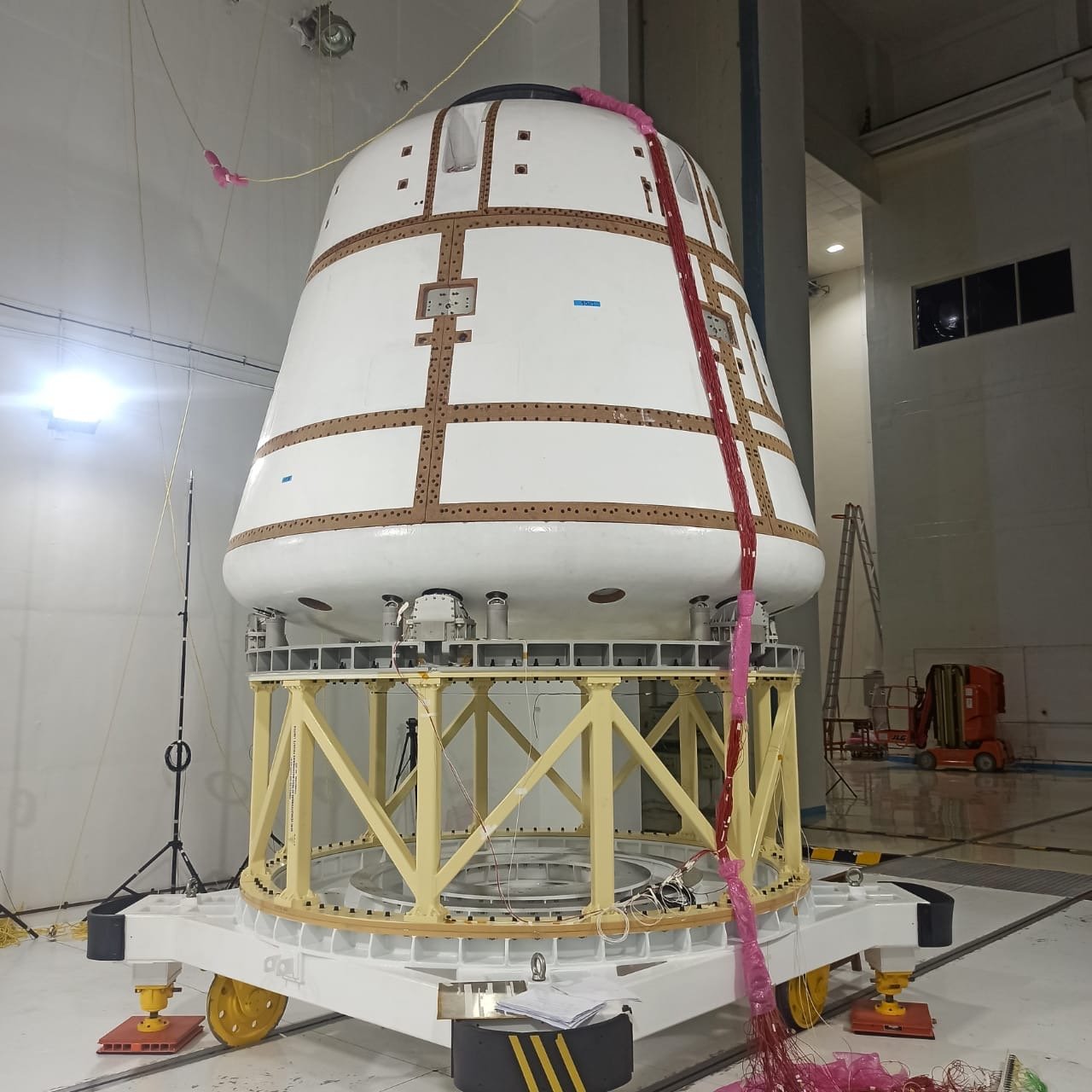
Sitting on top of that crew module is the Crew Escape System (CES), a roughly 4-metre-wide stack of its own, fitted with separate low-altitude and high-altitude escape motors. Inside the module itself are the systems a real crew would depend on in an emergency: crew seats, a suspension system to absorb the shock of separation, and an uprighting system to flip the capsule the right way up after splashdown.
Scaled up, the full TV-D2 stack runs about 35 metres tall – roughly the height of a 10-storey building – with the booster stage around 2.1 metres wide and the Crew Escape System itself widening out to about 4 metres at its base. It’s a small fraction of the size of an actual Gaganyaan launch vehicle, which is the point: TV-D2 only needs to go fast and high enough to put the escape system through a realistic abort, not into orbit.
The whole flight lasts around 20 minutes, end to end, and finishes with a parachute descent into the Bay of Bengal, where the Indian Navy recovers the module – the same recovery pattern used for TV-D1 three years earlier.
How TV-D2 Differs From TV-D1
ISRO already ran one version of this test. TV-D1 flew on October 21, 2023, triggering its abort at roughly 11 km altitude and reaching an apogee of about 15 km before the crew module parachuted into the Bay of Bengal. It worked – as ISRO’s own mission page details – and it made India the fourth country – after Russia, the United States, and China – to demonstrate this kind of crew-escape technology.
TV-D2 is built to be harder, not just a repeat. Here’s how the two compare:
| Test | Date | Abort Trigger | What Changed |
|---|---|---|---|
| TV-D1 | October 21, 2023 | Roughly 11 km altitude, around Mach 1.2 by contemporary estimates | First-ever test of the Crew Escape System; unpressurised crew module; proved the basic concept works |
| TV-D2 | Targeted for Q4 2026 | Booster shutdown at Mach 1.9, abort sequence beginning near Mach 1.6, escape motors firing around Mach 1.4 | A faster, higher-dynamic-pressure abort; reuses and upgrades the refurbished TV-D1 crew module with added equipment |
The Abort Sequence, Step by Step
On paper, TV-D2’s flight plan is a tightly choreographed few minutes. The modified L40 booster lifts the stack off the pad and burns until the vehicle is travelling at Mach 1.9 – nearly twice the speed of sound – at which point it shuts down.
As the stack coasts upward and begins to decelerate, the abort sequence starts to unfold: the crew module begins separating from the booster at around Mach 1.6, and the Crew Escape System’s own in-flight abort motors fire at roughly Mach 1.4 to pull the module clear and onto a safe trajectory. From there, parachutes deploy, the Reaction Control System reorients the capsule, and it descends into the Bay of Bengal for Navy recovery.
ISRO describes the goal plainly: demonstrate the test vehicle’s subsystems, the Crew Escape System’s separation sequence, and the crew module’s deceleration and recovery systems, all at a higher altitude and speed than TV-D1 attempted.
What’s Riding on This Test
TV-D2 isn’t an isolated experiment – it sits directly on the critical path to Gaganyaan-G1, the uncrewed orbital flight that will carry the half-humanoid Vyommitra, scientific instruments, and an engineering model of the life-support system into a roughly 400 km orbit. ISRO has said G1 is targeted for this same quarter, though the programme has slipped before and could again.
The booster for TV-D2 also matters beyond this one flight: it’s derived from the same L40 stage family used on the GSLV, while the actual Gaganyaan crewed missions will fly on HLVM3, the human-rated version of LVM3. Proving the escape system works at realistic abort speeds is what eventually lets ISRO certify HLVM3 to carry people.
The Road to Gaganyaan-1
TV-D2 is one stop on a longer, well-defined roadmap that ISRO has been working through step by step since 2023:
| Milestone | Status | What It Proves |
|---|---|---|
| TV-D1 | Completed, October 2023 | The Crew Escape System can separate and land safely from a low-altitude abort |
| TV-D2 | Targeted for Q4 2026 | The same system survives a faster, higher-dynamic-pressure abort |
| Further abort tests (TV-D3/D4) | Planned, dates unconfirmed | Additional abort conditions ISRO has not detailed publicly |
| Gaganyaan-G1 | Targeted for Q4 2026 | A full uncrewed orbital flight, carrying Vyommitra and life-support hardware |
| A second uncrewed flight | Planned before the crewed mission | Final validation ahead of putting astronauts on board |
| Gaganyaan-1 (crewed) | Targeted for 2027 | India’s first crewed orbital spaceflight – three astronauts, three days in orbit, a safe return |
Worth saying plainly: almost every date on this list has slipped at least once already – G1 itself was once pencilled in for December 2025. Treat these as ISRO’s current targets, not guarantees.
How This Compares Globally
Crew escape systems like this one are rare, deliberately so – they only exist because human spaceflight demands a level of reliability that satellite launches don’t. With TV-D1, India became only the fourth country, after Russia, the United States, and China, to flight-test this kind of abort technology. A successful TV-D2 would be India’s second demonstration of it, at a notably harder flight condition than the first.
Former ISRO Chairman K Sivan put the philosophy behind all of this bluntly: for Gaganyaan, human safety, reliability and quality matter more than optimum performance. That’s a different design philosophy than a typical satellite launch, where payload capacity and cost usually come first.
Every human-rated spacecraft flying today carries some version of this capability – NASA and SpaceX ran their own pad-abort and in-flight abort tests of the Crew Dragon capsule before it ever carried astronauts, and Russia’s Soyuz has used its abort system for real, not just in a test. TV-D2 is India building that same margin of safety into Gaganyaan from the ground up, rather than hoping it’s never needed.
Frequently Asked Questions
What is TV-D2?
TV-D2 (Test Vehicle Abort Mission-2) is ISRO’s second uncrewed flight test of the Gaganyaan Crew Escape System. It launches a boilerplate crew module on a modified GSLV L40 booster, deliberately triggers an in-flight abort, and checks that the escape system and crew module can separate, descend, and land safely.
How is TV-D2 different from TV-D1?
TV-D1 (October 2023) triggered its abort at a lower altitude, around 11 km. TV-D2 is designed to trigger the abort at a higher speed – after the booster shuts down at Mach 1.9, with the escape sequence unfolding between roughly Mach 1.6 and Mach 1.4 – a tougher test of the same system.
Will TV-D2 carry a crew?
No. TV-D2 is fully uncrewed. It flies a boilerplate crew module fitted with crew seats, a suspension system, and recovery hardware, but no astronauts are aboard. Crewed Gaganyaan flights are planned only after several more uncrewed tests.
What happens if the abort test itself fails?
ISRO would investigate the failure, make fixes, and very likely fly another test before proceeding to Gaganyaan-G1 or any crewed mission. The entire point of flying these tests uncrewed, repeatedly, is to catch problems like this long before a human is on board.
When will TV-D2 actually launch?
ISRO has targeted Q4 2026 for TV-D2 as of its most recent public statements, but the Gaganyaan programme’s timeline has slipped multiple times already, so treat this as a target rather than a confirmed date.
What is the Crew Escape System?
The Crew Escape System (CES) is a roughly 4-metre-wide stack mounted above the crew module, fitted with separate low-altitude and high-altitude escape motors. If a launch goes wrong, it pulls the crew module clear of the rocket and onto a safe parachute descent.
What comes after TV-D2?
ISRO’s publicly stated roadmap has Gaganyaan-G1 – the first uncrewed orbital flight, carrying the humanoid Vyommitra – targeted for the same quarter, followed by at least one more uncrewed test flight before any crewed mission.
When will Indian astronauts actually fly?
ISRO is currently targeting 2027 for Gaganyaan’s first crewed flight: three astronauts spending roughly three days in a 400 km orbit before returning safely to Earth. That date depends on TV-D2 and the remaining uncrewed tests going well.
The Bottom Line
TV-D2 won’t make headlines the way an actual astronaut launch will, but it’s arguably more important: it’s ISRO deliberately trying to break its own safety system, at a harder speed than before, specifically so it doesn’t break for real with people on board. If it goes well this quarter, the next major milestone is Gaganyaan-G1’s uncrewed orbital flight – and after that, for the first time, an Indian crew.
Also Read
- Gaganyaan Mission 2026: India’s First Human Spaceflight Explained
- Vyommitra: ISRO’s Robotic Astronaut Explained
- Pushpak RLV Explained: How ISRO Is Building India’s Reusable Rocket
- GSLV vs LVM3: Why ISRO Is Retiring One Rocket to Bet on the Other
- Bharatiya Antariksh Station: India’s Plan for Its Own Space Station
- ISRO Launch Schedule 2026: Every Mission You Need to Know