
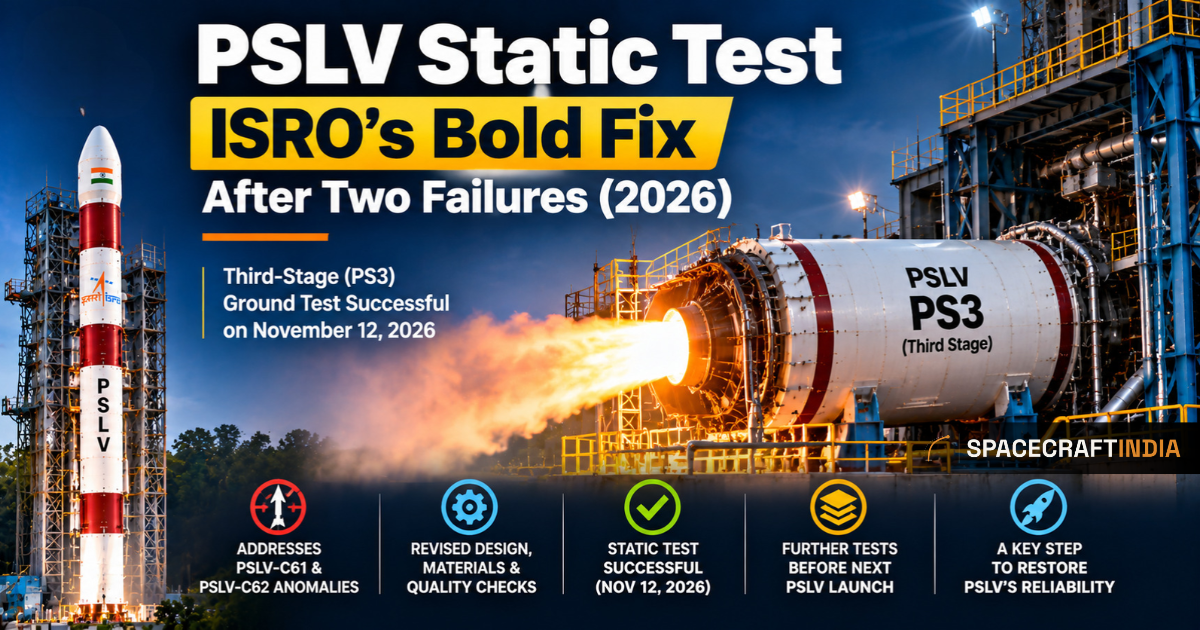
- Vehicle
- PSLV (Polar Satellite Launch Vehicle)
- Stage Tested
- Third stage (PS3), solid motor
- Test Type
- Ground static test
- Test Date
- November 12, 2026
- Test Site
- Static Test Facility, Satish Dhawan Space Centre, Sriharikota
- Why It Was Needed
- Anomalies in PSLV-C61 (May 2025) and PSLV-C62 (January 2026), both traced to the PS3 stage
- Result
- ISRO reports success; further tests planned
- Next PSLV Launch
- Not yet announced
ISRO’s workhorse rocket just took its most important step yet back toward flight. On November 12, 2026, the Indian Space Research Organisation carried out a PSLV static test — a ground test of the Polar Satellite Launch Vehicle’s third stage (PS3) at the Static Test Facility in Sriharikota, the exact stage blamed for the rocket’s two most recent launch failures. ISRO says the test was successful, and that a rebuilt version of the stage has been “realised and tested.”
It isn’t a launch, and ISRO hasn’t announced when PSLV will fly again. But after a year in which India’s most-flown rocket failed twice in a row for the first time in its 32-year history, this static test is the first concrete, public evidence that the fix is real, not just a promise.
Why This Test Matters
The PSLV is the closest thing India’s space programme has to a dependable daily driver. Since its first flight in 1993, it has flown roughly 64 times, carrying everything from Chandrayaan-1 and the Mars Orbiter Mission to Aditya-L1 and dozens of commercial rideshare missions for other countries. Historically, it has succeeded on about 92% of those flights, a record that put it in the same league as ISRO’s other reliable launcher, the newer, smaller SSLV.
That record is exactly why two failures in under a year rattled India’s space programme. This PSLV static test on November 12 is ISRO publicly showing its work on the fix, rather than just promising one.
What Went Wrong With PSLV’s Third Stage
PSLV is a four-stage rocket that alternates solid and liquid propulsion: PS1 and PS3 burn solid fuel, while PS2 and PS4 run on liquid engines. PS3 fires in the upper atmosphere, giving the rocket its final push toward orbit, and it is the stage behind both recent failures.
PSLV-C61 (May 18, 2025) carried EOS-09, a synthetic aperture radar Earth observation satellite. A drop in chamber pressure during the third-stage burn kept the satellite from reaching its intended orbit.
PSLV-C62 (January 12, 2026) carried the DRDO-built EOS-N1 hyperspectral satellite along with 15 co-passenger satellites. A roll-rate disturbance and a deviation from the planned flight path near the end of the PS3 burn meant none of the 16 payloads reached their intended orbit — read our full breakdown of that failure.
Both failures traced back to the same stage, back-to-back. It was PSLV’s first consecutive mission failure in 32 years of flying, interrupting a historical success rate of roughly 92% across 64 launches dating back to 1993.
What ISRO Tested on November 12
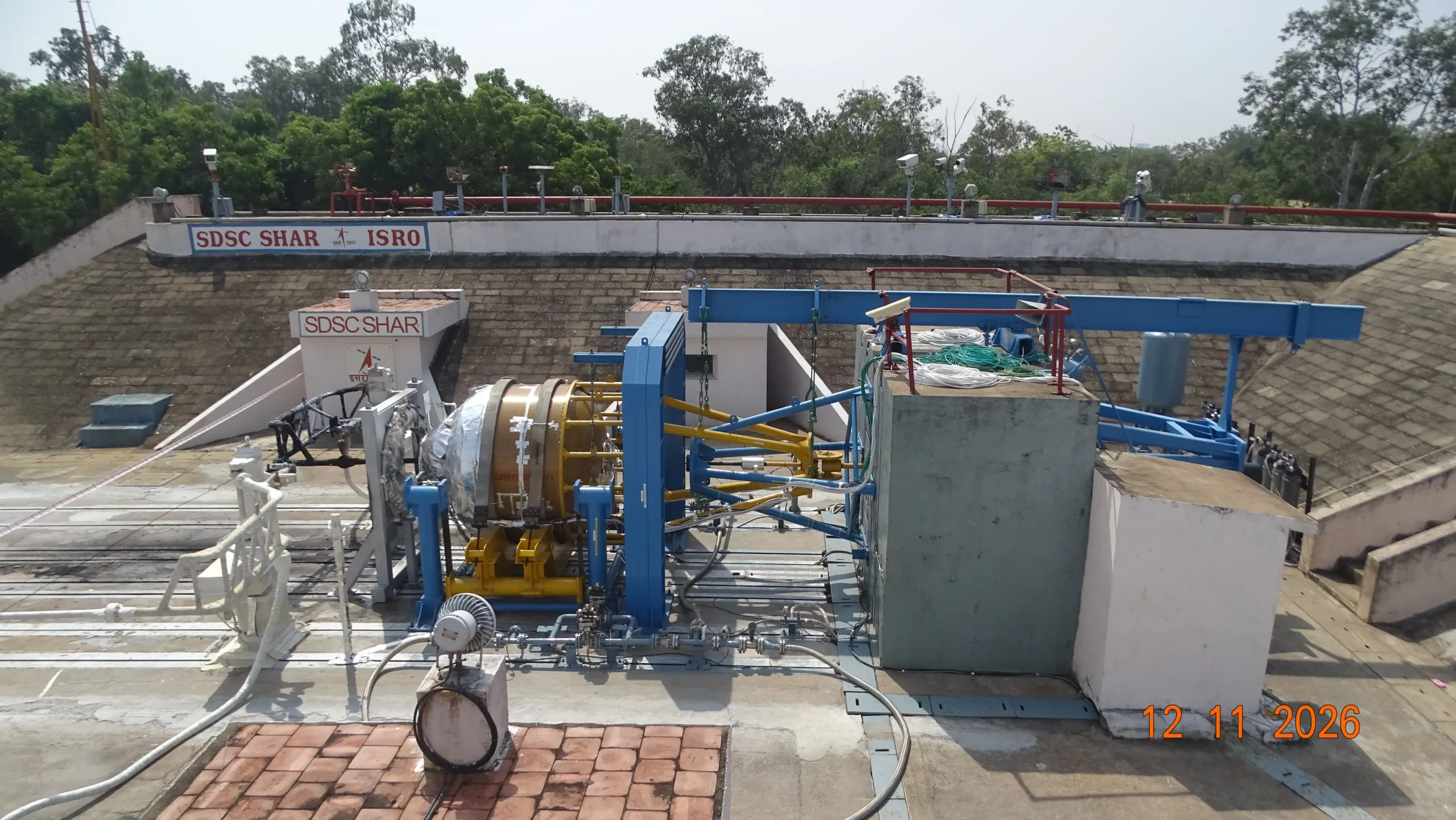
A static test fires a rocket motor while it stays bolted to the ground, letting engineers measure its performance under real combustion conditions without risking an actual flight. It’s standard practice before clearing a modified stage to fly again, and this PSLV static test is exactly what ISRO carried out at the Static Test Facility, Satish Dhawan Space Centre, on November 12, 2026 — independently confirmed by The Tribune.
In its own statement on the test, ISRO said the PS3 stage’s configuration was “revisited comprehensively” with respect to design margins, raw material acceptance criteria, assembly procedures, and quality checks, following the anomalies seen on PSLV-C61 and PSLV-C62. The agency’s statement: the “new version of the PS3 Solid motor stage is realised and tested successfully.” Based on the detailed analysis and review of this test’s data, ISRO says further tests are planned before the stage returns to actual flight.
What Actually Changed in the PS3 Stage
ISRO hasn’t published a detailed root-cause report from the failure analysis committees that reviewed PSLV-C61 and PSLV-C62 — a gap that some observers and commentators have pointed out. What the agency has disclosed is the list of engineering changes made to the stage:
- Nozzle configuration strengthened to improve design margins
- Mechanical interfaces strengthened, with redundant sealing systems and re-verified design margins
- Raw material acceptance criteria tightened
- Assembly procedures updated
- Non-Destructive Testing (NDT) added and updated during integration and transportation
Taken together, these read less like a single smoking-gun fix and more like ISRO tightening every link in the chain — manufacturing, assembly, and inspection — rather than pointing to one isolated defect.
How the Two Failures Compare
A side-by-side look at what went wrong on each mission, and where this PSLV static test fits in:
| Event | Date | Payload | What Happened | Outcome |
|---|---|---|---|---|
| PSLV-C61 | May 18, 2025 | EOS-09 (SAR Earth observation satellite) | Drop in PS3 chamber pressure during third-stage burn | Satellite did not reach intended orbit |
| PSLV-C62 | January 12, 2026 | EOS-N1 (DRDO hyperspectral) + 15 co-passengers | Roll-rate disturbance and flight-path deviation near the end of the PS3 burn | All 16 payloads lost |
| PS3 Static Test | November 12, 2026 | None — ground test, no payload | Rebuilt PS3 stage fired on the ground at the Static Test Facility | ISRO reports success; further tests planned |
What’s Next for PSLV
This PSLV static test hasn’t come with a return-to-flight date. ISRO’s own statement says only that further tests are planned, based on a review of this test’s data — so as of mid-November 2026, there’s no confirmed return-to-flight date.
A handful of PSLV missions are already waiting in the wings. One is TDS-01, a technology-demonstration satellite meant to test a new high-power electric propulsion thruster and a quantum-communication payload, which had been loosely pencilled in for around November 2026 before this recovery effort began — its exact timing is now unclear, and ISRO has not confirmed a new date. Separately, PSLV missions built with Indian industry partners under ISRO’s commercial launch push have already slipped more than once amid the recovery, with the first fully industry-built PSLV now not expected before March 2027.
Why This Matters for India’s Space Programme
PSLV underpins a lot of what ISRO does day to day: Earth observation, scientific satellites, navigation-support launches, and a growing commercial rideshare business through NSIL that brings in paying customers from other countries. A rocket that can’t fly reliably doesn’t just delay Indian missions — it costs ISRO’s commercial credibility with the international customers it has spent years courting.
It also lands alongside a broader push to modernise India’s launch fleet, from the reusable Pushpak RLV programme to the GSLV Mk II-to-LVM3 handover already underway. This PSLV static test is a small but necessary step toward keeping that foundation dependable.
Frequently Asked Questions
What is the PSLV third stage (PS3)?
PS3 is the third of PSLV’s four stages, and it burns solid fuel. It fires in the upper atmosphere to give the rocket its final push toward the target orbit, and it’s the stage behind both of PSLV’s two most recent failures.
Why did ISRO test the PSLV third stage on the ground instead of launching it?
A ground static test fires the motor while it is bolted down, letting engineers measure its performance under real combustion conditions without risking an actual flight. It’s the standard way to clear a modified rocket stage before committing it to a real mission.
Has ISRO announced when PSLV will launch again?
No. As of this static test on November 12, 2026, ISRO has only said that further tests are planned based on a review of the test data — there is no confirmed date yet for PSLV’s next launch.
What caused the PSLV-C61 and PSLV-C62 failures?
Both were traced to anomalies in the PS3 stage: a drop in chamber pressure on PSLV-C61 (May 2025), and a roll-rate disturbance with a flight-path deviation on PSLV-C62 (January 2026). ISRO has not published a detailed root-cause report, only the engineering changes made to the stage in response.
Is this PSLV’s first failure ever?
No. PSLV has had isolated failures before, in 1993, 1997, and 2017, spread widely apart. PSLV-C61 and PSLV-C62 were its first back-to-back failures in 32 years of flying, interrupting a historical success rate of roughly 92% across 64 launches.
What missions are waiting on PSLV’s return to flight?
TDS-01, a technology-demonstration satellite carrying a new electric propulsion thruster and a quantum-communication payload, had loosely been expected around November 2026 but now has no confirmed date. Separately, the first PSLV mission built with Indian industry partners has already slipped to no earlier than March 2027.