
- Mission
- PSLV-C62 / EOS-N1
- Launch date
- January 12, 2026, 10:17 hrs IST
- Site
- Satish Dhawan Space Centre, Sriharikota
- Vehicle
- PSLV-DL (64th PSLV flight)
- Payloads
- EOS-N1 + 15 co-passenger satellites
- Failed stage
- Third stage (PS3)
- Cause
- Roll-rate disturbance, propulsion instability
- Status
- Fix validated, PSLV cleared to fly again
- What Was PSLV-C62 Supposed to Do?
- What Caused the PSLV-C62 Failure?
- What Was EOS-N1, and Why Did It Matter?
- Who Else Lost Satellites on PSLV-C62?
- Is This ISRO’s First PSLV Failure?
- What Did ISRO’s Investigation Find?
- How Has ISRO Fixed the Problem?
- What Does This Mean for India’s Space Ambitions?
- What’s Next for PSLV?
- FAQs
What Was PSLV-C62 Supposed to Do?
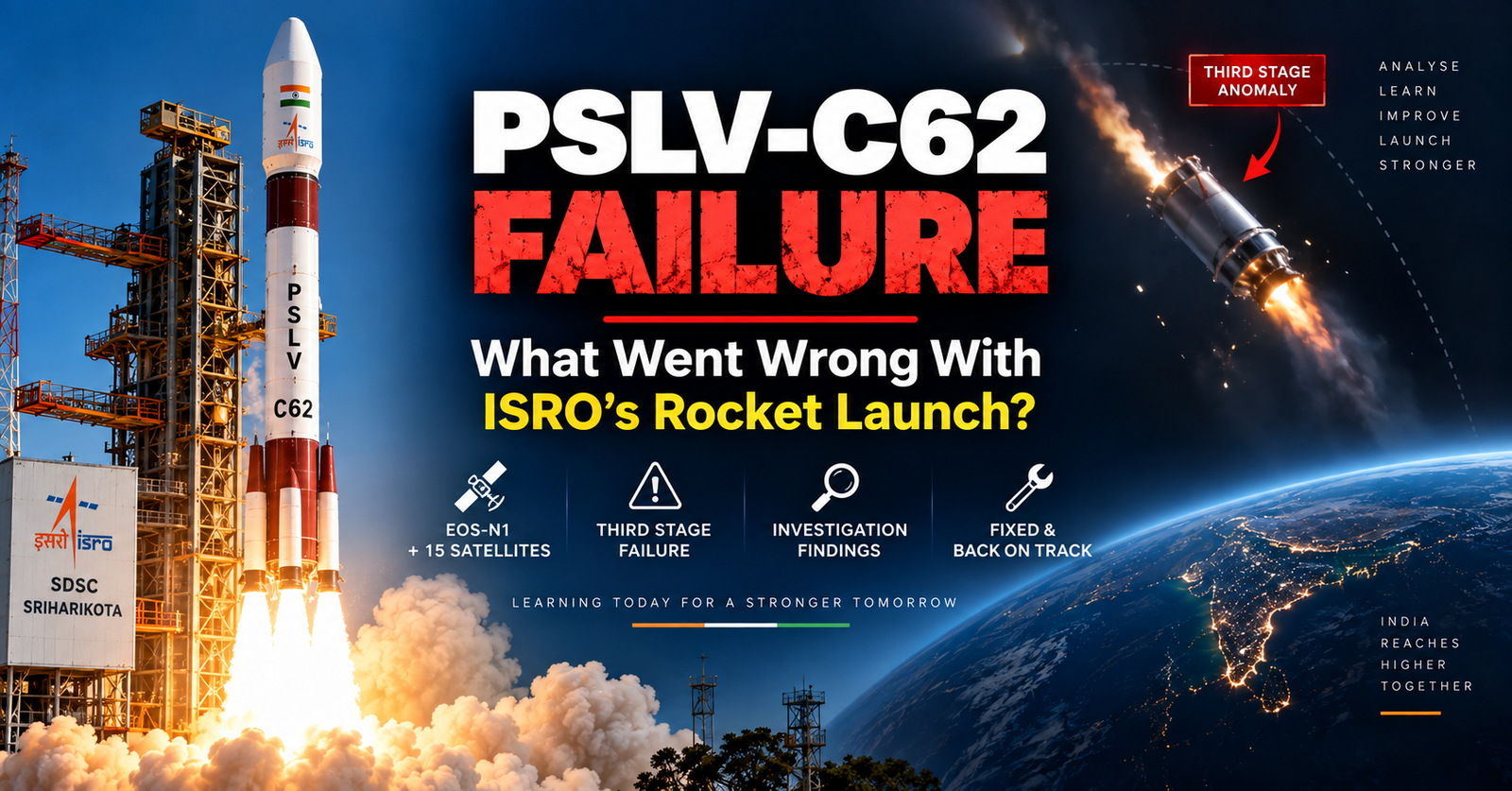
The PSLV-C62 failure happened on January 12, 2026, when ISRO’s 64th PSLV flight lost control during its third stage and failed to deliver its payloads to orbit. The mission lifted off at 10:17 hrs IST from the First Launch Pad at the Satish Dhawan Space Centre in Sriharikota, flying in the PSLV-DL configuration — a two-strap-on-booster variant of the Polar Satellite Launch Vehicle. It was a commercial rideshare mission run by NewSpace India Limited (NSIL), ISRO’s commercial arm, carrying one primary satellite and 15 co-passenger payloads for customers in India and abroad — India’s first launch attempt of 2026. Mission details are archived on ISRO’s own PSLV-C62 mission page.
What Caused the PSLV-C62 Failure?
The first two stages of PSLV-C62 flew normally. The trouble began in the third stage (PS3), which ignited at 264.2 seconds into flight at an altitude of roughly 220 km. About 110 seconds into the PS3 burn, telemetry showed the vehicle’s roll rate becoming unstable even though the engine was still firing. ISRO Chairman Dr. V. Narayanan described it plainly: “close to the end of the third stage, we were seeing a little more disturbance in the vehicle roll rates,” followed by “a deviation observed in the flight path.” Third-stage burnout was recorded at 396 seconds and 346 km altitude, but onboard camera footage appeared to show the vehicle tumbling rather than flying a controlled trajectory. With the stack off its intended path, none of the satellites reached a usable orbit.
What Was EOS-N1, and Why Did It Matter?
EOS-N1 was PSLV-C62’s primary payload — a next-generation Earth observation satellite built by the Defence Research and Development Organisation (DRDO) with hyperspectral imaging capability, designed for a sun-synchronous orbit and intended to support national defence surveillance, strategic monitoring and reconnaissance. Losing it was more than a technical setback: EOS-N1 was meant to strengthen India’s own space-based reconnaissance at a time of continuing border tensions, and its loss delayed a capability India’s defence establishment had been counting on.
Who Else Lost Satellites on PSLV-C62?
Alongside EOS-N1, PSLV-C62 carried 15 co-passenger satellites from domestic and international customers under NSIL’s commercial rideshare programme. Nearly all of them were lost with the primary payload. The one exception was KID, a re-entry vehicle prototype built by a Spanish company, which was designed to separate and attempt a controlled atmospheric re-entry toward the South Pacific Ocean; reports indicate it transmitted partial data despite the mission failure, making it the closest thing to a silver lining in an otherwise total loss. Until this flight, every PSLV mission carrying foreign commercial payloads had reached orbit successfully — a streak that mattered as India tried to grow its share of the global commercial launch market.
Is This ISRO’s First PSLV Failure?
No — and that’s what makes the PSLV-C62 failure especially concerning. It was the second consecutive PSLV mission to fail in the same stage within about eight months. On May 19, 2025, PSLV-C61 lifted off successfully and completed its first two stages normally, but an anomaly in the third stage left its payload, the EOS-09 earth observation satellite, off-target and the mission unaccomplished. Two failures in a row, both traced to the same third stage of the same four-stage rocket, turned what might have looked like a one-off glitch into a pattern ISRO needed to run to ground before flying PSLV again.
| Mission | PSLV-C61 / EOS-09 | PSLV-C62 / EOS-N1 |
|---|---|---|
| Date | May 19, 2025 | January 12, 2026 |
| Failed stage | Third stage (PS3) | Third stage (PS3) |
| Outcome | Payload left off-target | Vehicle lost control, tumbled |
| Payload lost | EOS-09 (earth observation) | EOS-N1 + 14 of 15 co-passengers |
What Did ISRO’s Investigation Find?
ISRO set up a national-level expert committee to investigate both the PSLV-C61 and PSLV-C62 failures together, bringing in outside expertise rather than relying solely on an internal review — the panel included former Principal Scientific Advisor to the Government of India K. Vijay Raghavan and former ISRO Chairman S. Somanath. The committee traced both incidents to critical issues in the third stage’s propulsion system that caused roll-rate disturbances and a loss of control during the PS3 burn. ISRO did not publicly detail the exact component-level fault immediately after either failure, which drew some criticism over transparency, but the eventual findings pointed squarely at propulsion-system instability rather than a one-off manufacturing defect.
How Has ISRO Fixed the Problem?
By mid-2026, ISRO announced it had resolved the PSLV third-stage anomaly. Engineers redesigned and modified the affected propulsion components, and subsequent ground tests validated the corrective measures — enough for ISRO to clear Satish Dhawan Space Centre for renewed launch operations. Rather than putting PSLV straight back on the pad, ISRO’s plan was to first demonstrate the corrected systems and processes on an upcoming GSLV mission, and only then fly a fresh PSLV return-to-flight mission to reaffirm the rocket’s reliability before resuming a normal cadence.
What Does This Mean for India’s Space Ambitions?
PSLV has been ISRO’s most dependable workhorse for over three decades, having launched 434 satellites for 36 countries since 1999 before this pair of failures. India has been trying to grow its share of the global commercial launch market from roughly 2–3% toward 8–9%, and a rocket’s reliability record is the single biggest factor international customers weigh before booking a rideshare slot. Two consecutive third-stage failures inevitably raise questions for commercial customers, even though ISRO’s broader track record — including successful missions on the GSLV and LVM3 families — remains strong. It’s also worth keeping the setback in context: PSLV-C62’s failure arrived in the same year Japan’s JAXA suffered an H3 launch failure and China faced its own reusable-booster recovery setbacks, a reminder that even mature space programmes carry real technical risk on every flight.
What’s Next for PSLV?
With the fix validated and Sriharikota cleared for operations again, ISRO’s near-term roadmap runs through a GSLV mission first, followed by a dedicated PSLV return-to-flight launch to prove the redesigned third stage under real flight conditions before the vehicle resumes routine commercial and government missions. For the fuller run of upcoming launches this will feed into, see our ISRO Launch Schedule 2026. Until PSLV notches a clean third-stage burn on that return-to-flight mission, expect India’s space watchers — and its commercial rideshare customers — to be watching PSLV’s next launch more closely than any in years.
FAQ’s
What caused the PSLV-C62 failure?
ISRO’s investigation found that a roll-rate disturbance and instability in the third stage’s (PS3) propulsion system caused the vehicle to lose control roughly 110 seconds into the third-stage burn, sending it off its intended flight path.
What satellites were lost in the PSLV-C62 failure?
The mission carried EOS-N1, a DRDO-built hyperspectral earth observation satellite, plus 15 co-passenger satellites from domestic and international customers. Nearly all were lost; only a Spanish re-entry vehicle prototype, KID, is reported to have transmitted partial data.
Was PSLV-C62 ISRO’s first launch failure?
No. PSLV-C62 (January 2026) was the second consecutive PSLV failure in its third stage, following PSLV-C61 in May 2025, which left the EOS-09 satellite off-target after a similar third-stage anomaly.
Has ISRO fixed the PSLV third-stage problem?
Yes. ISRO’s expert committee identified propulsion-system instability as the root cause, engineers redesigned the affected components, and ground tests validated the fix, clearing Satish Dhawan Space Centre for renewed launches by mid-2026.
When will PSLV fly again after the C62 failure?
ISRO’s plan is to first demonstrate the corrected systems on a GSLV mission, then fly a dedicated PSLV return-to-flight mission to confirm the redesigned third stage before PSLV resumes its normal launch cadence.