
- Satellite
- NVS-03 (NavIC navigation satellite)
- Launch Vehicle
- GSLV-F18 (GSLV Mk II, 20th flight)
- Launched
- October 30, 2026, 23:51 IST
- Current Status
- Orbit-raising in progress; satellite health normal
- First Burn
- October 31, 2026 — 2,174.8-second LAM engine firing
- Target Orbit
- Geostationary slot at 111.75°E
- Why It Matters
- Restores NavIC to its minimum 4-satellite operational strength
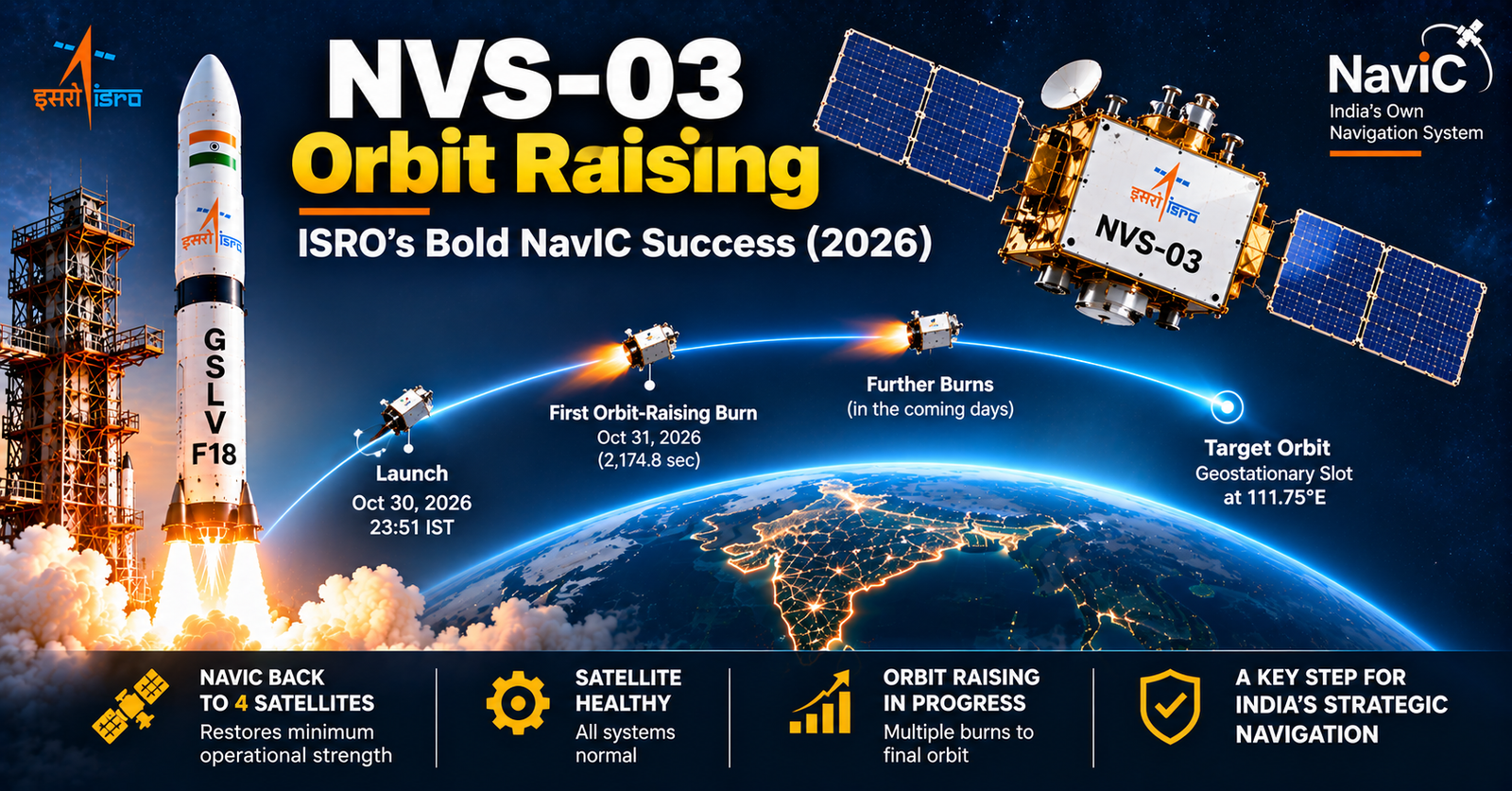
NVS-03 orbit raising is officially underway. GSLV-F18 lifted off from Sriharikota on October 30, 2026, at 23:51 IST, carrying NVS-03 into orbit — a launch we covered as it happened in our live-countdown piece. Less than 24 hours later, ISRO confirmed the part that actually matters for India’s everyday GPS alternative: the satellite is healthy, it has completed its first orbit-raising burn, and NavIC is once again standing on its full complement of four operational satellites.
This NVS-03 orbit raising update isn’t a repeat of the launch-day story. It’s what happened after the cameras stopped rolling — the numbers ISRO released on October 31, the safety trick engineers used to shave risk off the mission, and the honest answer to the question every NavIC user actually cares about: when does this satellite start working?
- NVS-03 launched on GSLV-F18, October 30, 2026, 23:51 IST, from Sriharikota.
- ISRO confirmed the satellite is healthy after its first orbit-raising burn on October 31, 2026.
- NavIC is now back to its minimum operational strength of four second-generation satellites.
- The satellite still has to reach its final geostationary slot and complete in-orbit testing before it goes live.
NVS-03 Orbit Raising: The First 24 Hours
NVS-03 separated from GSLV-F18’s upper stage about 18 minutes after liftoff, dropping into a geosynchronous transfer orbit (GTO) of 170.3 km x 38,080 km — a long, lopsided ellipse typical of any GSLV navigation-satellite launch. The real work of getting NVS-03 to its working post happens afterward, in a series of engine burns that gradually round out that orbit into a near-circular one 35,786 km above the equator.
ISRO ran the first of those burns on October 31, 2026, at 16:48 hrs, firing the satellite’s Liquid Apogee Motor (LAM) for 2,174.8 seconds — just over 36 minutes, continuously. According to ISRO’s own orbit-manoeuvring update, that single burn pushed the satellite’s perigee out dramatically, and the agency’s one-line verdict on the satellite itself was unambiguous: “satellite health is normal.”
| Milestone | When | Orbit (perigee x apogee) |
|---|---|---|
| Injection by GSLV-F18 | Oct 30, 2026, 23:51 IST | 170.3 km x 38,080 km |
| After 1st LAM burn | Oct 31, 2026, 16:48 hrs | 5,477.6 km x 37,833.4 km (est.) |
| Final geostationary orbit (target) | Over subsequent burns, “in the coming days” | ~35,786 km circular at 111.75°E |
ISRO hasn’t published exact dates for the remaining burns, only that more are planned “in the coming days.” That’s normal: geostationary transfer typically takes a handful of carefully timed apogee-motor firings spread over one to two weeks, not a single dramatic maneuver. Once NVS-03 settles into its slot at 111.75° East, it still has to go through on-orbit testing before ISRO declares it operational for the NavIC signal.
The “Unprecedented” Safety Step ISRO Took
Buried in the post-launch reporting was a detail ISRO itself flagged as a first: NVS-03 flew with its pyrotechnic valves already open. On most satellites, those valves — which control the flow of propellant to the thrusters — are fired open only after the satellite separates from the rocket, as a safeguard against an accidental propellant leak during ascent. Flying them pre-opened shaves time (and risk) off the critical first hours in orbit, when a satellite that can’t yet fire its own thrusters is most vulnerable to drifting off its intended path.
ISRO Chairman V. Narayanan described the mission in blunt engineering terms: “all the vehicle systems performed as predicted and as expected.” That’s the kind of sentence that sounds unremarkable until you remember this was GSLV’s 20th flight, on a rocket whose earlier variants earned a reputation as ISRO’s trickiest vehicle to fly reliably. A clean 20th flight, just 56 days after the previous GSLV mission, says as much about how far the vehicle has matured as it does about this specific satellite.
NavIC Is Back to Full Strength
Here’s the headline that actually affects users: with NVS-03 healthy in orbit, NavIC is back to its minimum operational configuration of four satellites. Narayanan confirmed it directly, saying NVS-03 has “restored Position, Navigation and Timing (PNT) services” for the constellation. We’ve covered the backstory of why that mattered in an earlier piece on NavIC’s satellite shortage: a propulsion anomaly on NVS-02 in January 2025 left the constellation short-handed, and NVS-03 was built and launched specifically to close that gap.
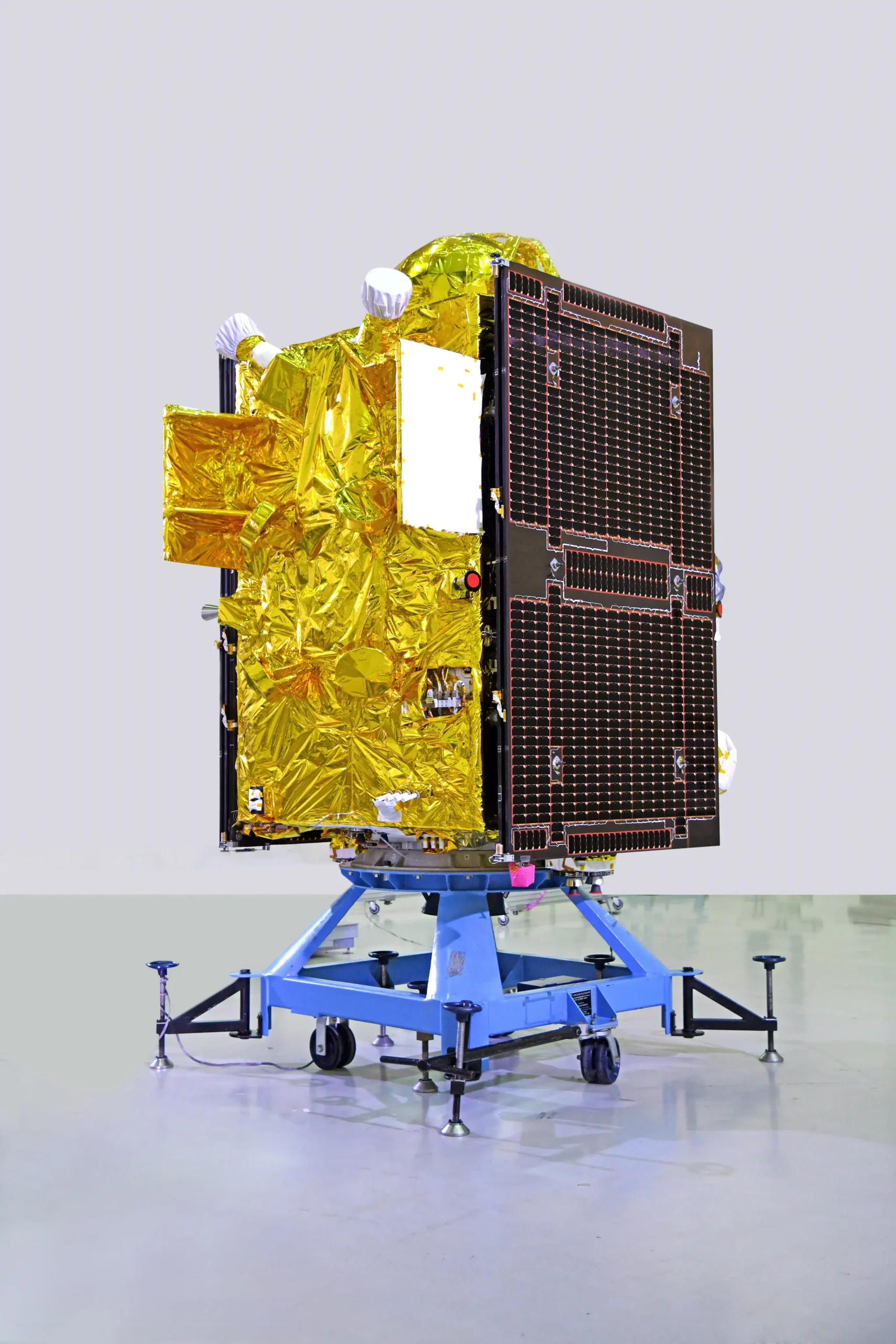
NVS-03 carries an indigenous Rubidium atomic clock alongside procured units, and transmits across the L1, L5, and S bands — adding the L1 civilian signal that lines NavIC up with the frequencies used by GPS, Galileo, and other global systems, making it easier for ordinary consumer chipsets to pick it up. Narayanan tied the clock specifically to ISRO’s “one nation, one time” push: a domestically-built atomic clock, now flying operationally, that doesn’t depend on an imported component some other country could restrict.
The NavIC Constellation, Satellite by Satellite
NavIC’s second generation is a work in progress, satellite by satellite. Here’s where each stands as of early November 2026:
| Satellite | Status | Notes |
|---|---|---|
| NVS-01 | Operational since 2023 | First of the second-generation NVS series; carries an indigenous atomic clock. |
| NVS-02 | Non-operational | Suffered a propulsion anomaly in January 2025 that left it unable to reach its intended orbit. |
| NVS-03 | Orbit-raising (launched Oct 30, 2026) | NVS-03 orbit raising underway; healthy after its first LAM burn Oct 31; en route to 111.75°E. |
| Older IRNSS satellites | Mixed; several past design life | The first-generation constellation NVS satellites are gradually replacing. |
That table is also the honest answer to “is NavIC fixed now?” It’s closer to fixed than it’s been since NVS-02’s failure, but NVS-03 restores the minimum operational count, not a comfortable margin above it. ISRO still has more NVS-series satellites planned to give the constellation real redundancy.
What’s Left Before NVS-03 Goes Live
ISRO hasn’t published a commissioning date for the NVS-03 orbit raising campaign, and we’re not going to invent one. What’s publicly known is the normal sequence any geostationary satellite goes through from here:
- More LAM burns as NVS-03 orbit raising continues over the coming days/weeks, circularizing the orbit and parking the satellite at its 111.75°E slot.
- In-orbit testing of the payload — checking the atomic clocks, the L1/L5/S signal transmissions, and attitude control — before the satellite is declared fit for service.
- Formal integration into the NavIC signal-in-space, after which receivers begin using NVS-03’s signal alongside the rest of the constellation.
If ISRO’s past NVS launches are any guide (NVS-01 took a few weeks from launch to entering service), expect NVS-03 to go from “healthy in transfer orbit” to “operational” sometime over the following weeks rather than days. We’ll update this piece, and our NVS-03 explainer, once ISRO confirms it.
We’ll keep this page updated as NVS-03 orbit raising continues and ISRO releases more milestones on the way to a confirmed in-service date.
Frequently Asked Questions
Did the NVS-03 launch succeed?
Yes. GSLV-F18 launched NVS-03 on October 30, 2026, at 23:51 IST, and placed it into its intended geosynchronous transfer orbit. ISRO confirmed the satellite is healthy and has completed its first orbit-raising burn.
Is NVS-03 operational yet?
Not yet. NVS-03 orbit raising is still in progress, moving toward its final geostationary slot at 111.75°E. ISRO has not announced a commissioning date; satellites in this class typically take a few weeks from launch to entering service.
What orbit is NVS-03 in right now?
After its first Liquid Apogee Motor burn on October 31, 2026, NVS-03’s orbit is estimated at roughly 5,477.6 km x 37,833.4 km, up from its injection orbit of 170.3 km x 38,080 km. Further burns will circularize it into a geostationary orbit.
How does NVS-03 fix NavIC?
A propulsion anomaly on NVS-02 in January 2025 left NavIC with only three fully functional second-generation satellites, short of the four needed for independent positioning. NVS-03 restores that fourth satellite, returning NavIC to its minimum operational configuration.
What was unusual about how ISRO flew this mission?
ISRO flew NVS-03 with its pyrotechnic propellant valves already open rather than firing them after separation — a first the agency highlighted as reducing risk during the satellite’s most vulnerable early hours in orbit.
What signals does NVS-03 transmit?
NVS-03 transmits on the L1, L5, and S frequency bands, using an indigenous Rubidium atomic clock alongside procured units. The L1 signal brings NavIC in line with frequencies used by GPS and other global navigation systems, widening consumer chipset support.