
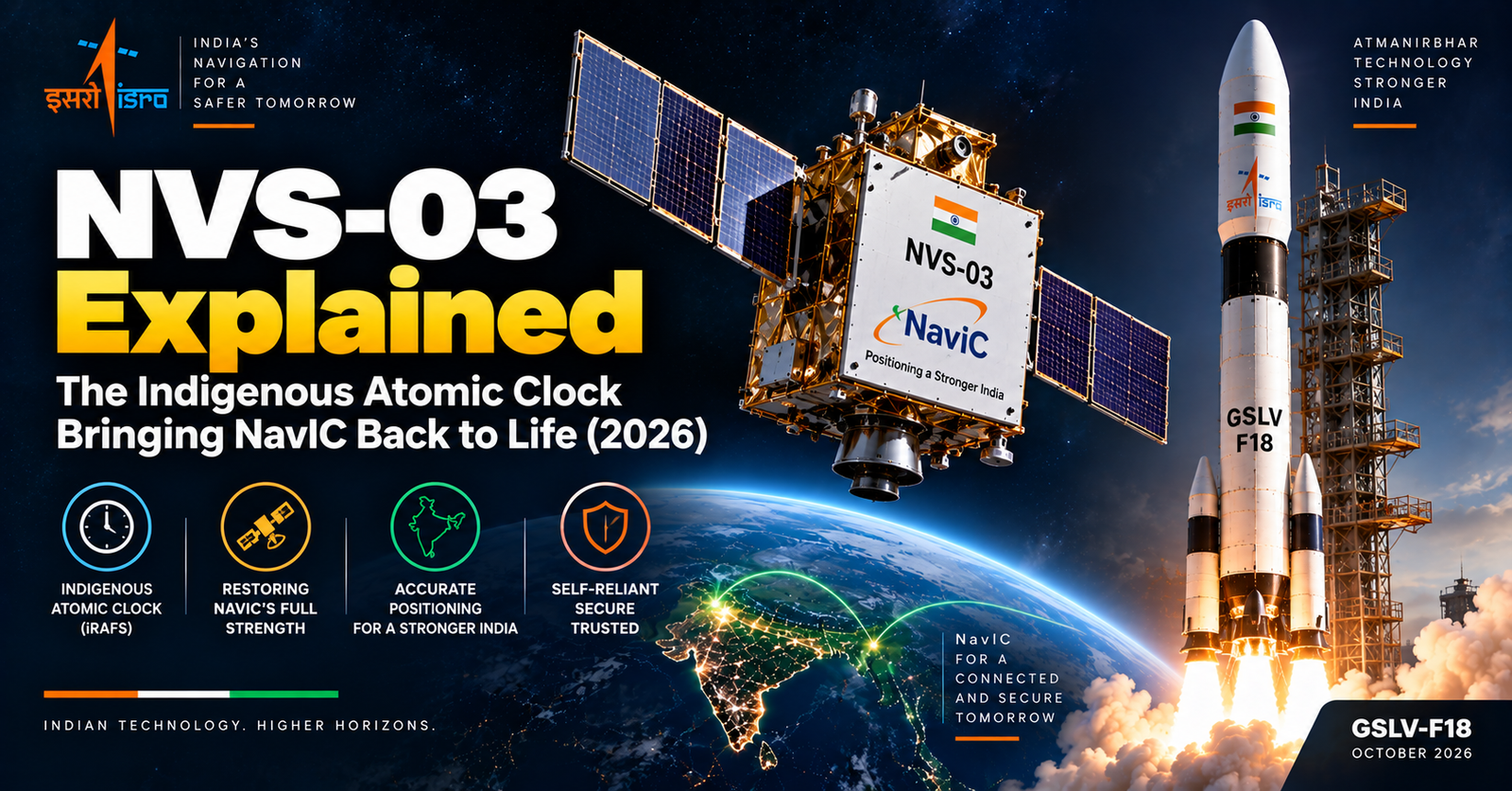
- Satellite
- NVS-03 (IRNSS-1L)
- Launch vehicle
- GSLV-F18
- Launch window
- October 2026
- Launch site
- SDSC SHAR, Sriharikota
- Mass
- 2,232 kg
- Target orbit
- Geosynchronous, 129.55°E
- Atomic clock
- Indigenous Rubidium (iRAFS)
- Design life
- 12 years
What Is NVS-03 and Why Does It Matter?
NavIC has been running on borrowed time for months. Our deep dive on NavIC’s trouble covered how the constellation fell to just three satellites capable of full navigation service, one short of the four needed for a standalone fix. NVS-03 is ISRO’s answer to that gap: the next second-generation NavIC satellite, built to fly on a GSLV-F18 rocket in October 2026, carrying the fourth working satellite the system has been waiting for.
NVS-03 also carries the older designation IRNSS-1L, continuing the original Indian Regional Navigation Satellite System naming scheme even though it belongs to the newer, more capable NVS family. Once in orbit, NVS-03 will transmit navigation signals across three frequency bands, L1, L5 and S, the same trio that lets a single NavIC satellite serve everything from farm equipment to fishing boats to a phone in your pocket.
If NVS-03 reaches its slot and starts broadcasting cleanly, NavIC moves from three working satellites to four, restoring standalone positioning for the first time since IRNSS-1F aged out of service earlier this year. That is the headline. The more interesting story is what ISRO changed inside NVS-03 to make sure it actually gets there.
The Atomic Clock Story: From Swiss Failure to Indian Comeback
NavIC exists because of a very specific moment in 1999: during the Kargil conflict, the United States declined to share GPS data for the exact stretch of territory India needed it most. That refusal is why India built its own constellation, approved in May 2006 and launched as seven IRNSS satellites between 2013 and 2018, each one carrying three imported Swiss rubidium atomic clocks for redundancy.
The redundancy did not hold. All three clocks on IRNSS-1A failed outright. More followed on other satellites. By 2018, nine of the constellation’s 24 imported clocks had stopped working, and by 2025 five of the original seven IRNSS satellites were completely defunct. A navigation system is only as good as the clock counting its nanoseconds, and India’s first-generation clocks kept running out of nanoseconds to count.
ISRO’s answer was to stop importing the problem. Scientists and engineers at the Space Applications Centre in Ahmedabad, led by Dr. Thejesh N Bandi, spent roughly seven years building an Indian Rubidium Atomic Frequency Standard, or iRAFS, from the ground up. Bandi has since called it the fastest development of a space-grade atomic clock anywhere in the world. The finished unit weighs 7.5 kg, draws under 40 watts, fits inside a 17-litre housing, and matches the stability of the imported clock it replaced, roughly two parts in a trillion.
NVS-01 carried the first iRAFS into orbit in May 2023, and it has run since with zero frequency jumps, the exact failure mode that crippled the earlier constellation. NVS-03 carries the same indigenous clock, this time as the satellite meant to actually restore NavIC’s four-satellite minimum.
The economics matter too. ISRO estimates each indigenous iRAFS unit saves roughly Rs 3 crore over the imported alternative it replaces, money that stays inside India’s own supply chain instead of flowing to a foreign vendor whose clocks had already let the programme down once. The one lingering dependency is that iRAFS still relies on some imported components, a gap ISRO has flagged as a reason earlier NVS launches slipped, and one more thing NVS-03’s success would help put to rest.
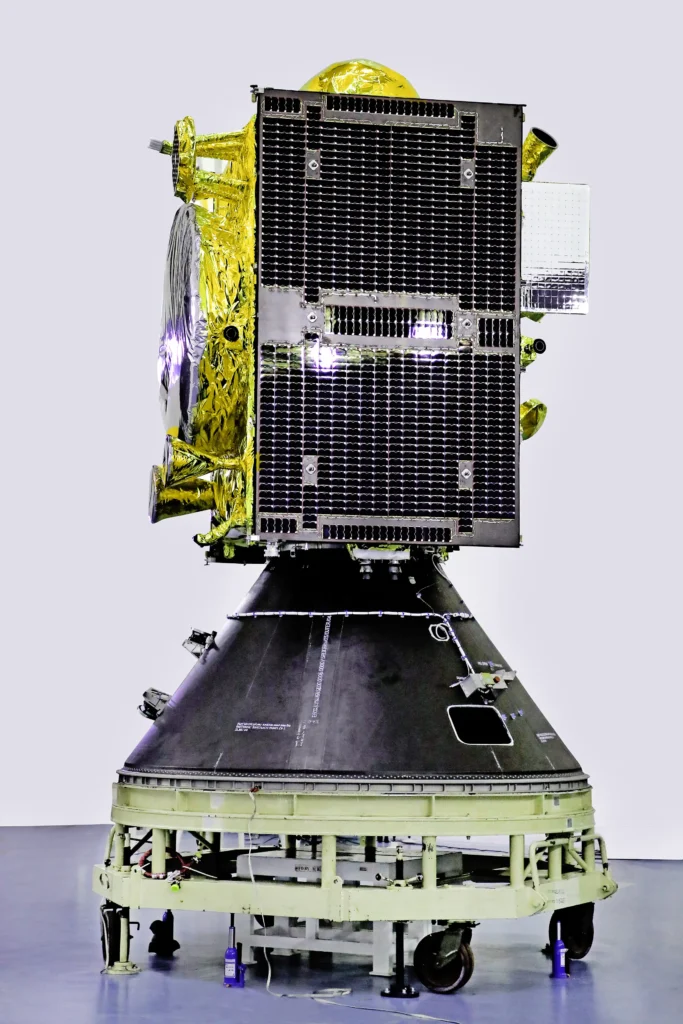
Inside NVS-03: Specs and Mission Profile
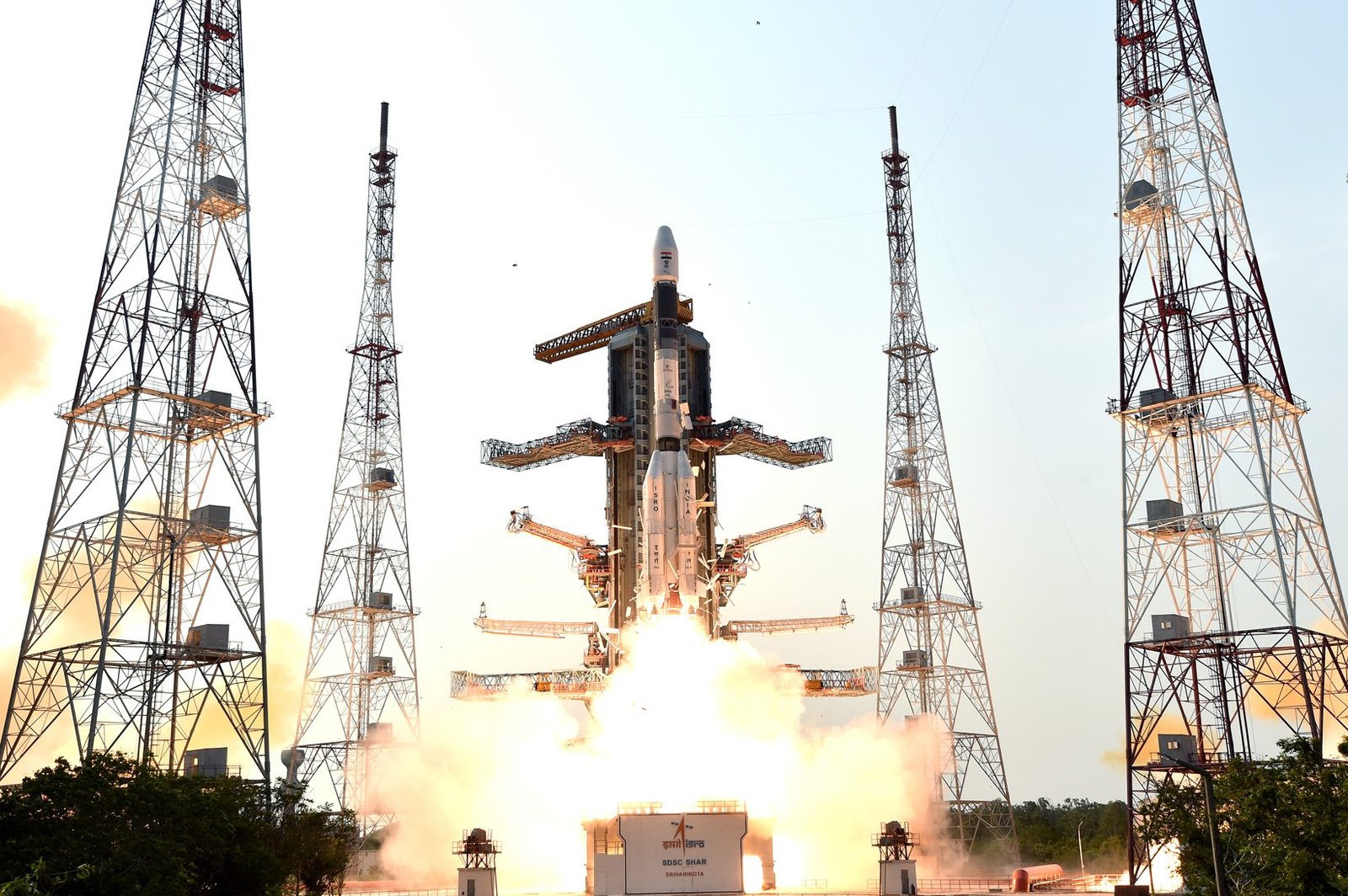
NVS-03 launches on a GSLV Mk II rocket, flight number GSLV-F18, from the Second Launch Pad at Satish Dhawan Space Centre in Sriharikota. ISRO has narrowed the window to mid-October 2026, with stacking of the rocket’s stages already underway ahead of a final confirmed date.
The satellite itself weighs 2,232 kg at launch. GSLV-F18 will place NVS-03 into a geosynchronous transfer orbit, after which the satellite fires its own propulsion system to climb into its final geostationary slot at 129.55° East, the same neighbourhood as the rest of the NavIC constellation. From there NVS-03 is designed to operate for 12 years.
Beyond the L1/L5/S navigation payload, NVS-03 carries a ranging payload with a CDMA transponder and an enhanced encryption system for India’s restricted-service users, mostly defence and government applications that need a version of NavIC that cannot be spoofed or intercepted as easily as the open civilian signal.
| Satellite | Launch date | Reached final orbit? | Current status |
|---|---|---|---|
| NVS-01 (IRNSS-1J) | 29 May 2023 | Yes | Operational, providing PNT service |
| NVS-02 (IRNSS-1K) | 29 Jan 2025 | No, propulsion failure | Stranded in transfer orbit, not operational |
| NVS-03 (IRNSS-1L) | ~Oct 2026 (planned) | Pending launch | Awaiting launch on GSLV-F18 |
The L1 addition is a quieter but genuinely practical upgrade. Older NavIC satellites broadcast mainly on L5 and S-band, which meant phones and trackers needed hardware built specifically for NavIC. L1 sits in the same frequency neighbourhood GPS, Galileo and other global systems already use, so a chipset that already listens for those signals can pick up NVS-03’s L1 broadcast with comparatively little extra engineering, which is exactly why NavIC has started showing up in mainstream smartphones and wearables rather than only specialist receivers.
Why NVS-02 Failed and What ISRO Changed
NVS-02’s story is why NVS-03 carries so much weight. Launched on GSLV-F15 in January 2025, as ISRO’s 100th mission, the rocket did its job perfectly and placed NVS-02 exactly where it was supposed to go. What failed came after separation: the valves meant to let oxidiser into the satellite’s own orbit-raising engine never opened. ISRO’s investigation traced it to a drive signal that never reached the valve, most likely because of a disengaged connector somewhere in the electrical path. Without that manoeuvre, NVS-02 never left its transfer orbit and has been listed as not operational since.
ISRO formed an Apex Committee to dig into the failure and came back with changes to how future spacecraft wire their pyro systems for redundancy. Those fixes already flew once, on CMS-03 aboard LVM3-M5 in November 2025, before NVS-03 became the second spacecraft carrying them. It is a small, unglamorous fix, more reliable connectors and cleaner redundancy, but it is exactly the kind of change that decides whether NVS-03 becomes NavIC’s fourth working satellite or its second satellite stuck in the wrong orbit.
The Road After NVS-03: NVS-04, NVS-05 and a Sustainable NavIC
NVS-03 is not meant to be the end of the rebuild. ISRO’s Science and Technology Minister has confirmed that NVS-04 and NVS-05 are already in advanced stages of production and are expected to follow NVS-03 into orbit, one after another rather than years apart. The eventual goal is a seven-satellite base layer for NavIC, restoring not just the bare four-satellite minimum but real redundancy above it.
That redundancy matters because four satellites is a floor, not a comfortable margin. A single clock glitch or another propulsion anomaly could push NavIC back below standalone-positioning strength again, exactly what happened after IRNSS-1F aged out. NVS-04 and NVS-05 are what turn NVS-03 from a one-time fix into an actual sustainable constellation.
Why Getting This Right Matters Beyond Your Phone
Nobody’s Google Maps route is riding on NVS-03. Multi-constellation GNSS chips already blend NavIC with GPS, Galileo and the rest, so ordinary phones barely notice which system is doing the work in a given moment. What NVS-03 is actually restoring is India’s ability to run its own independent Position, Navigation and Timing layer, one where ISRO answers to no other government’s priorities, the same way GPS answers to Washington, GLONASS to Moscow, Galileo to Brussels, and BeiDou to Beijing.
That independent layer already underwrites things far more specific than turn-by-turn directions: real-time train tracking across the Indian Railways network, distress messaging for fishing vessels in the Bay of Bengal and Arabian Sea, disaster alerts, and precise national timing that financial and telecom networks quietly depend on. None of it requires NavIC to be the only system in the mix. All of it gets more resilient once NavIC can stand on its own again, which is the entire point of getting NVS-03 right this October.
FAQ’s
When will NVS-03 launch?
ISRO has targeted an October 2026 launch window for NVS-03, flying on a GSLV-F18 rocket from Satish Dhawan Space Centre. Stacking of the rocket was underway as of September 2026, with an exact date to be confirmed closer to launch.
What is NVS-03’s other name?
NVS-03 also carries the designation IRNSS-1L, continuing India’s original Indian Regional Navigation Satellite System naming convention alongside the newer NVS branding used for second-generation satellites.
Will NVS-03 fix NavIC completely?
NVS-03 restores the four-satellite minimum NavIC needs for standalone positioning, but four satellites is still a bare minimum with little redundancy. NVS-04 and NVS-05 are needed after NVS-03 for a genuinely stable constellation.
What makes NVS-03’s atomic clock different from earlier NavIC satellites?
NVS-03 carries an Indian-built Rubidium Atomic Frequency Standard (iRAFS) developed by ISRO’s Space Applications Centre, replacing the imported Swiss clocks whose repeated failures crippled the original IRNSS constellation.
Why did NVS-02 fail?
NVS-02 reached its transfer orbit successfully but could not fire its own propulsion system to climb to its final orbit, after a drive signal failed to reach a critical valve. ISRO traced this to a likely disengaged electrical connector and has since fixed the underlying design ahead of NVS-03.
How is NVS-03 different from GPS?
NVS-03 is one satellite in NavIC, India’s own regional navigation system, whereas GPS is a US-owned global constellation. NavIC covers India and roughly 1,500 km beyond its borders, and unlike GPS, India controls NavIC end to end.
What comes after NVS-03?
ISRO plans to launch NVS-04 and NVS-05 in the missions following NVS-03, working toward a seven-satellite base layer for NavIC that gives the constellation real redundancy rather than just the bare four-satellite minimum.