
- Developed by
- ISRO
- Programme
- Gaganyaan
- Type
- Semi-humanoid robot
- Name meaning
- Vyoma (space) + Mitra (friend)
- Build
- Head, torso, two arms
- Role
- Cabin & life-support test passenger
- Coordinating body
- Human Space Flight Centre
- Precursor flight announced
- 2024
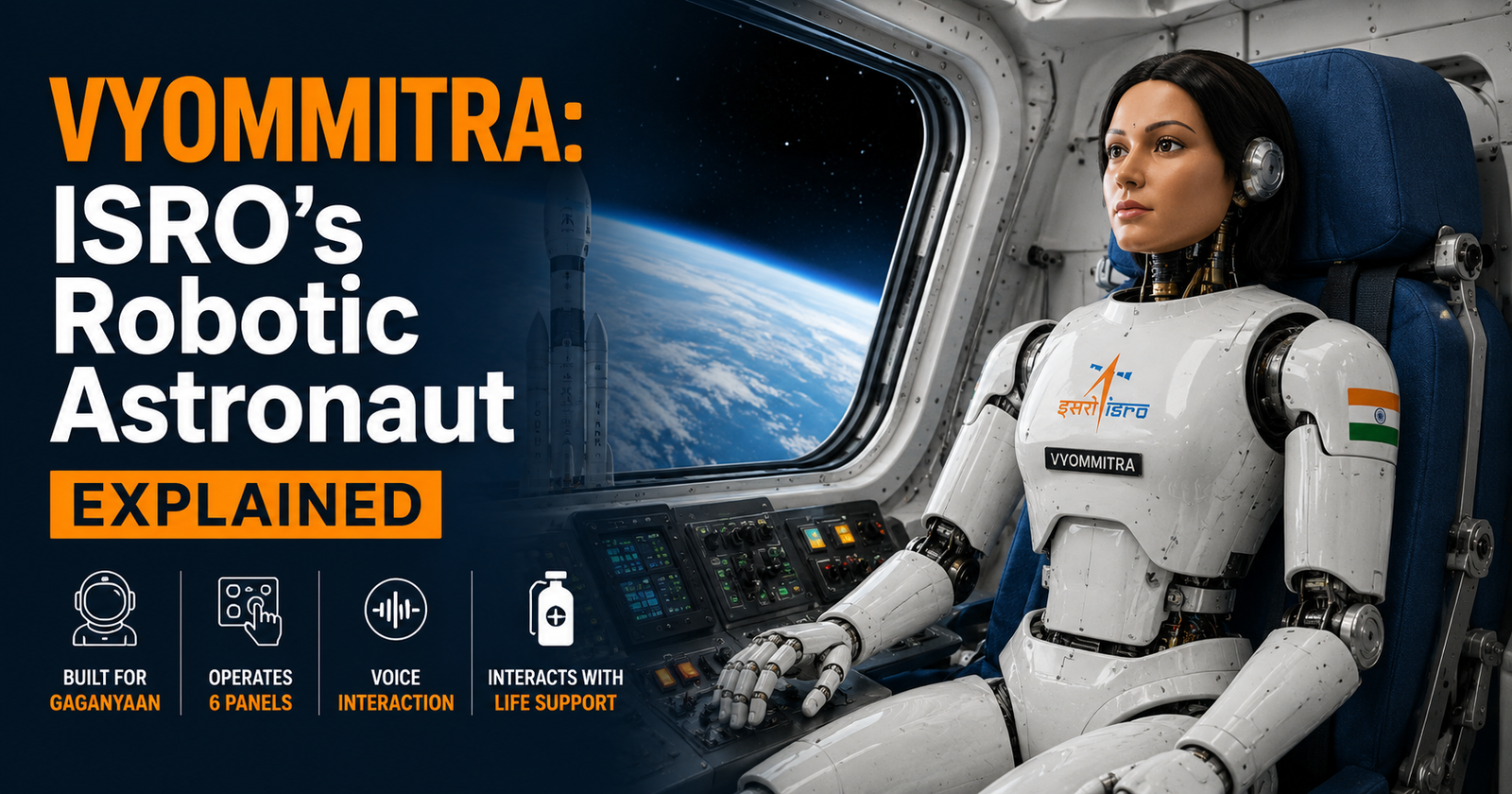
Vyommitra is a semi-humanoid robot designed by ISRO for India’s Gaganyaan human-spaceflight programme. It is not meant to replace an astronaut or make independent scientific discoveries like a human researcher. Its practical job is to help engineers test how the spacecraft, life-support systems and onboard controls behave before people fly inside them.
The name combines the Sanskrit words Vyoma, meaning space, and Mitra, meaning friend. ISRO has presented Vyommitra as a machine that can simulate selected human functions, interact with spacecraft systems and communicate with mission control.
What Is Vyommitra?
Vyommitra is a female-looking robotic astronaut with a head, torso and two arms. It is called semi-humanoid because it has a human-like upper body, but it is not built as a walking robot.
Its role is closer to an instrumented test passenger than a science-fiction android. By placing it in an uncrewed spacecraft, ISRO can observe whether cabin equipment, displays and emergency procedures work as expected in the space environment before risking astronauts.
Why Did ISRO Develop a Robotic Astronaut?
Human spaceflight has a smaller margin for error than an ordinary satellite mission. A crewed spacecraft must control pressure, temperature, oxygen, carbon dioxide, power, communications and many other conditions while also giving astronauts a safe way to return to Earth. Gaganyaan therefore includes precursor missions and uncrewed tests to prove the technology before the crewed flight.
Vyommitra adds a human-oriented test layer. A computer can report whether a sensor is switched on, but a robot designed to mimic selected human actions can also test panels, respond to commands and interact with life-support equipment. That helps engineers find problems in the relationship between people, hardware and software.
How Does Vyommitra Work?
According to the Ministry of Science and Technology’s 2024 description, Vyommitra can monitor module parameters, issue alerts, operate six panels and respond to queries. The same release said the robot was designed to simulate human functions in space and interact with the life-support system. These are specific engineering tasks, not evidence that the robot has human-like consciousness.
ISRO has also demonstrated the robot’s voice and robotics capabilities. During a review at the Vikram Sarabhai Space Centre, the organisation said Vyommitra interacted through voice commands in Hindi. In a mission setting, such interfaces could allow ground teams to check whether the robot recognises instructions and reacts correctly while the spacecraft is uncrewed.
The robot’s sensors and onboard computing are important here. They can help record the cabin environment and the machine’s own responses, while mission controllers compare those results with the spacecraft’s expected behaviour. Public descriptions do not provide a complete technical specification, so claims about advanced artificial intelligence or fully autonomous decision-making should be treated carefully.
Why Is Vyommitra Important for Gaganyaan?
Gaganyaan aims to demonstrate India’s ability to send a crew of three to a 400-kilometre orbit for a short mission and bring them safely back to Indian sea waters. The programme includes a human-rated launch vehicle, a crew escape system, a habitable crew module and life-support technology.
Vyommitra cannot certify the entire mission by itself. However, its flights can expose practical problems in cabin operations before astronauts are aboard. A successful robotic test does not guarantee a successful crewed mission; it is one part of a much wider safety and qualification process.
What Is India’s Role in Space Robotics?
Vyommitra shows that India’s human-spaceflight effort is not limited to building a bigger rocket. It also involves human factors, crew interfaces, life support, training and safety engineering. ISRO’s Human Space Flight Centre coordinates work across ISRO centres, research laboratories, universities and industry for Gaganyaan.
This type of robot also gives Indian engineers experience in designing machines that must operate around people, interpret commands and work with complex spacecraft systems. Future applications should not be presented as confirmed plans unless ISRO announces them.
What Are Vyommitra’s Limitations?
Vyommitra is not an astronaut, a general-purpose household robot or a substitute for crew training. It cannot reproduce every physical, emotional and decision-making demand placed on a human in orbit. A robot can test a cabin, but it cannot fully represent how a trained astronaut will respond to illness, fatigue or an emergency.
There is also a communication limit. Public statements describe selected functions, but they do not establish that Vyommitra can independently manage every spacecraft fault. The safe editorial position is to describe its announced capabilities and avoid turning the word “AI” into a claim of human-level intelligence.
What Happens Next for Vyommitra?
The next meaningful milestone is not a dramatic robot performance; it is the evidence from uncrewed Gaganyaan testing. ISRO says unmanned precursor missions are intended to prove safety and reliability before the human mission. Dates for individual flights should be described as targets or plans until confirmed in an official mission announcement.
Vyommitra is best understood as a bridge between laboratory testing and human spaceflight. It helps ISRO ask a basic but vital question: can the spacecraft keep a human safe, and can its controls and life-support systems be used reliably in space?
FAQs
Is Vyommitra a real astronaut?
No. Vyommitra is a robotic test platform developed for Gaganyaan. It is designed to simulate selected human functions and interact with spacecraft systems; it is not a human crew member.
Can Vyommitra walk like a human?
Public descriptions identify Vyommitra as a semi-humanoid robot with a human-like upper body. Its announced role is to operate panels, respond to queries, monitor spacecraft parameters and interact with life support, not to walk around the spacecraft.
Will Vyommitra fly before Gaganyaan astronauts?
The Ministry of Science and Technology announced an uncrewed Vyommitra flight ahead of the crewed Gaganyaan mission in 2024. The timing in that older announcement should not be treated as a current launch date. ISRO’s broader Gaganyaan plan includes uncrewed precursor missions before the human flight.