
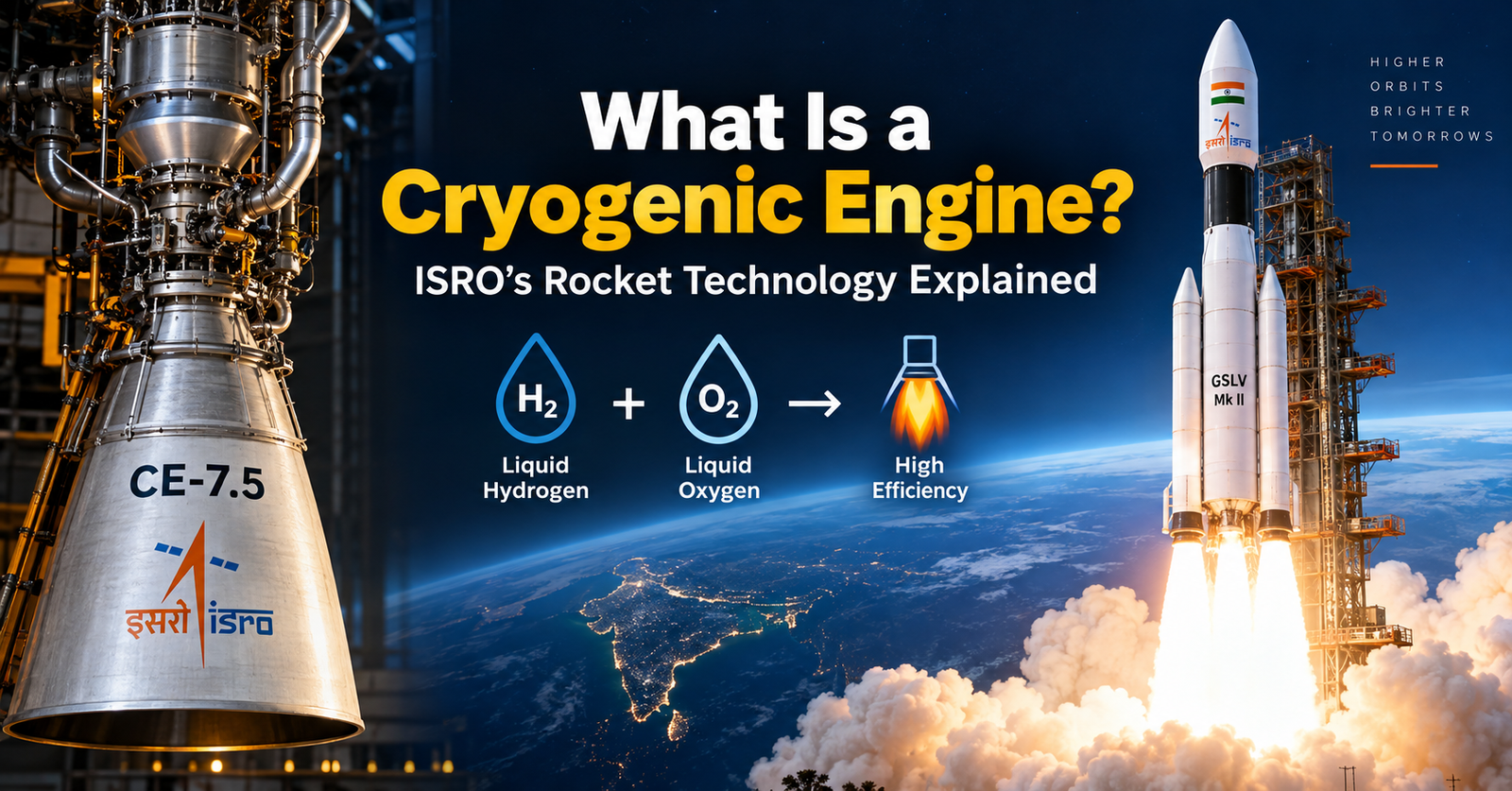
What Is a Cryogenic Engine?
A cryogenic engine is a rocket engine that uses propellants kept at extremely low temperatures, usually liquid hydrogen as fuel and liquid oxygen as the oxidiser. In simple terms, it burns very light hydrogen with oxygen to create hot, expanding gases that rush through a nozzle and push the rocket upwards.
The word “cryogenic” refers to the very cold conditions needed to keep these propellants in liquid form. This is not a separate type of rocket fuel by itself; it describes the technology needed to store, feed and burn substances such as liquid hydrogen and liquid oxygen in a launch vehicle.
Why Were Cryogenic Engines Developed?
Rockets need to carry their own fuel and oxidiser because there is no atmospheric oxygen in space. The more efficiently an engine uses each kilogram of propellant, the more mass a rocket can devote to its satellite or spacecraft. ISRO says cryogenic stages offer higher specific impulse, a measure of propulsion efficiency, than solid and earth-storable liquid stages, creating a payload advantage.
This is especially useful in the upper stage of a rocket. By the time an upper stage fires, the vehicle is already above much of the atmosphere, so its job is to provide the precise increase in speed needed to place a satellite into its intended orbit.
How Does a Cryogenic Engine Work?
The process begins with insulated tanks that keep liquid hydrogen and liquid oxygen cold. Pumps feed the propellants towards the combustion chamber, where they are mixed and ignited. The resulting gases expand rapidly and leave through the nozzle, producing thrust.
The engineering becomes difficult because liquid hydrogen is extremely low-density. A tank must hold a large volume of it, while seals, pipes, valves and turbopumps must work reliably at very low temperatures. The engine also has to manage a huge temperature difference: cryogenic propellants enter cold, while combustion creates intensely hot gases.
Different engines use different methods to drive their turbopumps. NASA describes an expander-cycle design in which liquid hydrogen cools the combustion chamber and nozzle, absorbs heat and becomes hydrogen gas; that gas then drives a turbine connected to the pump. ISRO’s CE-7.5, used in the indigenous cryogenic upper stage of GSLV Mk II, has a staged-combustion operating cycle.
Why Is a Cryogenic Engine Important?
The main advantage is efficiency. ISRO states that a cryogenic stage can provide more thrust for every kilogram of propellant burned than solid and earth-storable liquid stages.[2] NASA similarly explains that the liquid-hydrogen and liquid-oxygen combination produces high thrust for the amount of fuel consumed, which can leave a rocket with more payload capacity.
That advantage matters for demanding orbits. Communication satellites often need to reach geostationary transfer orbit before their own propulsion system raises them into a circular geostationary orbit. ISRO describes the cryogenic upper stage of GSLV as providing the high velocity needed for this transfer.
What Is India’s Cryogenic Engine Connection?
India developed the CE-7.5 under the Cryogenic Upper Stage Project, or CUSP. ISRO identifies it as the country’s first cryogenic engine and says it was developed by the Liquid Propulsion Systems Centre.
GSLV Mk II is a three-stage launch vehicle with four liquid strap-ons and an indigenous cryogenic upper stage. ISRO’s vehicle description says the indigenous stage was inducted from the GSLV-D5 mission onwards in January 2014. This development gave India an important capability for launching communication satellites into geosynchronous transfer orbit without depending entirely on an externally supplied upper stage.
What Are the Challenges of Cryogenic Engines?
The same properties that make cryogenic engines efficient also make them demanding. Liquid hydrogen is difficult to store because it is very light and requires exceptionally low temperatures. Small leaks, poor insulation or a problem in the ignition and turbopump systems can affect an entire launch.
The engine must also remain stable while switching from ground support equipment to onboard tanks and then operating in flight. Engineers have to test the stage repeatedly, check vibration and thermal loads, and ensure that the combustion process does not damage the chamber or nozzle.
For this reason, cryogenic propulsion programmes take years of research and qualification. A successful flight demonstrates not only thrust, but also control over a complete chain of difficult technologies.
What Happens Next for Cryogenic Propulsion?
Cryogenic engines will remain important wherever rockets need efficient upper-stage performance and substantial payload capacity. ISRO’s existing GSLV Mk II uses the CE-7.5 cryogenic upper stage, while the agency’s heavier launch vehicles use different cryogenic-stage designs for their own mission requirements.
The technology will continue to evolve through improvements in combustion, materials, sensors, manufacturing and reusability research. Specific future configurations and mission schedules should be treated as plans or targets until ISRO officially confirms them.
FAQ’s
Is a cryogenic engine the same as a nuclear engine?
No. A cryogenic engine is a chemical rocket engine. It burns very cold liquid propellants, such as liquid hydrogen and liquid oxygen; a nuclear engine would use energy from a nuclear reaction.
Why are liquid hydrogen and liquid oxygen used?
Together, they can deliver high propulsion efficiency. Their low-temperature storage requirements, however, make the tanks, plumbing and engine systems more complex than those used by many conventional propellants.
Which Indian rocket uses the CE-7.5 engine?
The CE-7.5 powers the indigenous cryogenic upper stage of ISRO’s GSLV Mk II. ISRO says the engine was developed under CUSP by the Liquid Propulsion Systems Centre.