
- Agency
- ISRO
- Launch date
- 14 Jul 2023
- Launch vehicle
- LVM3-M4
- Launch site
- SDSC SHAR, Sriharikota
- Landing date
- 23 Aug 2023
- Landing site
- ~69.37°S, near Manzinus crater
- Lander
- Vikram
- Rover
- Pragyan
- Mission cost
- ₹615 crore
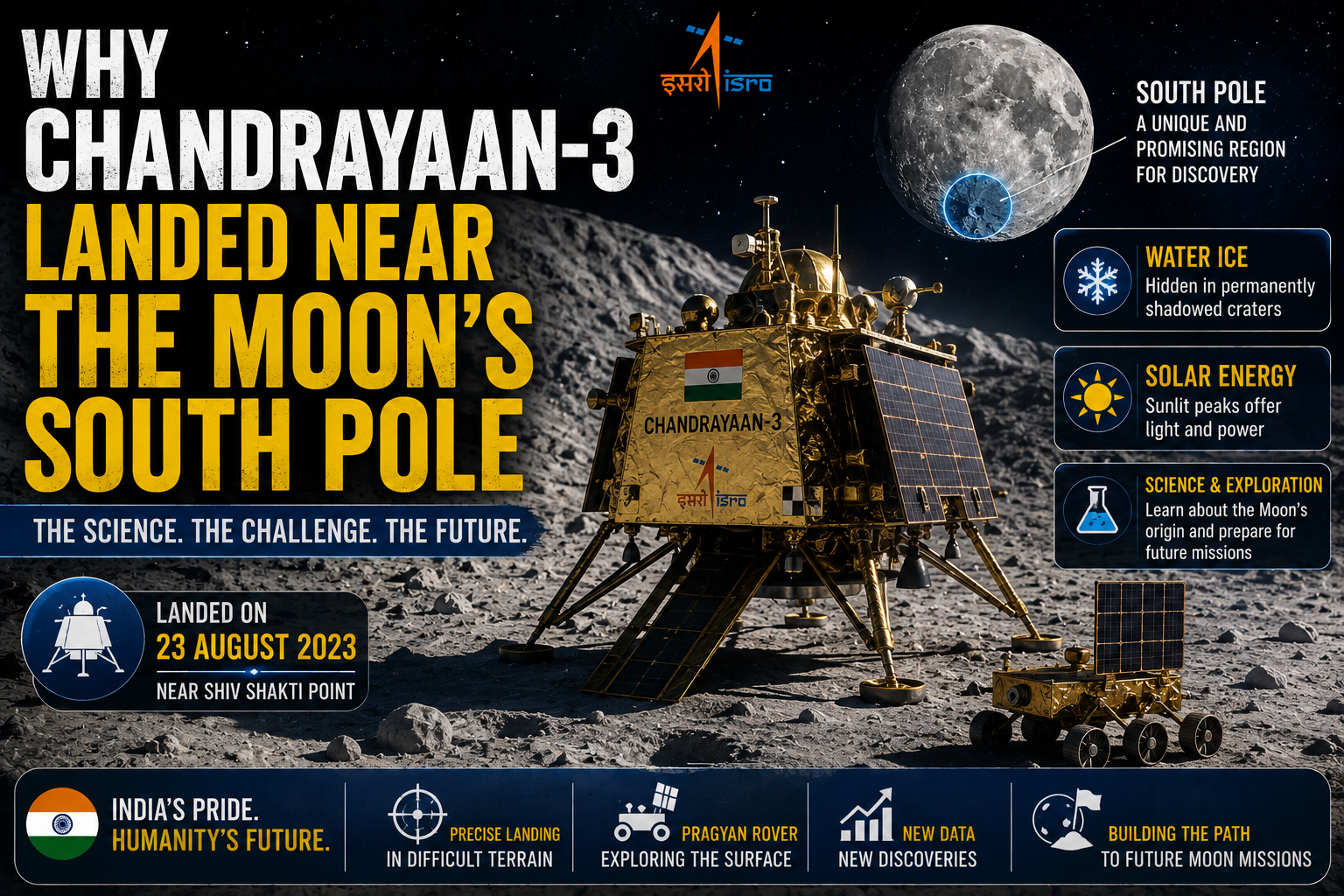
Chandrayaan-3 landed near the Moon’s south pole because the region offers a rare combination of scientific clues and future exploration value. Its permanently shadowed areas may preserve water ice, while the surrounding terrain can reveal how the Moon’s surface evolved. For India, the mission was also a practical test of landing and operating in one of the most difficult places to reach.
The Vikram lander touched down on 23 August 2023, carrying the Pragyan rover. ISRO designed Chandrayaan-3 to demonstrate a safe and soft landing, rover movement and in-situ experiments on the lunar surface.
What Makes the Lunar South Pole Different?
The Moon’s south polar region is not simply a colder version of the areas visited by earlier missions. The Sun stays very low above the horizon, and deep craters can remain in permanent shadow. Their floors may not receive sunlight for extremely long periods, allowing volatile materials such as water ice to survive.
At the same time, nearby ridges and crater rims may receive sunlight for much longer than the crater floors. That contrast creates an interesting environment: possible ice deposits in darkness and potential energy from sunlight on illuminated high ground. Scientists therefore study the region both as a natural laboratory and as a possible destination for later robotic or human missions.
Water on the Moon does not mean there are lakes or rivers waiting below the surface. NASA describes water in more subtle forms, including molecules in sunlit lunar soil and ice in permanently shadowed regions. Earlier observations, including measurements of hydrogen near the poles and the detection of water ice in impact debris, strengthened the case for lunar water.
Why Did ISRO Choose Such Difficult Terrain?
A south-pole landing offered Chandrayaan-3 a scientific opportunity that was different from repeating a landing in a smoother, more familiar area. The region’s unusual lighting, temperature conditions and geology can answer questions about lunar materials that are difficult to study elsewhere.
But the same features made the landing hazardous. The surface is uneven and filled with craters and boulders, according to the BBC’s account of the mission and the challenges of reaching the region. A lander must reduce its speed precisely, identify a safe patch and avoid obstacles during the final descent.
Chandrayaan-3 followed the unsuccessful Chandrayaan-2 landing attempt in 2019. ISRO’s follow-up mission included changes and additional capabilities intended to improve landing performance, including systems for measuring altitude, velocity and the terrain below the spacecraft.
How Did Chandrayaan-3 Study the Landing Site?
Chandrayaan-3 was more than a flag-planting exercise. Its lander carried instruments to measure temperature, thermal properties, near-surface plasma and seismic activity around the landing site. A NASA-provided laser retroreflector was also carried for lunar laser-ranging studies.
The rover carried two instruments for analysing the elemental composition of lunar soil and rocks near the landing area. One used X-rays and another used laser-induced breakdown spectroscopy. These measurements help scientists understand what the surface is made of without bringing those rocks back to Earth.
This is why the landing location matters. The instruments were not examining an abstract point on a map; they were investigating a polar landscape with distinctive shadows, slopes, rocks and thermal conditions. The data becomes more useful when it is connected to the wider environment around the lander.
Why Is the Chandrayaan-3 South Pole Landing Important?
The landing demonstrated that India could guide a spacecraft through a difficult descent and place it safely on the lunar surface. It also made India the first country to land in the lunar south-pole region, while joining the smaller group of nations that have achieved a soft landing on the Moon.
The achievement matters scientifically as well as technically. Measurements from the lander and rover can improve our understanding of the Moon’s crust, soil, temperature and local environment. They also add Indian observations to an international effort to understand polar water and plan responsible exploration.
Still, a successful landing is not proof that usable water has already been found at the site. The presence, depth, concentration and accessibility of polar ice remain scientific questions. Turning ice into a useful resource would require careful mapping, excavation technology, power and strict protection of the lunar environment.
What Is India’s Role in Future Lunar Exploration?
Chandrayaan-3 gives India experience in soft landing, surface mobility and small-scale lunar science. Those capabilities can support later missions, but each future mission will have its own engineering and scientific goals. A rover demonstration is not the same as building a permanent base or extracting resources.
The next step is to study the data, improve reliability and develop technologies suited to longer and more complex operations. The south pole will remain important because it combines scientific uncertainty with difficult operating conditions. Chandrayaan-3 showed that India can reach this region; future missions will help explain it in greater detail.
FAQs
Why is the Moon’s south pole important?
The south pole contains permanently shadowed areas that may preserve water ice. It also has unusual lighting, temperature and terrain conditions that make it valuable for lunar science.
Did Chandrayaan-3 find water on the Moon?
Chandrayaan-3 studied the lunar surface and its environment, but the landing itself should not be described as proof of easily usable water at the landing site. Lunar water exists in different forms, and polar ice needs further mapping and study.
Where did Chandrayaan-3 land?
The Vikram lander landed near the Moon’s south-pole region on 23 August 2023. ISRO describes the mission as a demonstration of safe landing, rover movement and in-situ experiments.