
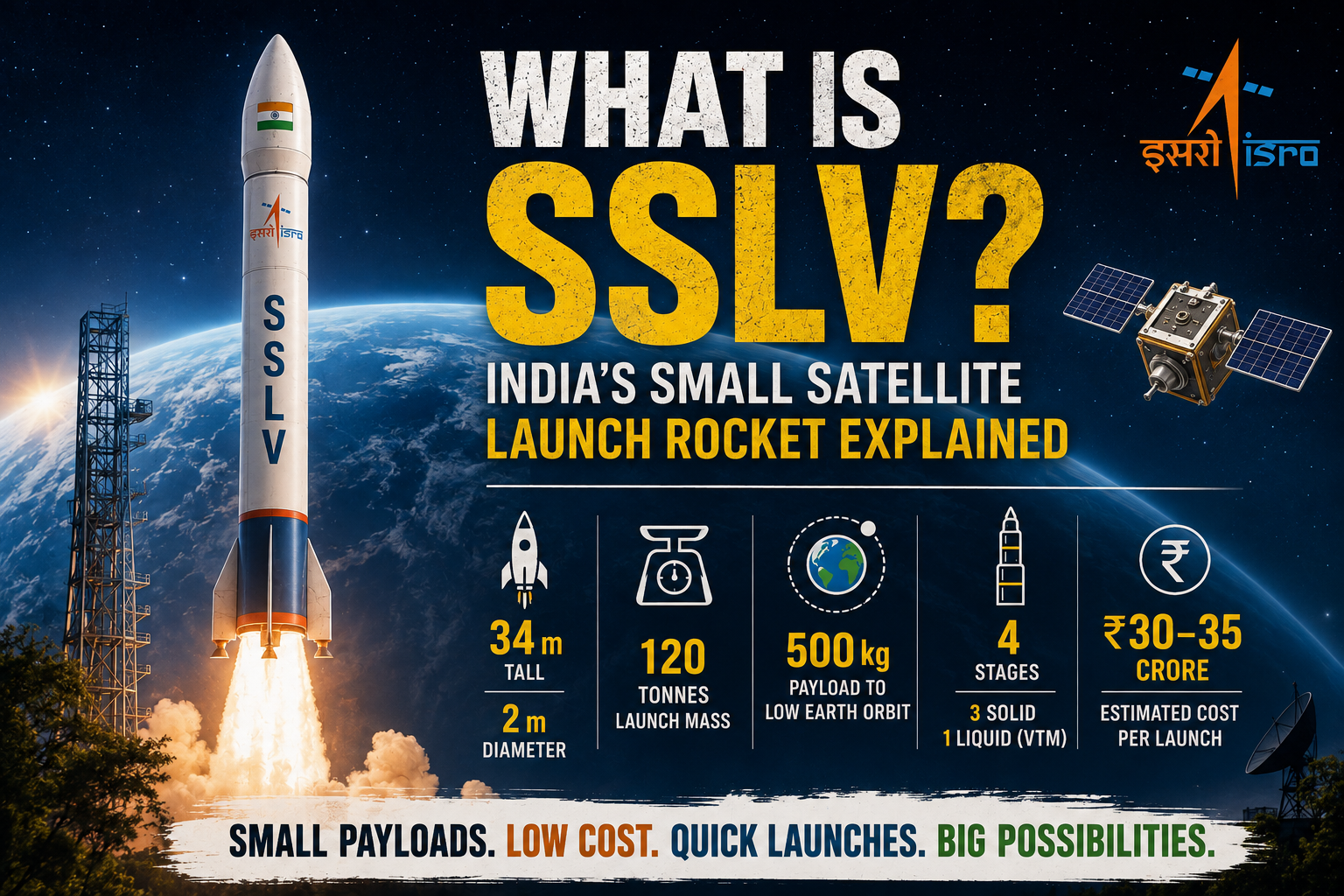
- Agency
- ISRO
- Full name
- Small Satellite Launch Vehicle
- Height
- 34 metres
- Diameter
- 2 metres
- Launch mass
- ~120 tonnes
- Stages
- 3 solid + VTM
- Payload to LEO
- ~500 kg
SSLV stands for Small Satellite Launch Vehicle, and it is India’s newest rocket. Built by ISRO, it does one job: carry small satellites into space quickly and at low cost. Think of it as the compact car of India’s launch fleet, far lighter than the PSLV, much faster to prepare, and aimed at a growing market the older rockets were too big for.
What Is SSLV?
SSLV is a 34-metre-tall rocket with a diameter of just two metres and a launch mass of about 120 tonnes. It has three solid-fuel stages and a small liquid-powered fourth module called the Velocity Trimming Module (VTM). Together they can place roughly 500 kilograms of payload into low Earth orbit, enough for a small Earth-observation satellite, a technology demonstrator, or a cluster of tiny cubesats.
Because every stage is solid except the final trimming module, the rocket is simpler to build and assemble than India’s liquid-fuelled workhorses. ISRO designed it so that a small team can prepare a launch in days rather than months.
Why Did India Build SSLV?
The small-satellite boom of the last decade created a new kind of customer. Universities, startups and companies began building satellites that weigh anywhere from a few kilograms to a few hundred — and they needed a ride that matched their size and budget.
The PSLV, India’s most reliable rocket, can lift far more mass than most small missions need. Booking a PSLV for a 200-kilogram satellite is like hiring a bus for two passengers: it works, but it is expensive and the waiting list is long. SSLV was built to fill that gap, a rocket sized for small payloads, cheap enough for startups, and quick enough for “launch on demand”.
How Does SSLV Work?
The first three stages do the heavy lifting, burning through solid propellant one after another to climb out of the atmosphere. The job of the Velocity Trimming Module is different: it makes small, careful corrections to the rocket’s speed near the end of the flight, nudging the payload into the exact orbit intended.
That final adjustment matters more than it sounds. In August 2022, on SSLV’s very first flight, the solid stages performed correctly but the rocket failed to trim its velocity precisely enough. The two satellites aboard were released into an orbit that decayed, and they burned up in the atmosphere days later. The lesson shaped the vehicle’s design, SSLV’s fourth stage exists precisely so that insertion errors can be corrected before the satellites are let go.
Why Is SSLV Important for India?
Cost is the headline. A single SSLV launch is expected to cost around ₹30–35 crore — a fraction of a typical PSLV mission. That number matters because India wants its small-satellite ecosystem to grow: startups, private companies and research institutions all need affordable access to space.
Speed matters too. The rocket is designed for rapid assembly, which means customers no longer have to wait behind large government missions. For a company testing a new sensor or a school launching a student-built satellite, a short wait can be the difference between a useful mission and an outdated one.
India’s ISRO Connection and the Private Sector Handover
SSLV’s flight history tells a familiar ISRO story of learning by doing. The first development flight, SSLV-D1 in August 2022, failed to reach the correct orbit. The second, SSLV-D2 in February 2023, succeeded and carried three satellites — EOS-07, Janus-1 and AzaadiSAT-2. The third, SSLV-D3 in August 2024, delivered the EOS-08 satellite and closed the development phase.
What happened next is the bigger story. In 2026, ISRO transferred SSLV’s technology and production rights to Hindustan Aeronautics Limited (HAL) after a competitive bidding process — the first time an ISRO launch vehicle has been handed over to industry to build and operate. ISRO’s chairman has said the agency will move away from manufacturing rockets altogether, focusing on research and new technology while companies like HAL take over production. SSLV is the proof that the shift has begun.
Challenges and Limitations
SSLV is not for every mission. Its payload capacity caps out around 500 kilograms to low Earth orbit, so heavy communication satellites and deep-space probes will keep flying on GSLV and LVM3. The vehicle also has only three flights behind it, two of them successful a short record compared with the PSLV’s decades of service. And now that production has moved to industry, the rocket’s reputation will depend on how consistently HAL can reproduce ISRO’s quality.
Competition is another factor. India’s private launch companies are building their own small rockets — Skyroot’s Vikram-1 reached orbit in July 2026. SSLV’s advantages are its proven ISRO design and the experience of a giant like HAL behind it.
What Happens Next?
The next few years will show whether the handover works. HAL is expected to build SSLV for commercial customers, including the growing number of Indian satellite startups. At the National Space Day celebrations in August 2026, ISRO Chairman Dr V Narayanan said India may need between 200 and 300 new satellites over the next five years, demand that small, quick rockets like SSLV are well placed to serve.
FAQs
Is SSLV the same as PSLV?
No. PSLV is ISRO’s larger workhorse rocket, capable of carrying payloads of more than a tonne to a variety of orbits. SSLV is a much smaller vehicle built for payloads of up to about 500 kilograms, with lower cost and faster turnaround. The two are designed for different kinds of customers.
How many satellites can SSLV carry at once?
It depends on their combined mass. SSLV can carry roughly 500 kilograms to low Earth orbit, so it can launch a single medium satellite or several small ones together. On its second flight it released three satellites — EOS-07, Janus-1 and AzaadiSAT-2 — in one mission.
Is SSLV the same as PSLV?
No. PSLV is ISRO’s larger workhorse rocket, capable of carrying payloads of more than a tonne to a variety of orbits. SSLV is a much smaller vehicle built for payloads of up to about 500 kilograms, with lower cost and faster turnaround. The two are designed for different kinds of customers.
How many satellites can SSLV carry at once?
It depends on their combined mass. SSLV can carry roughly 500 kilograms to low Earth orbit, so it can launch a single medium satellite or several small ones together. On its second flight it released three satellites — EOS-07, Janus-1 and AzaadiSAT-2 — in one mission.
Who builds SSLV now?
Hindustan Aeronautics Limited (HAL). ISRO transferred SSLV’s technology and production rights to the company in 2026 after a bidding process. ISRO remains the design authority and continues to develop new launch vehicles, while HAL produces the rocket for commercial missions.