
- Company
- Dhruva Space
- Founded
- 2012
- Founders
- Sanjay Nekkanti, Krishna Teja Penamakuru, Abhay Egoor & Chaitanya Dora Surapureddy
- Headquarters
- Hyderabad, India
- Focus
- Full-stack satellite manufacturing & space infrastructure
- 2026 funding raised
- ₹105 Cr (RDIF) + ₹60 Cr (Antariksh Fund)
- Latest deal
- €5M+ contract with Safran (Sept 2026)
- Manufacturing target
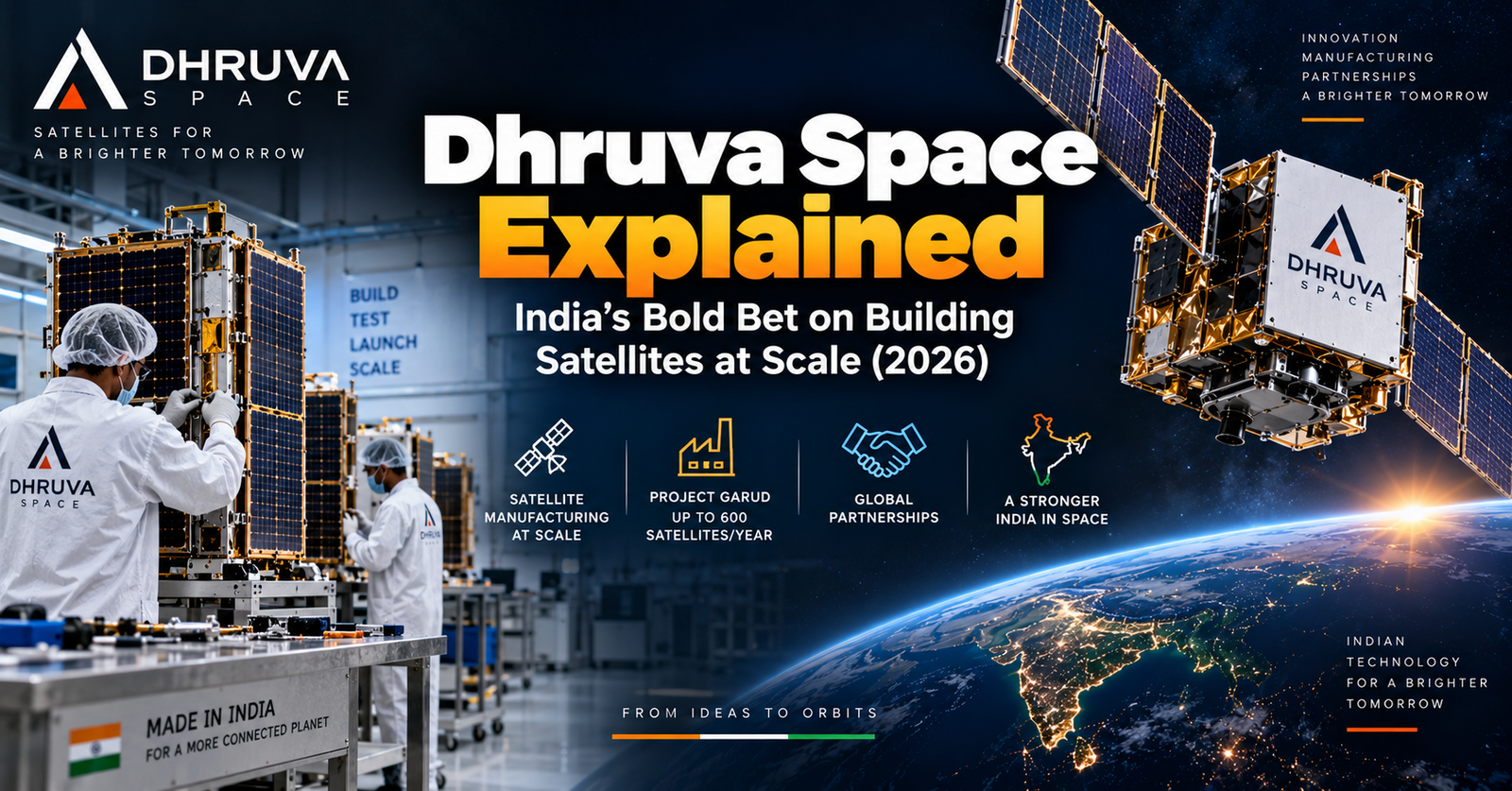
- Up to 600 satellites/year (Project Garud)
- What Is Dhruva Space?
- From Cleanroom Startup to Satellite Factory
- Project Garud: Satellites Built Like an Assembly Line
- India Backs Its Own: The Antariksh Venture Capital Fund
- The Safran Deal and India’s 52-Satellite Surveillance Push
- Dhruva Space vs India’s Other Space-Tech Startups
- Why Dhruva Space Matters for India’s Space Economy
- FAQ’s
What Is Dhruva Space?
Dhruva Space is a Hyderabad-based space engineering company that designs, builds, tests and operates satellites, along with the ground stations and orbital deployers that support them. It doesn’t stick to one narrow job. The company builds spacecraft platforms, solar arrays, ground infrastructure and launch integration, all under one roof.
Sanjay Nekkanti, Krishna Teja Penamakuru, Abhay Egoor and Chaitanya Dora Surapureddy founded the company back in 2012. For most of the next decade, they worked quietly, qualifying hardware on ISRO’s PSLV rockets and building credibility long before the funding and contracts that put Dhruva Space in the spotlight through 2026.
These days the company has moved well past supplying individual components. It now designs and sells entire small satellite buses under its LEAP product line, and it was also one of the first Indian private companies authorised by ISRO’s private space regulator, IN-SPACe, to offer commercial ground station services.
From Cleanroom Startup to Satellite Factory
Dhruva Space’s manufacturing story started small. Its first real base was a 22,000 square foot facility in Hyderabad’s Begumpet, built around two Class 10,000 cleanrooms, a Helmholtz cage for magnetic testing, and a mission control centre. That’s where the company’s early orbital deployers and satellite buses were put together and tested.
The hardware flew in stages, one mission at a time. A satellite orbital deployer got qualified on PSLV-C53 in June 2022. The Thybolt-1 and Thybolt-2 technology demonstration CubeSats followed on PSLV-C54 that November, then more deployers rode PSLV-C55 in April 2023. By January 2024, the company’s LEAP-TD nanosatellite platform had been space-qualified on PSLV-C58. In August 2025, its LEAP-1 commercial mission, carrying an Australian customer’s imaging payload, launched aboard a SpaceX Falcon 9.
Somewhere along the way, the ambitions grew. In October 2023, Dhruva Space announced a much bigger facility on the outskirts of Hyderabad, 280,000 square feet, with its first phase including a dedicated solar array assembly line. That expansion is what set up the company’s next chapter: building satellites at industrial scale instead of one at a time.
Project Garud: Satellites Built Like an Assembly Line
In May 2026, Dhruva Space secured ₹105 crore from India’s RDIF (Research, Development and Innovation Fund), a government initiative that backs deep tech manufacturing. It was among the first five startups to receive this kind of support, and the grant was formalised specifically to fund a new satellite platform initiative called Project Garud.
Project Garud is a modular, flat pack 500 kilogram class communications satellite platform. It’s designed to stack efficiently inside a rocket fairing and to work across low Earth orbit, medium Earth orbit and, eventually, geostationary missions too. The stated goal is a production cadence of roughly two satellites a day, or an annualised capacity of 500 to 600 satellites across different configurations, aimed at telecommunications, Earth observation and national security constellations.
Dhruva Space co-founder and CTO Abhay Egoor described the effort as “the industrialisation of satellite manufacturing from India,” positioning the company as a globally competitive spacecraft manufacturer rather than a boutique builder of one-off satellites.
India Backs Its Own: The Antariksh Venture Capital Fund
Two months later, on July 13, 2026, Dhruva Space became the first company to receive an investment from the Antariksh Venture Capital Fund, India’s sovereign space-tech fund. The fund is anchored by IN-SPACe and managed by SIDBI Venture Capital, and carries a target corpus of ₹1,600 crore, having crossed ₹1,000 crore at its first close. Dhruva Space’s tranche was ₹60 crore.
Arup Kumar, MD and CEO of SIDBI Venture Capital, said the fund’s first investment “reflects strong belief that the next generation of Space leaders will be built by companies that can integrate innovation, manufacturing, mission execution, and commercial deployment under one roof.” Co-founder Chaitanya Dora Surapureddy called it “a strong endorsement of Dhruva Space’s vision, execution, and long-term commitment to building sovereign Space capabilities from India.”
According to the company, the funds are earmarked for expanding satellite-manufacturing capacity, building out space infrastructure, and executing customer programmes both in India and abroad. Dhruva Space has said its total funds raised now stand at around ₹275 crore, split between roughly ₹150 crore in equity and ₹125 crore in debt, against what it describes as an order book of more than ₹500 crore. (Source: Dhruva Space press release)
The Safran Deal and India’s 52-Satellite Surveillance Push
The most recent development came at the International Space Summit in Paris on September 9-10, 2026, where French aerospace major Safran Space signed a contract worth more than €5 million (roughly ₹45 crore) with Dhruva Space. Under the deal, Safran will supply communication systems, inertial navigation units, optical payloads and ground stations to support Dhruva Space’s satellite production.
The hardware is destined for India’s Space-Based Surveillance-III (SBS-III) programme, a military satellite constellation approved by the Cabinet Committee on Security in October 2023. SBS-III comprises 52 satellites in total, 21 built by ISRO and 31 by private industry, carries a budget of roughly ₹26,968 crore, and is intended to sharpen India’s surveillance of its borders and the Indian Ocean Region, with the full constellation targeted for completion around 2029.
The Safran-Dhruva Space contract was one of three private-sector India-France space agreements announced at the summit, part of a broader package of roughly 51 announcements worth close to €20 billion between the two countries. It builds on Safran’s earlier contribution of parachute systems to ISRO’s Chandrayaan-3 mission. (Source: Business Standard)
Dhruva Space vs India’s Other Space-Tech Startups
India’s private space sector has grown into a small ecosystem of specialists, not one company trying to do everything at once. Dhruva Space builds the satellite itself, the “chassis” that carries a payload into orbit, while other startups focus on what sits on top of that chassis or on the rocket that gets it there. Pixxel, for instance, builds the hyperspectral cameras and runs the imaging business. It even partners with Dhruva Space as part of a Pixxel led consortium building India’s first privately led national Earth observation constellation. Agnikul Cosmos and Skyroot Aerospace, meanwhile, are focused on the launch vehicles that carry these satellites to orbit in the first place.
| Company | Focus Area | Founded | Founders | Signature Product/Deal |
|---|---|---|---|---|
| Dhruva Space | Satellite platforms & manufacturing | 2012 | Sanjay Nekkanti, Krishna Teja Penamakuru, Abhay Egoor & Chaitanya Dora Surapureddy | Project Garud 500 kg-class satellite platform |
| Pixxel | Earth observation / hyperspectral imaging | Feb 2019 | Awais Ahmed & Kshitij Khandelwal | Firefly & Honeybee satellite constellations |
| Agnikul Cosmos | Launch vehicles (3D-printed engines) | Dec 2017 | Srinath Ravichandran & Moin SPM | Agnibaan rocket |
| Skyroot Aerospace | Launch vehicles (solid-fuel) | 2018 | Pawan Kumar Chandana & Naga Bharath Daka | Vikram-series rockets |
Why Dhruva Space Matters for India’s Space Economy
On their own, none of Dhruva Space’s 2026 milestones would be all that remarkable. Put together, they tell a different story. A government backed venture fund choosing it as the very first bet, a deep tech grant aimed squarely at mass manufacturing instead of prototypes, and a European industrial giant signing on to supply parts for a defence constellation all point in the same direction. India’s private space sector is now being asked to build at the scale of dozens of satellites, not just one at a time.
That matters because programmes like SBS-III genuinely need 31 satellites from private industry. India’s own Earth observation ambitions, the constellation involving Pixxel, Dhruva Space and other partners, call for around a dozen more. None of that happens without a company that can actually produce satellites on something like an assembly line instead of hand building them one by one.
Whether Dhruva Space can really hit a cadence of two satellites a day is something that will be proven in hardware, not in press releases. Still, the fact that sovereign capital, deep tech grants and an established European supplier are all betting on that outcome in the same year says a lot about how seriously India now treats private satellite manufacturing. It isn’t a side project anymore. It’s being treated as national infrastructure.
FAQ’s
What does Dhruva Space do?
Dhruva Space is a Hyderabad-based space engineering company that designs, builds and operates satellites, satellite platforms, orbital deployers, solar arrays and ground stations, offering full-stack space infrastructure to commercial, government and defence customers.
What is Project Garud?
Project Garud is Dhruva Space’s initiative to build a modular, flat-pack 500-kilogram-class communications satellite platform designed for mass production, with a target cadence of roughly two satellites a day, funded by a ₹105 crore grant from India’s RDIF programme secured in May 2026.
How much money has Dhruva Space raised in 2026?
In 2026 alone, Dhruva Space secured ₹105 crore from RDIF for Project Garud in May, ₹60 crore from the Antariksh Venture Capital Fund in July, and a contract worth over €5 million (about ₹45 crore) with Safran Space in September, on top of a total raise the company puts at around ₹275 crore in equity and debt combined.
What is the Antariksh Venture Capital Fund?
The Antariksh Venture Capital Fund is India’s sovereign space-tech fund, anchored by IN-SPACe and managed by SIDBI Venture Capital, with a target corpus of ₹1,600 crore. Dhruva Space became its first-ever portfolio investment in July 2026.
What is SBS-III and why is Dhruva Space involved?
SBS-III (Space-Based Surveillance-III) is a 52-satellite Indian military surveillance constellation approved in 2023, with 21 satellites built by ISRO and 31 by private industry. Dhruva Space is involved through a September 2026 contract with France’s Safran Space to supply communication, navigation and optical hardware for the programme.
How is Dhruva Space different from Pixxel or Agnikul Cosmos?
Dhruva Space builds the satellite platform itself, the structural and electronic “bus” that carries a payload into orbit. Pixxel instead focuses on hyperspectral imaging payloads and data, while Agnikul Cosmos and Skyroot Aerospace build the rockets that launch satellites, making the three companies complementary parts of India’s private space supply chain rather than direct competitors.