
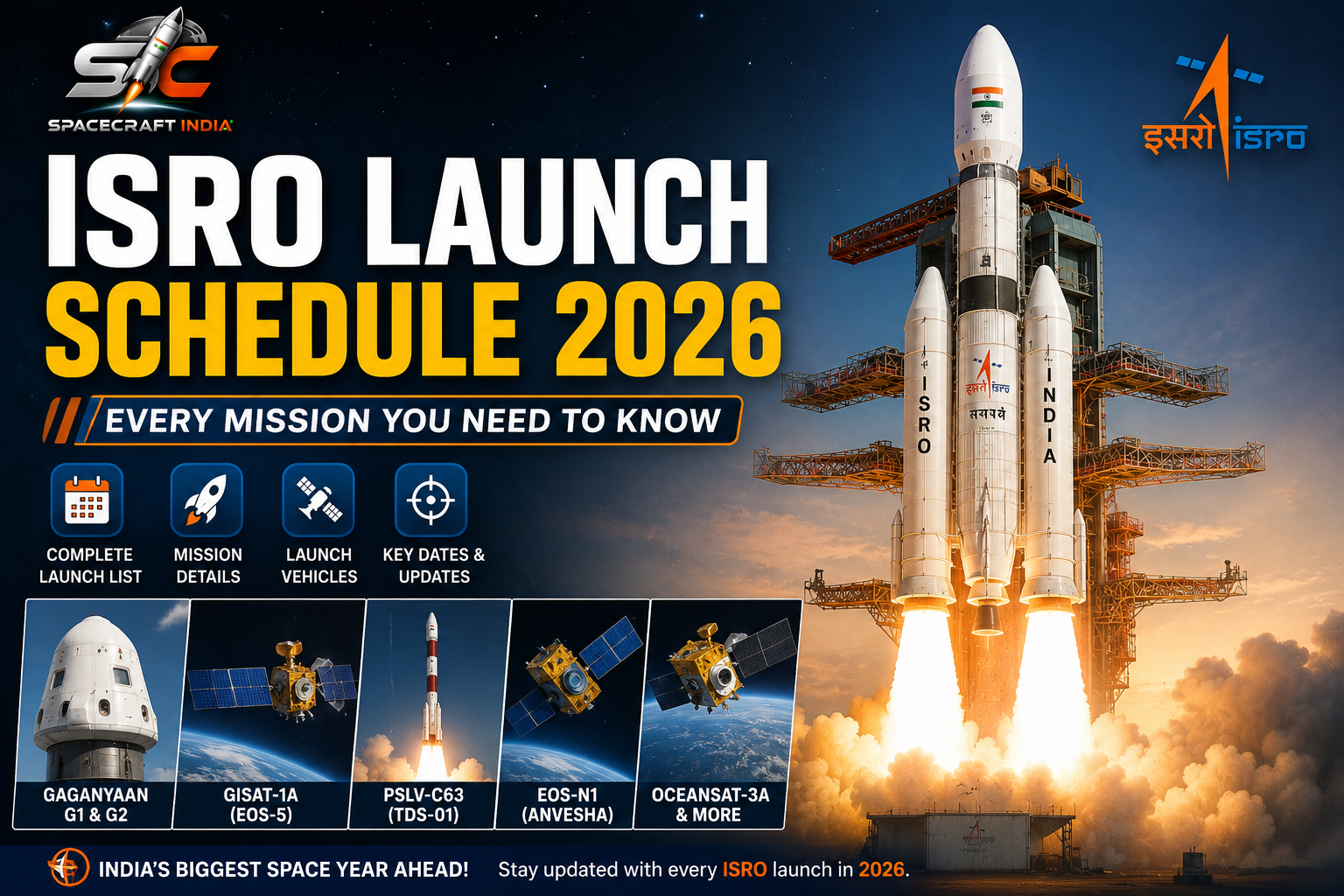
- Missions covered
- 7
- Timeframe
- 2026
- Agency
- ISRO
- Live tracker
- View schedule →
- ISRO Launch Schedule 2026 — Quick Overview
- Mission 1 — Gaganyaan G1: India’s Most Important Launch of 2026
- Mission 2 — GISAT-1A / EOS-5: India’s Geostationary Eye in the Sky
- Mission 3 — PSLV-C63 / TDS-01: Testing Tomorrow’s Space Technologies
- Mission 4 — EOS-N1 (Anvesha): India’s Hyperspectral Spy Satellite
- Mission 5 — Oceansat-3A: Watching India’s Oceans
- Mission 6 — NVS-02: Strengthening India’s GPS Alternative
- Mission 7 — Gaganyaan G2: The Second Uncrewed Test
- What Makes ISRO Launch Schedule 2026 Historic
- Frequently Asked Questions
Last Updated: June 2026
If you have been following India’s space programme, 2026 is the year you have been waiting for.
The ISRO launch schedule 2026 is the most ambitious in the agency’s history. From the first uncrewed test of India’s human spaceflight capsule to new Earth observation satellites and commercial launches for global clients — this is the year ISRO shifts from building capability to demonstrating it at scale.
This guide covers every confirmed and planned mission in the ISRO launch schedule 2026, what each mission does, which rocket carries it, and why it matters for India’s future in space.
Bookmark this page. We update it as launches happen.
ISRO Launch Schedule 2026 — Quick Overview
| Mission | Launch Vehicle | Target Date | Status |
|---|---|---|---|
| Gaganyaan G1 (Uncrewed) | HLVM3 | Q3 2026 | In preparation |
| GISAT-1A / EOS-5 | GSLV Mk II | July 2026 | Confirmed |
| PSLV-C63 / TDS-01 | PSLV | 2026 | Confirmed |
| EOS-N1 (Anvesha) | PSLV | 2026 | Confirmed |
| Oceansat-3A | PSLV (Industry-built) | 2026 | Confirmed |
| NVS-02 (NavIC) | GSLV | December 2026 | Planned |
| Gaganyaan G2 (Uncrewed) | HLVM3 | Late 2026 | Planned |
Mission 1 — Gaganyaan G1: India’s Most Important Launch of 2026
Of everything in the ISRO launch schedule 2026, this is the one the entire country is watching.
Gaganyaan G1 is the first uncrewed orbital test flight of India’s human spaceflight programme. It will carry Vyommitra — ISRO’s half-humanoid robot with female features — aboard the crew module of the Human-Rated LVM3 (HLVM3) rocket.
This is not just a test. It is the mission that determines whether Indian astronauts fly to space in 2027.
What Vyommitra Will Do in Space
Vyommitra is not just a prop. She is a functional robot designed to simulate what a human astronaut would experience in the Gaganyaan capsule. During the G1 mission, Vyommitra will:
- Monitor life-support system parameters continuously
- Issue alerts if environmental conditions drift out of safe range
- Operate crew module systems and switches
- Provide real-time feedback to ground controllers via voice and data
- Simulate crew behaviour during re-entry and recovery
The data collected during this mission will directly inform how ISRO sets up the crew module for actual astronauts in 2027.
What the Rocket Will Prove
The Human-Rated LVM3 is a specially upgraded version of ISRO’s most powerful rocket. For Gaganyaan, LVM3 has been modified with:
- A new C-32 upper stage (replacing the standard C-25)
- Crew Escape System at the top — which can pull the crew module to safety within milliseconds of a launch emergency
- Enhanced structural and avionics systems certified to carry humans
Over 8,000 ground and structural tests have been completed for this mission, with a 97% success rate. ISRO Chairman Dr. V. Narayanan has been clear: “We need to score a hundred out of a hundred in the rocket system.”
Expected launch window: Q3 2026 (officially H2 2026) Launch site: Satish Dhawan Space Centre, Sriharikota Orbit: Low Earth Orbit (approximately 400 km) Mission duration: Several days before crew module splashdown in Bay of Bengal
Mission 2 — GISAT-1A / EOS-5: India’s Geostationary Eye in the Sky
The GISAT-1A, also known as EOS-5 (Earth Observation Satellite-5), is India’s next-generation geostationary Earth imaging satellite. It replaces the earlier GISAT-1, which failed to reach its intended orbit in 2021 due to a GSLV anomaly.
GISAT-1A will orbit at 36,000 km above the Earth — the geostationary belt — and provide continuous, real-time imaging of the Indian subcontinent.
Why This Satellite Matters
Unlike low Earth orbit satellites that pass over India for a few minutes at a time, a geostationary satellite sits fixed above the same spot permanently. This gives GISAT-1A unique capabilities:
- Disaster monitoring — continuous watch during floods, cyclones, and earthquakes
- Border surveillance — persistent imaging of India’s borders and coastal zones
- Agricultural monitoring — tracking crop health and moisture levels across seasons
- Weather forecasting — real-time cloud and storm tracking to support IMD forecasts
Launch vehicle: GSLV Mk II (F16) Expected launch: July 2026 Launch site: Satish Dhawan Space Centre, Sriharikota
Mission 3 — PSLV-C63 / TDS-01: Testing Tomorrow’s Space Technologies
The TDS-01 (Technology Demonstration Satellite-01) is one of the most technically interesting payloads in the ISRO launch schedule 2026. It carries three cutting-edge technology demonstration payloads:
High-Thrust Electric Propulsion
India’s first operational test of electric propulsion in space. Electric thrusters use ion acceleration rather than chemical combustion, consuming far less propellant. This technology is essential for future deep space missions, satellite station-keeping, and reducing launch weight.
Quantum Key Distribution (QKD)
A global first for India — demonstrating secure, quantum-encrypted communication from space to ground. QKD uses quantum physics to create encryption keys that are physically impossible to intercept without detection. This technology will be the backbone of India’s future secure military and government satellite communications.
Other Indigenous Technologies
TDS-01 also demonstrates several other ISRO-developed technologies that will feed into future operational missions.
Launch vehicle: PSLV Launch site: Satish Dhawan Space Centre, Sriharikota
Mission 4 — EOS-N1 (Anvesha): India’s Hyperspectral Spy Satellite
EOS-N1, codenamed Anvesha (meaning “quest” in Sanskrit), is a hyperspectral imaging satellite developed primarily for the Defence Research and Development Organisation (DRDO).
Hyperspectral imaging goes far beyond what the human eye or standard cameras can see. It breaks down reflected light into hundreds of narrow wavelength bands, allowing analysts to identify:
- Specific materials on the ground (camouflage vs. natural vegetation, for example)
- Underground structures through soil analysis
- Pollution levels and chemical compositions
- Mineral deposits and geological features
This is a rideshare mission — EOS-N1 will fly alongside smaller domestic and international satellites, making the mission commercially efficient.
Launch vehicle: PSLV (from First Launch Pad) Status: Confirmed for 2026
Mission 5 — Oceansat-3A: Watching India’s Oceans
Oceansat-3A continues ISRO’s long-running ocean observation programme. It will collect data on:
- Ocean colour (indicating phytoplankton and marine ecosystem health)
- Sea surface temperature (critical for fishermen and climate research)
- Wind vector data (essential for monsoon prediction)
This is the first PSLV to be built entirely by India’s private sector — assembled by the NSIL–HAL–L&T consortium. The success of this mission will demonstrate that India’s private space industry can independently manufacture and deploy operational launch vehicles, a major milestone for the country’s commercial space ambitions.
Launch vehicle: Industry-built PSLV Status: Confirmed for 2026
Mission 6 — NVS-02: Strengthening India’s GPS Alternative
NVS-02 is a replacement satellite for India’s NavIC system — the Navigation with Indian Constellation, India’s homegrown alternative to GPS.
NavIC currently provides navigation coverage over India and a region extending 1,500 km around the country. NVS-02 will:
- Replace an ageing NavIC satellite nearing end of life
- Carry L1 band signals (making NavIC compatible with civilian smartphones for the first time)
- Strengthen positioning accuracy across the Indian subcontinent
When your phone shows your location on Google Maps in India, it may soon be using NavIC signals from satellites like NVS-02 — not American GPS.
Launch vehicle: GSLV Expected launch: December 2026 Status: Planned
Mission 7 — Gaganyaan G2: The Second Uncrewed Test
If Gaganyaan G1 succeeds, ISRO plans a second uncrewed orbital test — Gaganyaan G2 — in late 2026. G2 will validate any improvements made after G1 and further de-risk the crewed mission.
After G2, a third uncrewed test (G3) is planned before the historic crewed Gaganyaan flight carries Indian astronauts to space in 2027.
The four astronaut-candidates selected for Gaganyaan are all Indian Air Force pilots:
- Wing Commander Prasanth Balakrishnan Nair
- Wing Commander Ajit Krishnan
- Wing Commander Angad Pratap
- Group Captain Shubhanshu Shukla (who already flew to the ISS on Axiom Mission 4 in 2025)
Expected launch: Late 2026 Status: Planned, subject to G1 success
What Makes ISRO Launch Schedule 2026 Historic
Looking at the ISRO launch schedule 2026 as a whole, a few things stand out.
First, this is the year ISRO transitions from preparation to proof. Every major capability — human spaceflight, electric propulsion, quantum communication, private launch vehicles — is being tested in real missions this year.
Second, the PSLV is going private. The industry-built PSLV for Oceansat-3A is a watershed moment. When private companies can manufacture India’s most trusted rocket, launch frequency goes up and costs come down dramatically.
Third, the LVM3 is being human-rated. The HLVM3 for Gaganyaan has gone through modifications and testing that make it fundamentally different from the commercial LVM3. A successful G1 mission means India has a rocket that can carry people to space — joining an extremely small club of nations.
Frequently Asked Questions
When is the next ISRO launch in 2026?
The next confirmed ISRO launch is GISAT-1A aboard GSLV Mk II, targeted for July 2026 from Satish Dhawan Space Centre, Sriharikota.
Will Gaganyaan launch in 2026?
The first uncrewed Gaganyaan mission (G1) carrying Vyommitra is scheduled for Q3 2026 (H2 2026). The crewed mission with Indian astronauts is planned for 2027.
How many missions is ISRO launching in 2026?
ISRO has confirmed at least 6-7 missions for 2026, making it one of the most active years in the agency’s history.
What rocket does ISRO use for Gaganyaan?
Gaganyaan uses the Human-Rated LVM3 (HLVM3) — a specially modified version of India’s most powerful rocket, the Launch Vehicle Mark 3.
Where can I watch ISRO launches live?
ISRO broadcasts all launches live on its official YouTube channel and website at isro.gov.in.
What is Vyommitra?
Vyommitra is a half-humanoid robot developed by ISRO to fly on the Gaganyaan G1 mission. She monitors life-support systems and simulates astronaut behaviour to help ISRO prepare for human spaceflight.
Stay updated on every ISRO launch — subscribe to Space India Weekly, our free newsletter delivered every Sunday.