
- Founded
- 15 Aug 1969
- Founder
- Vikram Sarabhai
- Headquarters
- Bengaluru
- Launch site
- SDSC SHAR, Sriharikota
- First satellite
- Aryabhata (1975)
- What is ISRO? (And What Does ISRO Stand For?)
- Who Founded ISRO and When?
- What Does ISRO Actually Do?
- Where Does ISRO Work From? (Key Centres Across India)
- ISRO’s Major Milestones — A Journey That Will Make You Proud
- What Are ISRO’s Rockets? A Simple Explanation
- What is Gaganyaan? India’s Human Spaceflight Mission
- What’s Coming Next? ISRO’s Future Missions
- How is ISRO Different from NASA?
- Why Should Every Indian Care About ISRO?
- Frequently Asked Questions About ISRO
- The Bottom Line
Last Updated: June 2026
India is a country that sent a mission to Mars for less money than it cost to make the Hollywood film Gravity. That’s not a joke, it’s a fact that made the entire world stop and take notice of the Indian Space Research Organisation, better known as ISRO.
If you’ve been hearing this name for years but never quite understood what ISRO actually does, how it works, or why it matters, this guide is for you.
No jargon. No complicated science. Just a clear, honest look at one of the most impressive space agencies on the planet.
ISRO Quick Facts
| Full Form | Indian Space Research Organisation |
| Founded | 15 August 1969 |
| Founder | Dr. Vikram Sarabhai |
| Headquarters | Bengaluru, Karnataka |
| Current Chairman | Dr. V. Narayanan |
| Parent Organization | Department of Space, Government of India |
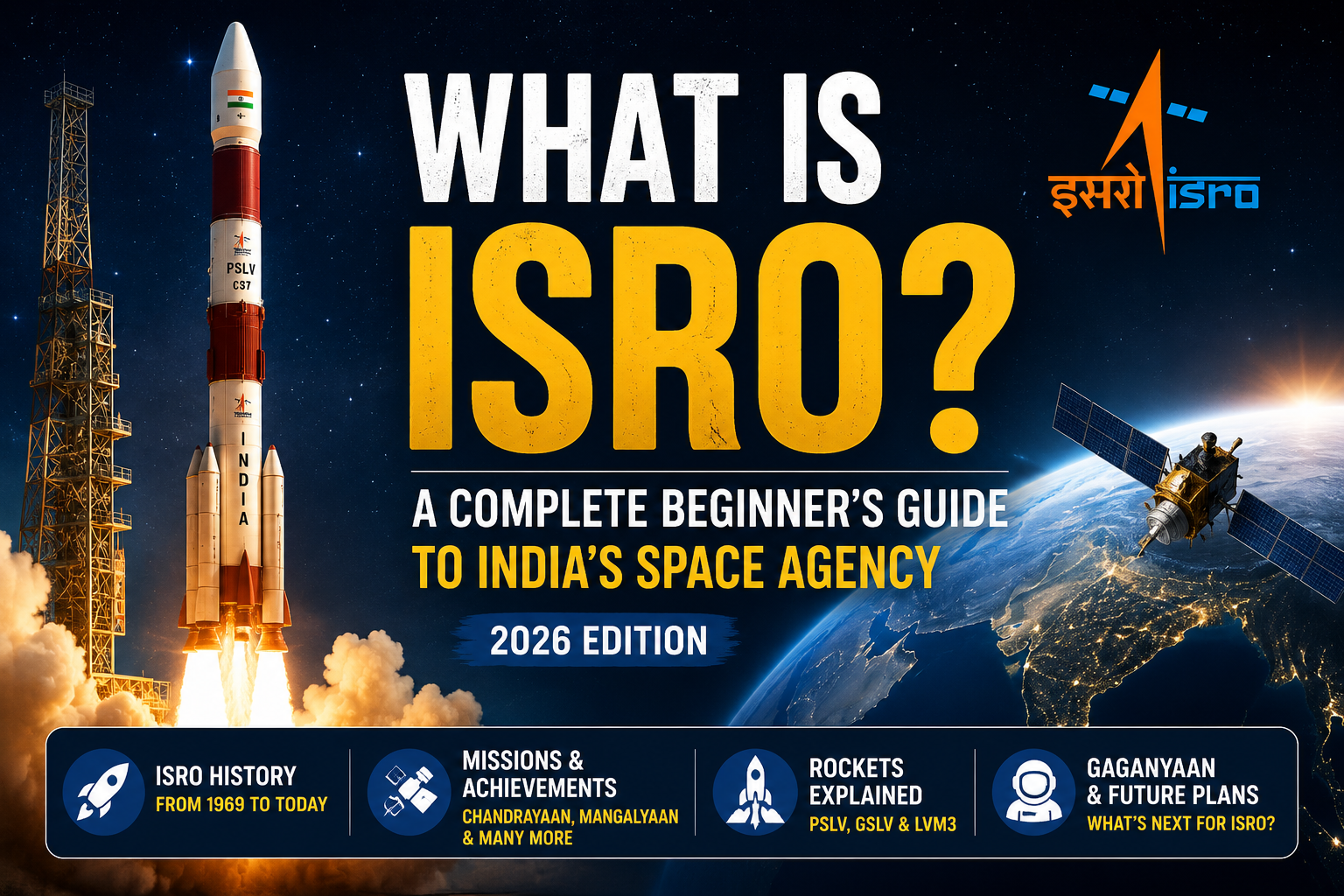
What is ISRO? A Complete Beginner’s Guide to India’s Space Agency (2026)
India is a country that sent a mission to Mars for less money than it cost to make the Hollywood film Gravity. That’s not a joke — it’s a fact that made the entire world stop and take notice of the Indian Space Research Organisation, better known as ISRO.
If you’ve been hearing this name for years but never quite understood what ISRO actually does, how it works, or why it matters — this guide is for you. No jargon. No complicated science. Just a clear, honest look at one of the most impressive space agencies on the planet.
Let’s start from the very beginning.
What is ISRO? (And What Does ISRO Stand For?)
ISRO stands for Indian Space Research Organisation. It is India’s national space agency — the government body responsible for everything related to space in our country.
Think of ISRO the way you think of NASA in the United States or ESA in Europe. It is the organization that builds India’s rockets, launches India’s satellites, sends missions to the Moon and Mars, and develops the space technology that silently powers a large chunk of your daily life.
ISRO is headquartered in Bengaluru, Karnataka, and operates under the Department of Space (DoS), which reports directly to the Prime Minister of India. This means space research in India is treated as a matter of national priority — not an afterthought.
Who Founded ISRO and When?
This is where the story gets genuinely inspiring.
According to the official ISRO website, the agency was founded in 1969.
ISRO came into existence on 15 August 1969 — India’s Independence Day — under the visionary guidance of Dr. Vikram Ambalal Sarabhai, who is rightfully called the Father of the Indian Space Programme.
But the roots go back even further. Formerly, ISRO was known as the Indian National Committee for Space Research (INCOSPAR), which was set up in 1962 by Prime Minister Jawaharlal Nehru on the recommendation of scientist Vikram Sarabhai.
Dr. Sarabhai was remarkable. He was born on 12 August 1919 in Ahmedabad, Gujarat, obtained his PhD in Cosmic Ray Physics from Cambridge University, and worked with Nobel laureate Sir C.V. Raman at the Indian Institute of Science in Bangalore.
What makes him extraordinary is his vision. India in the 1960s was a young, independent nation still figuring out its identity. Many questioned whether a developing country should spend money on something as ambitious as space research. Dr. Sarabhai had a clear and powerful answer.
He said — and these words are still quoted today — that India was not trying to compete with America or Russia in a space race. The goal was to use space technology to solve the real problems of real people: to bring education to remote villages, to predict monsoons that millions of farmers depend on, to connect a country as vast and diverse as India through satellites.
That philosophy — that space is not a vanity project but a development tool — became ISRO’s DNA. And it is still the reason ISRO earns respect globally that far exceeds its budget.
The Indian Space Programme began officially with the launch of the first sounding rocket from Thumba, near Thiruvananthapuram, Kerala, on 21 November 1963. The launch site was so modest that the instruments were transported to the launch pad on a bicycle. The rocket parts arrived by bullock cart. From that humble beginning to landing on the Moon’s south pole — that is ISRO’s story.
What Does ISRO Actually Do?
This is the question most people can’t answer clearly, even if they’ve been following ISRO’s news. Let’s break it down simply.
ISRO does four main things:
1. Builds and Launches Satellites
India depends on satellites for things you use every day — weather forecasts, television signals, internet connectivity, GPS navigation, disaster early warnings, and agricultural monitoring. ISRO designs, builds, and launches these satellites. Without ISRO’s work in this area, India’s technological infrastructure would look very different.
2. Develops Rockets (Launch Vehicles)
A satellite is useless unless you can get it into space. ISRO builds the rockets that carry these satellites. Its primary rockets include the Polar Satellite Launch Vehicle (PSLV) for putting satellites into polar orbit, the Geostationary Space Launch Vehicle (GSLV) for placing satellites into geostationary orbit, and a heavy-lift version called the LVM3. The PSLV in particular has become one of the most reliable rockets in the world. For smaller payloads, ISRO also operates the Small Satellite Launch Vehicle (SSLV) — see the full 2026 launch schedule for all of ISRO’s upcoming missions.
3. Conducts Space Exploration
Chandrayaan to the Moon. Mangalyaan to Mars. Aditya-L1 to study the Sun. These are not just national achievements — they are genuine scientific contributions that have advanced humanity’s understanding of our solar system. India is one of very few countries to have sent missions to the Moon, Mars, and the Sun.
4. Provides Technology for National Development
This is the part most people forget about. ISRO’s satellite data is actively used for crop monitoring, flood prediction, forest mapping, fishery alerts for coastal communities, tele-education in remote tribal areas, and disaster management. The organization quite literally saves lives and livelihoods through its work.
Where Does ISRO Work From? (Key Centres Across India)
ISRO isn’t just one building in Bengaluru. It operates through a nationwide network of specialized centres, each with a specific role:
Sensors and payloads are developed at the Space Applications Centre in Ahmedabad, Gujarat. Satellites are designed, assembled, and tested at the U R Rao Satellite Centre in Bengaluru. Launch vehicles (rockets) are developed at the Vikram Sarabhai Space Centre in Thiruvananthapuram, Kerala. Launches take place at the Satish Dhawan Space Centre on Sriharikota Island, Andhra Pradesh. The Master Control Facilities for satellite operations are located at Hassan, Karnataka, and Bhopal, Madhya Pradesh.
Sriharikota — often called SHAR — is where the world watches when India launches a rocket. That island on the coast of Andhra Pradesh is India’s window to space.
ISRO’s Major Milestones — A Journey That Will Make You Proud
1975 — India’s First Satellite: Aryabhata
ISRO built India’s first satellite, Aryabhata, which was launched by the Soviet space agency Interkosmos in 1975. Named after the ancient Indian mathematician and astronomer, Aryabhata was a statement to the world: India had arrived.
1980 — India Becomes Self-Reliant in Space
In 1980, ISRO launched the satellite RS-1 aboard the indigenously built launch vehicle SLV-3, making India the seventh country in the world to undertake orbital launches. This was enormous. India was no longer dependent on others to reach space.
2008 — Chandrayaan-1 Discovers Water on the Moon
India’s first mission to the Moon wasn’t just a flag-planting exercise. Chandrayaan-1 made one of its most celebrated achievements — the discovery of water molecules near the Moon’s poles, confirming a long-held scientific hypothesis. This was a contribution to global science, and it came from an organization that many in the West hadn’t heard of.
2013 — Mars Orbiter Mission (Mangalyaan): The Record Books Rewritten
If Chandrayaan-1 put ISRO on the map, Mangalyaan made the world’s jaw drop. India became the first country to reach Mars orbit in its very first attempt. No other nation — not the USA, not Russia, not China — had managed that. And ISRO did it at a cost of approximately ₹450 crore, making it the most cost-effective Mars mission in history.
2023 — Chandrayaan-3: India Lands on the Moon’s South Pole
This is the one that made India cry with joy. Chandrayaan-3 achieved a successful soft landing on the Moon on 23 August 2023, making India the fourth country to demonstrate lunar landing capability — and the first country ever to land near the Moon’s south pole. It was a moment of pure national pride, and deservedly so.
2024 — Aditya-L1: Studying the Sun
Aditya-L1, India’s first solar observatory mission, was placed in halo orbit around the Sun-Earth Lagrange Point 1 on 6 January 2024. India now has a dedicated eye on the Sun — studying solar winds and flares that affect everything from communication satellites to power grids on Earth.
January 2025 — SpaDeX: India Masters Space Docking
This one didn’t get as much public attention as it deserved. On 16 January 2025, ISRO successfully completed the SpaDeX (Space Docking Experiment) mission, making India the fourth country in the world — after the USA, Russia, and China — to possess space docking technology. Space docking is the ability to connect two spacecraft in orbit. Without this capability, you cannot build space stations, refuel satellites, or assemble large structures in space. India now has it.
June 2025 — An Indian in Space: Axiom Mission 4
Axiom Mission 4 (Ax-4), launched in June 2025, included Shubhanshu Shukla as mission pilot, marking the first time an Indian astronaut traveled to the International Space Station. He spent 18 days aboard the ISS, conducting experiments that will directly feed into India’s own Gaganyaan crewed spaceflight programme.
July 2025 — NISAR: India and NASA Together
The NISAR mission, launched on 30 July 2025, is a landmark Earth observation satellite jointly developed by ISRO and NASA. It uses dual-frequency radar technology to study subtle changes on the Earth’s surface — landslides, earthquakes, glacier movements, forest cover, and agricultural patterns. It is a mission of global significance and a symbol of how far ISRO’s international credibility has grown.
What Are ISRO’s Rockets? A Simple Explanation
You don’t need an engineering degree to understand this. Think of rockets as different-sized trucks — each one designed to carry a specific load to a specific destination.
PSLV (Polar Satellite Launch Vehicle) — This is ISRO’s most reliable workhorse. It’s been used for over 50 missions and has an almost unblemished track record. It’s the rocket that carried Chandrayaan-1 to the Moon and Mangalyaan to Mars. When ISRO needs something done and done right, PSLV is usually the answer.
GSLV (Geosynchronous Satellite Launch Vehicle) — Used for heavier communication satellites that need to go into a specific orbit high above the Earth. GSLV uses cryogenic engines — a technology India had to develop entirely on its own after international restrictions — making it a significant technological achievement.
LVM3 (Launch Vehicle Mark 3) — This is ISRO’s heavy-lifter. All seven LVM3 missions have achieved 100% success. It’s the rocket India will use to launch Gaganyaan — carrying Indian astronauts to space for the first time.
What is Gaganyaan? India’s Human Spaceflight Mission
Gaganyaan is arguably the most ambitious project ISRO has ever attempted. The goal: to send Indian astronauts into space on an Indian rocket, making India the fourth country to independently achieve human spaceflight.
Originally planned for 2024, the crewed Gaganyaan flight has since been pushed to 2026. Delays are par for the course in space — it’s a complicated, high-stakes business. But the programme is very much alive and moving forward. On 24 August 2025, ISRO successfully completed the first integrated air drop test for the Gaganyaan human spaceflight programme — a critical safety test of the crew escape system.
Four Indian Air Force pilots have been selected and trained as astronaut candidates. One of them will become the first Indian to travel to space on an Indian spacecraft. That moment, when it comes, will rank alongside Chandrayaan-3 as one of India’s greatest achievements.
What’s Coming Next? ISRO’s Future Missions
ISRO’s pipeline for the next few years is genuinely exciting:
Gaganyaan (2026) — India’s first crewed orbital spaceflight. The most watched ISRO mission in the country’s history when it happens.
Chandrayaan-4 (around 2028) — A planned lunar sample return mission, where ISRO aims to bring back up to 3 kg of lunar soil from near the Shiv Shakti point — the exact spot where Chandrayaan-3 landed.
LUPEX (around 2028) — A joint lunar mission with Japan’s JAXA, sending an uncrewed lander and rover to explore the Moon’s south pole for water ice.
Venus Orbiter Mission (VOM) (2028) — India’s first mission to Venus, approved by the Union Cabinet in September 2024, designed to study Venus’s atmosphere and surface.
Mars Lander Mission / Mangalyaan 2 (2030) — India goes back to Mars, this time with a lander.
Indian on the Moon (2040) — ISRO’s stated ambition is to put an Indian astronaut on the lunar surface by 2040. That’s a 15-year goal that requires Gaganyaan to succeed first — but it is the direction India is heading.
How is ISRO Different from NASA?
People often compare ISRO to NASA, and while the comparison is flattering, the two organizations are quite different in scale and approach. Here’s a simple breakdown:
| ISRO | NASA | |
|---|---|---|
| Country | India | United States |
| Founded | 1969 | 1958 |
| Annual Budget | ~₹13,000 crore (~$1.5 billion) | ~$24 billion |
| Primary Focus | Satellites, exploration, cost efficiency | Deep space, human spaceflight, large-scale science |
| Known For | Doing more with less | Doing things first |
| Chandrayaan/Mangalyaan | First attempt successes | Decades of Moon/Mars experience |
ISRO’s annual budget is roughly one-sixteenth of NASA’s. And yet, it has achieved things that left NASA scientists genuinely impressed. The comparison isn’t about who’s better — it’s about recognizing that ISRO punches far above its weight, consistently.
Why Should Every Indian Care About ISRO?
Here’s something most people don’t realize: ISRO isn’t just about pride and prestige. It directly improves the quality of life for ordinary Indians.
The weather forecast you check before stepping out? That data comes from ISRO’s meteorological satellites. The GPS you use to navigate? India has its own GPS system called NavIC, built by ISRO, which doesn’t depend on American GPS signals. The fishing alerts that warn coastal communities about rough seas? ISRO’s satellites send those directly to fishermen’s mobile phones. The flood and cyclone warnings that give people time to evacuate? ISRO imagery makes those predictions accurate.
Even the Direct-To-Home television that brings news and entertainment to villages without cable infrastructure runs on ISRO satellites.
ISRO is not a luxury. For a country of 1.4 billion people with enormous development challenges, it is infrastructure.
Frequently Asked Questions About ISRO
What is the full form of ISRO?
ISRO stands for Indian Space Research Organisation. It is India’s national space agency, headquartered in Bengaluru, Karnataka.
Who is the founder of ISRO?
Dr. Vikram Ambalal Sarabhai is considered the founder and father of the Indian Space Programme. ISRO was formally established on 15 August 1969 under his leadership.
Who is the current chairman of ISRO?
Dr. V. Narayanan is the current Chairman of ISRO, having assumed charge in January 2025.
How many satellites has ISRO launched?
ISRO has completed 133 spacecraft missions, 104 launch missions, and facilitated the launch of 434 foreign satellites from various countries.
What is ISRO’s biggest achievement?
This depends on who you ask, but most would say Chandrayaan-3’s successful landing on the Moon’s south pole on 23 August 2023 — the first time any country landed a spacecraft near the lunar south pole.
Does ISRO launch satellites for other countries?
Yes, and it’s a significant business. ISRO has launched over 434 foreign satellites from countries around the world through its commercial arm, Antrix Corporation and NewSpace India Limited (NSIL). In December 2025, ISRO launched AST SpaceMobile’s BlueBird Block-2 satellite weighing 6,100 kg — the heaviest foreign satellite ever launched from Indian soil.
Where does ISRO launch its rockets from?
All ISRO rocket launches happen from the Satish Dhawan Space Centre (SDSC-SHAR) on Sriharikota Island, Andhra Pradesh. A third launch pad is currently being built to increase launch capacity.
Is ISRO better than NASA?
ISRO and NASA operate in different contexts with different budgets. NASA has far more resources, but ISRO consistently achieves world-class results at a fraction of the cost. Mangalyaan reaching Mars on the first attempt for ₹450 crore remains one of the most cost-efficient space missions in history. They are peers, not competitors.
What is Gaganyaan?
Gaganyaan is ISRO’s human spaceflight programme — India’s mission to send Indian astronauts into space on an Indian rocket. The crewed mission is currently planned for 2026.
What is ISRO’s annual budget?
ISRO’s annual budget is approximately ₹13,000 crore (around $1.5 billion), which is modest compared to major space agencies but is used with exceptional efficiency.
The Bottom Line
ISRO is one of the most remarkable institutions India has ever built.
It was born in a country that was barely two decades old, with limited resources, an uncertain future, and a world that wasn’t paying much attention. It was built by scientists who believed that space technology wasn’t about competing with the superpowers — it was about solving India’s problems in the smartest possible way.
Six decades later, India has landed on the Moon’s south pole, orbited Mars on the first attempt, docked spacecraft in orbit, put an Indian astronaut on the International Space Station, and launched satellites for dozens of countries. All of this done by a government agency that operates on less than one-sixteenth of NASA’s budget.
The next chapter — Gaganyaan, Chandrayaan-4, the Venus mission, and ultimately an Indian on the Moon — is going to be even more extraordinary.
We’ll be covering every step of that journey right here on SpaceCraft India. Stay with us.
Have a question about ISRO that we didn’t cover? Drop it in the comments below — we read every one.
Also Read
- What is Chandrayaan? India’s Journey to the Moon Explained
- Gaganyaan Mission: Everything You Need to Know
- PSLV vs GSLV vs LVM3: ISRO Rockets Explained
About the Author
Prabhu M. is the founder of SpaceCraft India and a technology and digital media entrepreneur with over two decades of experience in content publishing, SEO, and online media. Through SpaceCraft India, he aims to make India’s space journey easy to understand for students, professionals, and space enthusiasts.
Share this article if it helped you understand ISRO better. Every share helps more Indians discover the incredible story of their own space agency. 🚀
1 thought on “What is ISRO? A Complete Beginner’s Guide to India’s Space Agency (2026)”