
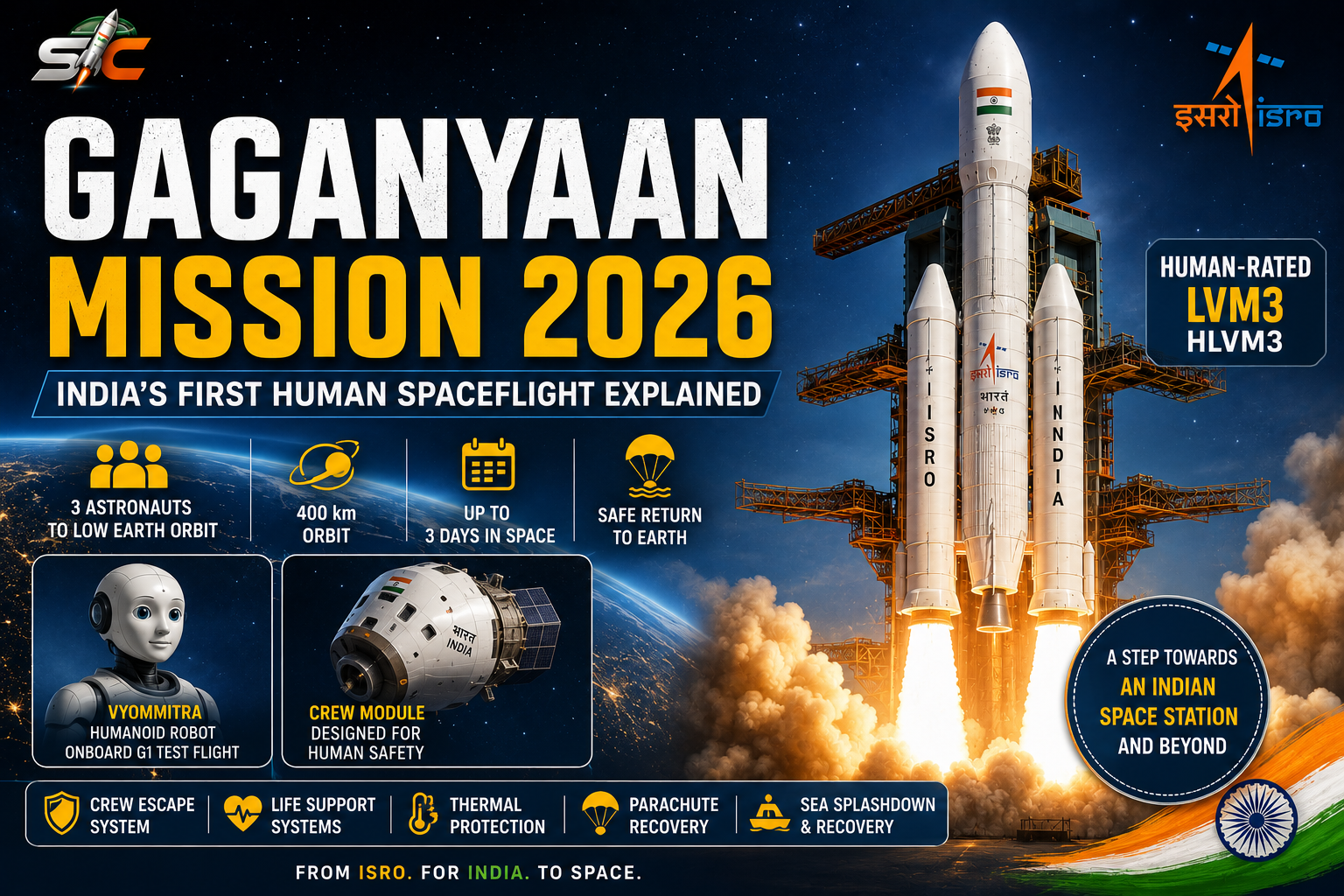
- Mission
- Gaganyaan
- Agency
- ISRO
- 2026 goal
- G1 uncrewed test
- Test passenger
- Vyommitra
- Rocket
- HLVM3
- Target orbit
- ~400 km LEO
- Crewed goal
- 3 astronauts, up to 3 days
- Landing zone
- Indian sea waters
- What is Gaganyaan Mission 2026?
- Why Gaganyaan Matters for India
- Will Gaganyaan Launch Humans in 2026?
- What is Gaganyaan G1?
- Who is Vyommitra?
- Which Rocket Will Launch Gaganyaan?
- What is the Crew Module?
- What is the Service Module?
- How Will Gaganyaan Return to Earth?
- What Tests Has ISRO Already Completed?
- Why Human Spaceflight is So Difficult
- How Gaganyaan Connects to India’s Future Space Station
- Gaganyaan Mission 2026: Quick Facts
- How Gaganyaan Compares with Previous ISRO Missions
- What Happens After Gaganyaan G1?
- Why Gaganyaan is a National Milestone
- Conclusion
- FAQ
Last Updated: June 2026
The Gaganyaan Mission 2026 is one of the most important space missions in Indian history. For decades, India has launched satellites, sent spacecraft to the Moon and Mars, built powerful rockets, and proved that ISRO can achieve complex missions at a fraction of global costs. But Gaganyaan is different.
This mission is not only about sending a spacecraft into orbit. It is about proving that India can safely send humans to space, support them in orbit, and bring them back to Earth.
In simple words, Gaganyaan is India’s human spaceflight programme. It is the mission that will prepare India to join the small group of countries capable of launching humans into space using their own rocket, spacecraft, training systems, safety systems, and recovery operations.
As of June 2026, ISRO is preparing for the first uncrewed Gaganyaan flight, also known as G1. According to recent updates, ISRO is working toward conducting the first uncrewed mission within 2026, before moving toward crewed human spaceflight.
What is Gaganyaan Mission 2026?
Gaganyaan Mission 2026 is ISRO’s human spaceflight programme designed to demonstrate India’s ability to send astronauts into low Earth orbit and bring them back safely.
According to ISRO, the Gaganyaan project aims to launch a crew of three members to an orbit of about 400 km for a three-day mission and return them safely to Earth by landing in Indian sea waters.
That one sentence explains the scale of the mission. ISRO has to master every part of human spaceflight: launch, orbit, life support, emergency escape, re-entry, parachute descent, sea landing, and crew recovery.
Unlike a satellite mission, Gaganyaan cannot be judged only by whether the spacecraft reaches orbit. The real success is safe return.
Why Gaganyaan Matters for India
The Gaganyaan Mission 2026 matters because it moves India from robotic space exploration to human spaceflight.
India has already achieved major milestones with missions like Chandrayaan-3, Mars Orbiter Mission, Aditya-L1, PSLV launches, LVM3 missions, and SpaDeX docking. But human spaceflight is a different level of national capability.
Gaganyaan will help India build expertise in:
- Human-rated rockets
- Crew module design
- Life support systems
- Astronaut training
- Emergency escape systems
- Re-entry and heat shield technology
- Ocean recovery operations
- Space medicine and human factors engineering
These technologies are not useful only for one mission. They are the foundation for India’s future space station, longer-duration missions, lunar missions, and deep-space human exploration.
Will Gaganyaan Launch Humans in 2026?
This is the most important question readers will ask.
The Gaganyaan Mission 2026 is expected to focus on uncrewed test flights first. ISRO is preparing the G1 uncrewed mission, which will test the spacecraft without astronauts onboard. This test is critical before India attempts a crewed flight.
The first uncrewed mission is expected to carry Vyommitra, ISRO’s humanoid robot, to help test spacecraft systems in a human-like mission environment.
So, 2026 is not just “launch year.” It is a validation year.
Before astronauts fly, ISRO must prove that the spacecraft, rocket, parachutes, crew escape system, life support architecture, communication systems, and recovery teams work reliably.
What is Gaganyaan G1?
Gaganyaan G1 is the first major uncrewed orbital test flight under the Gaganyaan programme.
The goal of G1 is to test the crew module and service module in real mission conditions. Even though no human astronauts will be onboard, the mission will behave like a rehearsal for future crewed flights.
G1 is expected to test:
- Launch performance of the human-rated rocket
- Separation of the orbital module
- Spacecraft operations in low Earth orbit
- Avionics and control systems
- Re-entry into Earth’s atmosphere
- Parachute-assisted descent
- Splashdown and recovery
If G1 succeeds, it will give ISRO confidence to move toward the next stages of the human spaceflight programme.
Who is Vyommitra?
Vyommitra is ISRO’s humanoid robot designed for the Gaganyaan programme.
The name comes from Sanskrit words meaning “space friend.” Vyommitra is expected to fly on an uncrewed Gaganyaan mission and help simulate some human-like conditions inside the spacecraft.
Vyommitra can support the mission by helping monitor cabin conditions, interact with onboard systems, and provide data that is useful before astronauts fly.
The main purpose of Vyommitra is not to replace astronauts. It is to reduce risk before astronauts are placed inside the spacecraft.
For a mission like Gaganyaan, that approach makes sense. ISRO is testing step by step, because in human spaceflight, safety is the mission.
Which Rocket Will Launch Gaganyaan?
The Gaganyaan Mission 2026 will use a human-rated version of ISRO’s LVM3 rocket, known as HLVM3.
LVM3 is India’s most powerful operational rocket and has already proven itself in major missions, including Chandrayaan-3. For Gaganyaan, ISRO has modified and human-rated the launch vehicle to meet stricter safety requirements.
HLVM3 includes:
- Solid rocket boosters
- Liquid core stage
- Cryogenic upper stage
- Crew Escape System
- Human-rating modifications
The Crew Escape System is one of the most important additions. If a serious problem occurs during launch, the system is designed to pull the crew module away from the rocket and carry astronauts to safety.
What is the Crew Module?
The crew module is the part of the Gaganyaan spacecraft where astronauts will sit during launch, orbit, re-entry, and landing.
ISRO describes the crew module as a habitable space with an Earth-like environment for the crew. It includes crew interfaces, life support systems, avionics, deceleration systems, and thermal protection for re-entry.
The crew module has to protect astronauts from:
- Launch vibrations
- Vacuum of space
- Temperature extremes
- Re-entry heating
- High-speed descent
- Ocean splashdown forces
This is why Gaganyaan is such a complex mission. The spacecraft must work like a small home, a control room, a survival capsule, and a return vehicle at the same time.
What is the Service Module?
The service module supports the crew module while it is in orbit.
It contains systems for propulsion, power, thermal control, avionics, and other mission operations. While the crew module protects astronauts, the service module helps the spacecraft function during the orbital phase.
Together, the crew module and service module form the orbital module.
How Will Gaganyaan Return to Earth?
The return phase is one of the most dangerous parts of the Gaganyaan mission.
After completing its mission in orbit, the spacecraft must re-enter Earth’s atmosphere at very high speed. During re-entry, the crew module will face extreme heating. Its thermal protection system must keep the inside safe.
After slowing down in the atmosphere, parachutes will deploy in sequence to reduce the capsule’s speed before splashdown in the sea.
ISRO has been testing parachute systems for Gaganyaan, including drogue parachute deployment tests and integrated air drop tests. These tests are important because parachutes are critical for the final landing phase.
A safe launch is only half the story. A safe landing is what completes the mission.
What Tests Has ISRO Already Completed?
ISRO has already completed several major tests for the Gaganyaan programme.
One important milestone was the TV-D1 mission, which demonstrated the Crew Escape System during an in-flight abort scenario. ISRO stated that the Crew Escape System performed as intended, marking a successful step for Mission Gaganyaan.
ISRO has also tested parachute systems, including drogue parachutes that help stabilize and slow the crew module during descent. These tests are part of proving that the spacecraft can return safely after re-entry.
Every test may look small from the outside, but each one reduces mission risk.
Why Human Spaceflight is So Difficult
Human spaceflight is difficult because the acceptable margin for failure is extremely low.
A satellite can fail and still teach engineers something. A human mission must be designed around survival from the beginning.
ISRO has to think about:
- What happens if the rocket has a problem?
- What happens if the cabin pressure drops?
- What happens if communication is interrupted?
- What happens if re-entry is not perfect?
- What happens if parachutes deploy late?
- What happens after splashdown?
That is why Gaganyaan is being built through multiple test missions. ISRO is not rushing directly to a crewed launch. It is proving each system before astronauts fly.
How Gaganyaan Connects to India’s Future Space Station
Gaganyaan is not a one-time mission. It is the beginning of India’s long-term human spaceflight roadmap.
The technologies developed for Gaganyaan can support future missions such as:
- Bharatiya Antariksh Station
- Long-duration astronaut missions
- Human space science experiments
- Docking and rendezvous missions
- Lunar orbit missions
- Future international human spaceflight collaborations
India has already demonstrated space docking through the SpaDeX mission. Combined with Gaganyaan, this gives India a stronger foundation for building and operating future orbital infrastructure.
Gaganyaan Mission 2026: Quick Facts
Mission Name: Gaganyaan
Programme Type: Human Spaceflight Programme
Space Agency: ISRO
First Major 2026 Goal: Uncrewed G1 test mission
Expected Passenger on Test Flight: Vyommitra humanoid robot
Rocket: Human-rated LVM3, also called HLVM3
Target Orbit: Around 400 km low Earth orbit
Crewed Mission Goal: Three astronauts for up to three days
Landing Zone: Indian sea waters
Main Objective: Demonstrate safe human spaceflight capability
How Gaganyaan Compares with Previous ISRO Missions
Gaganyaan is different from missions like PSLV satellite launches, Chandrayaan, Mangalyaan, or Aditya-L1.
Those missions were robotic. Gaganyaan is human-rated.
A robotic spacecraft can be compact, automated, and mission-specific. A human spacecraft must include life support, crew safety systems, emergency abort capability, training systems, medical planning, and recovery teams.
That makes Gaganyaan one of the most ambitious missions ISRO has ever attempted.
What Happens After Gaganyaan G1?
After the first uncrewed Gaganyaan mission, ISRO will review the mission data carefully.
If systems perform as expected, ISRO can move toward additional uncrewed tests and then the eventual crewed mission. The timeline depends on technical readiness, test results, and safety reviews.
In human spaceflight, a delay is not always bad news. Sometimes a delay means the agency is doing the responsible thing: testing more, improving systems, and reducing risk.
Why Gaganyaan is a National Milestone
The Gaganyaan Mission 2026 is not just a space mission. It is a national capability test.
If India succeeds, it will prove that the country can design, build, launch, operate, and recover a human spacecraft using its own systems. That would place India among a very small group of nations with independent human spaceflight capability.
For young Indians, Gaganyaan may also become what the Moon landing was for earlier generations: a moment that inspires students to dream of science, engineering, aviation, robotics, medicine, and space exploration.
Conclusion
The Gaganyaan Mission 2026 is India’s boldest step toward human spaceflight.
The mission is complex, risky, and historic. It involves a human-rated rocket, an advanced crew module, life support systems, parachute recovery, astronaut training, emergency escape systems, and uncrewed test flights before astronauts fly.
The first uncrewed Gaganyaan mission will be a major test of ISRO’s readiness. If it succeeds, India will move much closer to sending its own astronauts into space from Indian soil.
Gaganyaan is not just about reaching orbit. It is about proving that India can send humans to space and bring them home safely.
FAQ
What is Gaganyaan Mission 2026?
Gaganyaan Mission 2026 is ISRO’s human spaceflight programme focused on testing India’s ability to send humans to low Earth orbit and bring them back safely.
Will astronauts fly in Gaganyaan in 2026?
As of June 2026, the major expected milestone is the first uncrewed Gaganyaan test mission. Crewed flight will depend on successful testing and safety validation.
Who is Vyommitra?
Vyommitra is ISRO’s humanoid robot designed to fly on an uncrewed Gaganyaan mission and help test spacecraft systems before astronauts fly.
Which rocket will launch Gaganyaan?
Gaganyaan will use HLVM3, the human-rated version of ISRO’s LVM3 heavy-lift rocket.
Why is Gaganyaan important?
Gaganyaan is important because it will help India develop independent human spaceflight capability and prepare for future missions such as an Indian space station.