
- Satellites
- IDRSS-1 and IDRSS-2
- Operator
- ISRO
- Mission Type
- Geostationary data-relay satellite system
- Mass
- ~2,000 kg class each (I-2K extended bus)
- Launch Vehicle
- GSLV Mk II
- Launch Site
- Second Launch Pad, Satish Dhawan Space Centre, Sriharikota
- Target Window
- 2027, TBD – per public mission trackers
- Status
- Approved and funded since the 2019–20 budget; still awaiting launch as of late 2026
- Next Step
- ISRO’s ESA ground-support stopgap keeps Gaganyaan covered until IDRSS flies
Why India Needs IDRSS
Every satellite ISRO flies in low-Earth orbit has the same blind spot: it can only talk to mission control while it is directly overhead one of India’s own ground stations, a window that lasts just a few minutes out of a roughly 90-minute orbit. For an uncrewed Earth-observation satellite, a few quiet minutes per lap is a routine, manageable gap. For Gaganyaan, India’s first crewed spaceflight programme, it is not.
ISRO has been explicit about this for years. Back in 2020, then-ISRO Chairman K. Sivan put it plainly while describing the need for a dedicated relay system: “We require the IDRSS system when our astronauts are in space,” he said, adding that the goal was for the crew module to be visible “100%, so that action can be taken in any exigency.” Six years on, that system still hasn’t flown — and the problem it was built to solve hasn’t gone away.
What Is IDRSS, Exactly
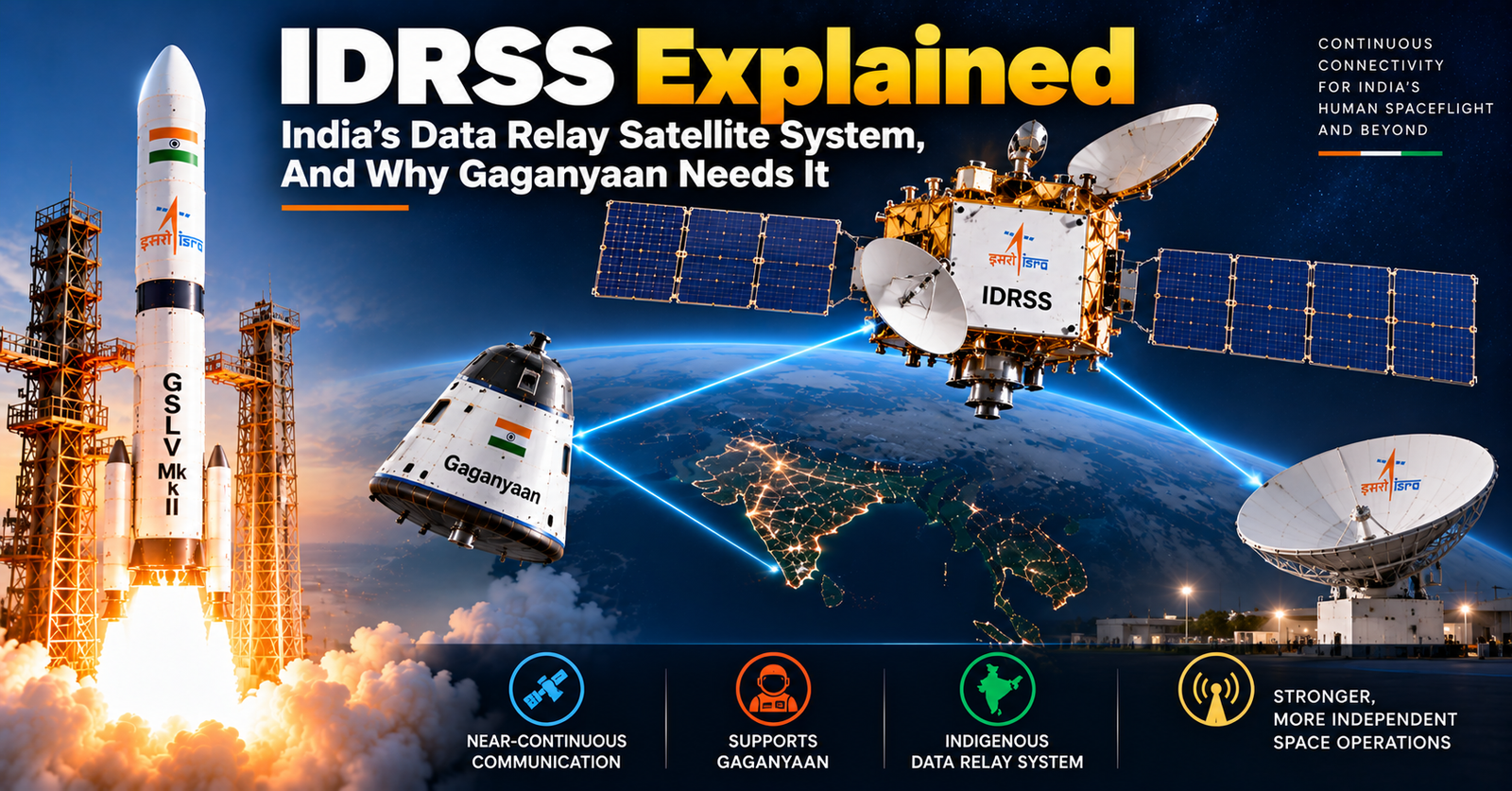
IDRSS — the Indian Data Relay Satellite System — is ISRO’s planned pair of geostationary relay satellites, IDRSS-1 and IDRSS-2. Each is built on the roughly 2,000 kg-class I-2K extended bus and carries a 2.5-metre deployable Cassegrain antenna for dual S- and Ka-band links, plus a 1.5-metre fixed Cassegrain antenna covering Ku- and Ka-band, with an optical communication payload also under consideration.
The idea is the same one NASA pioneered with its TDRS network in the 1980s: park a satellite in geostationary orbit, 36,000 km up, where it can simultaneously see both a low-orbiting spacecraft and an Indian ground station, then bounce the signal between the two. Instead of brief, scheduled ground-station passes, a spacecraft gets near-continuous contact.
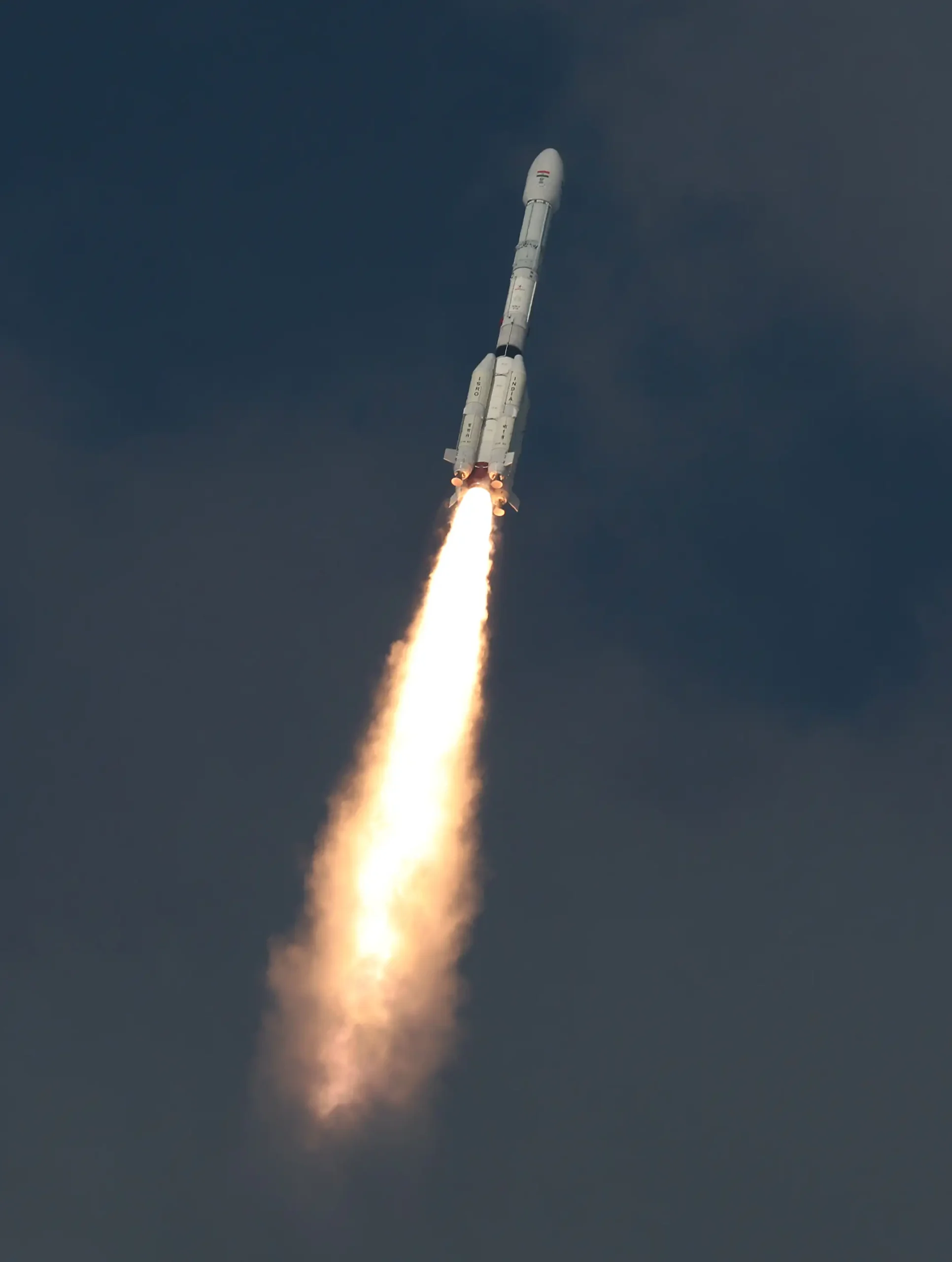
IDRSS-1 is set to fly on a GSLV Mk II from the Second Launch Pad at Sriharikota. IDRSS-2 is planned for a slightly different orbital slot, chosen to improve coverage of launch-vehicle ascent phases and to strengthen the link with ISRO’s tracking terminal on the Cocos Islands.
Why It’s Taken So Long
IDRSS isn’t a new idea. The project was approved and funded under the Government of India’s 2019–20 budget, with ISRO initially targeting a first launch by the end of 2020 and a second satellite in 2021 — well ahead of what was then a much earlier Gaganyaan crewed-flight timeline.
That schedule slipped almost immediately. The COVID-19 pandemic disrupted satellite assembly and testing through 2020 and 2021, and Gaganyaan’s own uncrewed milestones — the abort test flights, the TV-D2 safety demonstration, and the upcoming uncrewed G1 orbital flight — along with operational satellites like NVS-03 took priority for scarce GSLV Mk II launch slots. As of September 2026, public mission trackers still list IDRSS-1 with no firm date, only a tentative 2027 window marked TBD — more than six years past its original target.
The ESA Stopgap
With IDRSS still grounded, ISRO has leaned on an international workaround. On December 4, 2024, ISRO and the European Space Agency signed a Technical Implementing Plan at Satish Dhawan Space Centre under which ESA provides ground-station support for Gaganyaan missions, helping maintain continuous data flow and communication with the Orbital Module during its orbital operations.
This doesn’t replace what IDRSS is designed to do. Borrowed ground stations can narrow the blackout windows during a Gaganyaan flight, but they still depend on line-of-sight passes rather than the near-continuous, always-on coverage a geostationary relay satellite provides. It buys ISRO time — not the capability itself.
What IDRSS Unlocks
Once it’s flying, IDRSS isn’t just a Gaganyaan accessory — it becomes backbone infrastructure for most of what ISRO does next:
- Near-continuous tracking and voice/data contact with Gaganyaan astronauts, instead of contact only during Indian ground-station passes
- Round-the-clock ground contact for the planned Bharatiya Antariksh Station, once a crew is living aboard it long-term
- Better coverage for India’s wider fleet of satellites in low-Earth orbit, most of which currently get only brief ground-station windows per orbit
- Real-time monitoring of GSLV, LVM3, and SSLV ascent phases for range safety and faster anomaly response
- Faster ground confirmation of time-critical events on future missions, the kind of split-second milestones SpaDeX-style docking tests depend on
How India Compares Globally
Every other major spacefaring power already operates a relay-satellite backbone like the one IDRSS is meant to become. India is currently the only one in this group without a single satellite of its own in orbit:
| System | Country / Agency | Satellites | Technology | Status |
|---|---|---|---|---|
| IDRSS | India – ISRO | 2 planned (IDRSS-1, IDRSS-2) | S/Ku/Ka-band radio relay via GSLV Mk II, geostationary orbit | Planned; none launched as of late 2026, tentatively 2027 |
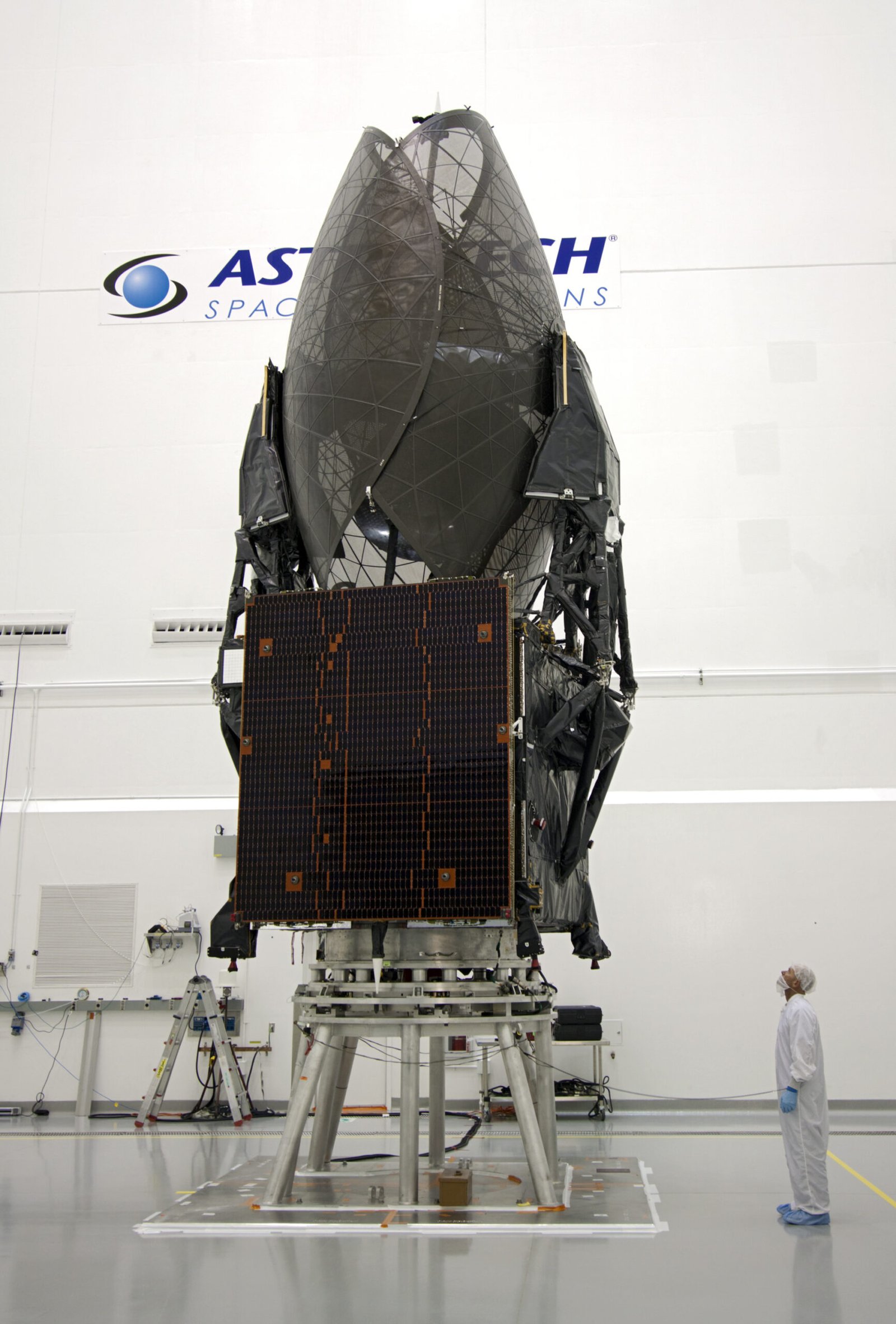
| TDRS | USA – NASA | Multiple generations since 1983; several still active | S/Ku/Ka-band radio relay, geostationary orbit | Operating since 1983; NASA began shifting to commercial relay providers from 2022 |
| Tianlian | China – CNSA | 11 launched (5 Tianlian I + 6 Tianlian II); 8 active | S/Ku-band radio relay, geostationary orbit | Operational; supports Shenzhou crewed flights and the Tiangong space station |
| Luch | Russia – Roscosmos | Luch-5A (2011), Luch-5V (2014), Luch-5B procured | S/Ku-band relay plus COSPAS-SARSAT distress relay | Small, ageing constellation |
| EDRS | ESA / Europe | 2 satellites (EDRS-A 2016, EDRS-C 2019) | Laser optical inter-satellite links, up to 1,800 Mbit/s | Operational; primarily serves Copernicus Earth-observation satellites |
NASA and China have run operational relay fleets for decades and years respectively; Russia’s is smaller and older; Europe’s EDRS takes a different, laser-based approach built for high-bandwidth Earth-observation data rather than human spaceflight. IDRSS would be India’s first entry into this club — whenever it finally launches.
Frequently Asked Questions
What is IDRSS?
IDRSS, the Indian Data Relay Satellite System, is ISRO’s planned pair of geostationary relay satellites that would give near-continuous contact with Indian spacecraft in low-Earth orbit, including the Gaganyaan crew module, instead of brief windows whenever a satellite passes over an Indian ground station.
Why does India need a data relay satellite system?
India’s ground stations can only track a satellite while it is in their direct line of sight – a few minutes per orbit. That’s manageable for routine satellites, but for a crewed mission like Gaganyaan, ISRO wants close to 100% visibility of the crew module so it can react immediately to any emergency.
Why has IDRSS been delayed?
IDRSS was approved and funded in the 2019–20 budget, with a first launch originally targeted for late 2020. It has repeatedly slipped as Gaganyaan’s own test flights and other GSLV Mk II payloads took priority. As of late 2026 it is still listed as planned, with trackers citing a tentative 2027 window and no confirmed date.
What is the ESA ground-support arrangement?
In December 2024, ISRO and the European Space Agency signed a Technical Implementing Plan letting ESA’s ground stations support Gaganyaan missions and help maintain communication with the Orbital Module. It’s a stopgap, not a substitute for the continuous coverage IDRSS is designed to provide.
How does IDRSS compare to NASA’s TDRS or China’s Tianlian?
NASA has operated its Tracking and Data Relay Satellite System since 1983, and China has launched 11 Tianlian satellites with 8 currently active. IDRSS, by contrast, is still pre-launch – India remains the only major spacefaring nation in this group without an operational relay satellite of its own.
When will IDRSS actually launch?
There’s no confirmed date yet. Mission trackers list IDRSS-1 on a GSLV Mk II flight with a tentative 2027 window marked TBD, more than six years after the system’s original end-of-2020 target.
The Bottom Line
IDRSS isn’t a flashy mission — there’s no crew, no planetary flyby, no record-setting payload. But it’s the kind of infrastructure that everything else quietly depends on. Until it flies, India’s human-spaceflight programme leans on a patchwork of its own limited ground stations and a borrowed European network. Gaganyaan’s first crewed flight, and the longer-term Bharatiya Antariksh Station, will both be safer, and far more capable, once ISRO finally gets this relay constellation into orbit.