
- Mission
- Venus Orbiter Mission (VOM), popularly called Shukrayaan
- Operator
- ISRO
- Approved
- 18 September 2024, Union Cabinet
- Budget
- About ₹1,236 crore
- Launch
- March 2028 on LVM3 from Sriharikota
- Venus Arrival
- Planned for around July 2028
- Science Orbit
- 200 × 600 km, about 90° inclination
- Payloads
- 19 instruments (16 Indian, 2 collaborative, 1 international)
- Status (2026)
- Preliminary design review completed April 2026
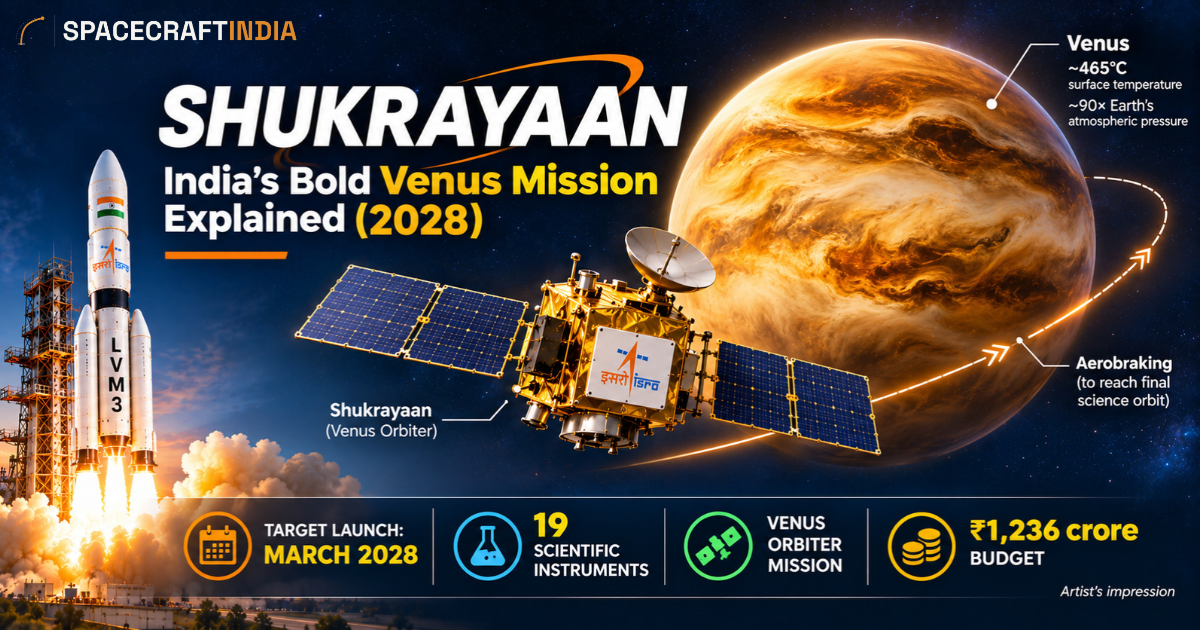
Shukrayaan is ISRO’s first mission to Venus, and in 2026 it moved from a paper plan toward real hardware. The Venus Orbiter Mission (VOM), as the agency officially calls it, was cleared by the Union Cabinet in September 2024 with a budget of about ₹1,236 crore, according to ISRO. Its preliminary design review was finished in April 2026, and The Week reports the mission is on schedule. If that holds, an LVM3 rocket will carry Shukrayaan from Sriharikota in March 2028. This guide covers what the spacecraft will do, how it will get there, what its 19 instruments will study, and why the timing matters.
Why Venus, and Why Now
Venus is almost exactly Earth’s size, yet it turned out to be a nightmare world. The surface sits at roughly 465°C, hot enough to melt lead, under air pressure around 90 times what we feel at sea level, and the whole planet is wrapped in clouds of sulphuric acid. It also spins so slowly that one rotation takes longer than its year. Scientists want to know how two planets that started so alike ended up so different, whether Venus once had oceans, and whether it is still volcanically active today.
The timing is part of the story. Japan’s Akatsuki, the last spacecraft studying Venus up close, quietly ended its operations in 2025, with a final command sent in September that year. That leaves the planet without an active orbiter for now. NASA and ESA have Venus missions planned, but they are early-2030s projects, so a working Indian orbiter in 2028 would arrive in a quiet sky.
What Shukrayaan Actually Is
Officially it is the Venus Orbiter Mission, VOM. The name Shukrayaan comes from Sanskrit, roughly “Venus craft”, and it is what almost everyone uses. The Cabinet approved it on the same day as Chandrayaan-4, the Moon sample-return mission. It will be India’s second interplanetary mission, after the Mars Orbiter Mission launched in 2013.
This is an orbiter, not a lander. It will circle Venus and study the surface, the atmosphere and the way the planet reacts to the Sun, all from above the clouds. The Week notes the budget is much lower than comparable foreign missions, which is typical of how ISRO works. A follow-up Mars mission, Mangalyaan-2, is also being discussed for around 2030, but that date is more of an ambition than a commitment, so treat it as a separate story.
Getting There: LVM3, Aerobraking, and the Science Orbit
Shukrayaan will fly on LVM3, the same heavy-lift rocket that took Chandrayaan-3 to the Moon. If you want the background on that vehicle, our LVM3 explainer and the GSLV vs LVM3 comparison cover it in detail. The rocket will first place the spacecraft in a temporary orbit around Earth, then the spacecraft will fire its own engine to head for Venus.
| Phase | What Happens | Orbit |
|---|---|---|
| Launch | LVM3 lifts off from Sriharikota in March 2028 | Earth parking orbit, 170 × 36,000 km |
| Cruise | The spacecraft leaves Earth orbit and coasts toward Venus | Interplanetary transfer |
| Venus orbit insertion | An engine burn lets Venus capture the spacecraft, planned around July 2028 | 500 × 60,000 km |
| Aerobraking | Six to eight months of dipping into the upper atmosphere to shed speed | Shrinks step by step |
| Science operations | Planned five years of observations | 200 × 600 km at about 90° |
Aerobraking is the clever part. Instead of burning lots of fuel to shrink its orbit, the spacecraft repeatedly skims the top of Venus’s atmosphere and lets drag slow it down. It is fuel-efficient but demanding, because the spacecraft has to survive heat and atmospheric drag on every pass. ISRO lists demonstrating aerobraking and thermal management as one of the mission’s own objectives, so this is as much a technology test as a science mission.
The 19 Instruments, in Plain English
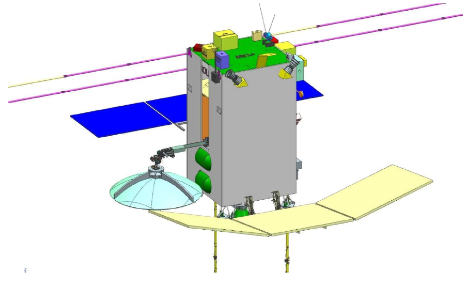
ISRO’s expert review committee recommended 19 payloads: 16 Indian, two Indian-international collaborations and one fully international instrument. The full list is long, but the instruments fall into four groups.
| Group | Key Instruments | What They Study |
|---|---|---|
| Surface and subsurface | VSAR (S-band radar), VARTISS | Volcanoes, tectonics, surface features and structure below the surface |
| Atmosphere and clouds | VSEAM, VTC, VCMC, LIVE, VASP, VIRAL | Cloud tops, winds, water vapour, aerosols, gases and lightning |
| Upper atmosphere and solar wind | VETHICA, VEDA, RPA, VIPER, VISWAS, RAVI | The ionosphere, plasma and how Venus loses atmosphere to space |
| Space environment | VeRad, SSXS, VODEX | Solar radiation, soft X-rays and interplanetary dust near Venus |
The radar is the headline instrument. VSAR will map the surface at high resolution to look for signs of active volcanism, the kind of question the old Magellan radar images from the early 1990s could only hint at. The atmosphere instruments aim to build uniform global datasets on winds, waves and chemistry, something earlier missions with limited coverage could not provide. And the ionosphere and plasma instruments tackle a big question: how did Venus lose its water over time?
Sweden, Russia, and Germany on Board
Shukrayaan is not a solo effort. In May 2026, ISRO and Sweden’s National Space Agency signed an agreement in Gothenburg during the Prime Minister’s visit, and The Week reports the Swedish Institute of Space Physics will supply the Venusian Neutrals Analyser. It will sit inside VISWAS, a plasma package built by the Space Physics Laboratory in Thiruvananthapuram, to study how the solar wind interacts with Venus. Russia’s Space Research Institute (IKI) provides VIRAL, an infrared instrument that profiles atmospheric gases, and a German team collaborates on RAVI, a radio-occultation experiment.
Who Else Is Going to Venus
After Akatsuki, Venus is about to get busy again. NASA’s DAVINCI and VERITAS and ESA’s EnVision are all planned for the early 2030s, some of them under budget pressure. Shukrayaan would get there first, so its data could shape what those later missions look at. It also fits India’s wider deep-space push alongside Gaganyaan, Chandrayaan-4 and the Bharatiya Antariksh Station.
What Could Go Wrong, and What to Watch
Honest answer: a lot can slip between 2026 and 2028. Interplanetary launch windows are fixed by orbital mechanics, so missing the March 2028 window would likely mean waiting for the next one. ISRO also has a crowded schedule, and the aerobraking phase is new territory for the agency. The good news is that no delays have been reported so far, and the design review is behind it.
What to watch next: the completion of the spacecraft’s critical design review, news on integration and testing of the 19 payloads, and any official confirmation of the exact launch date. We will update this guide as ISRO announces them.
Frequently Asked Questions
What is Shukrayaan?
Shukrayaan is the popular name for ISRO’s Venus Orbiter Mission (VOM), India’s first mission to Venus. It is an orbiter that will study the planet’s surface, atmosphere and interaction with the Sun using 19 scientific instruments.
When will Shukrayaan launch?
ISRO plans to launch it in March 2028, and The Week cites 29 March 2028. The spacecraft is expected to enter Venus orbit around July 2028, followed by six to eight months of aerobraking before science operations begin.
How much does the Venus mission cost?
The Union Cabinet approved a budget of about ₹1,236 crore in September 2024, which is much lower than comparable foreign Venus missions.
Which rocket will launch Shukrayaan?
ISRO’s LVM3, the same vehicle that launched Chandrayaan-3. It will place the spacecraft in a 170 × 36,000 km parking orbit before the spacecraft heads for Venus.
Will Shukrayaan land on Venus?
No. It is an orbiter and will study Venus from above the clouds. Venus’s surface is far too hot and the pressure too high for a simple lander.
Which countries are helping with Shukrayaan?
Sweden supplies an instrument through the Swedish Institute of Space Physics, Russia’s Space Research Institute provides the VIRAL infrared spectrometer, and a German team collaborates on the RAVI radio-occultation experiment. Most of the 19 payloads are Indian-built.