
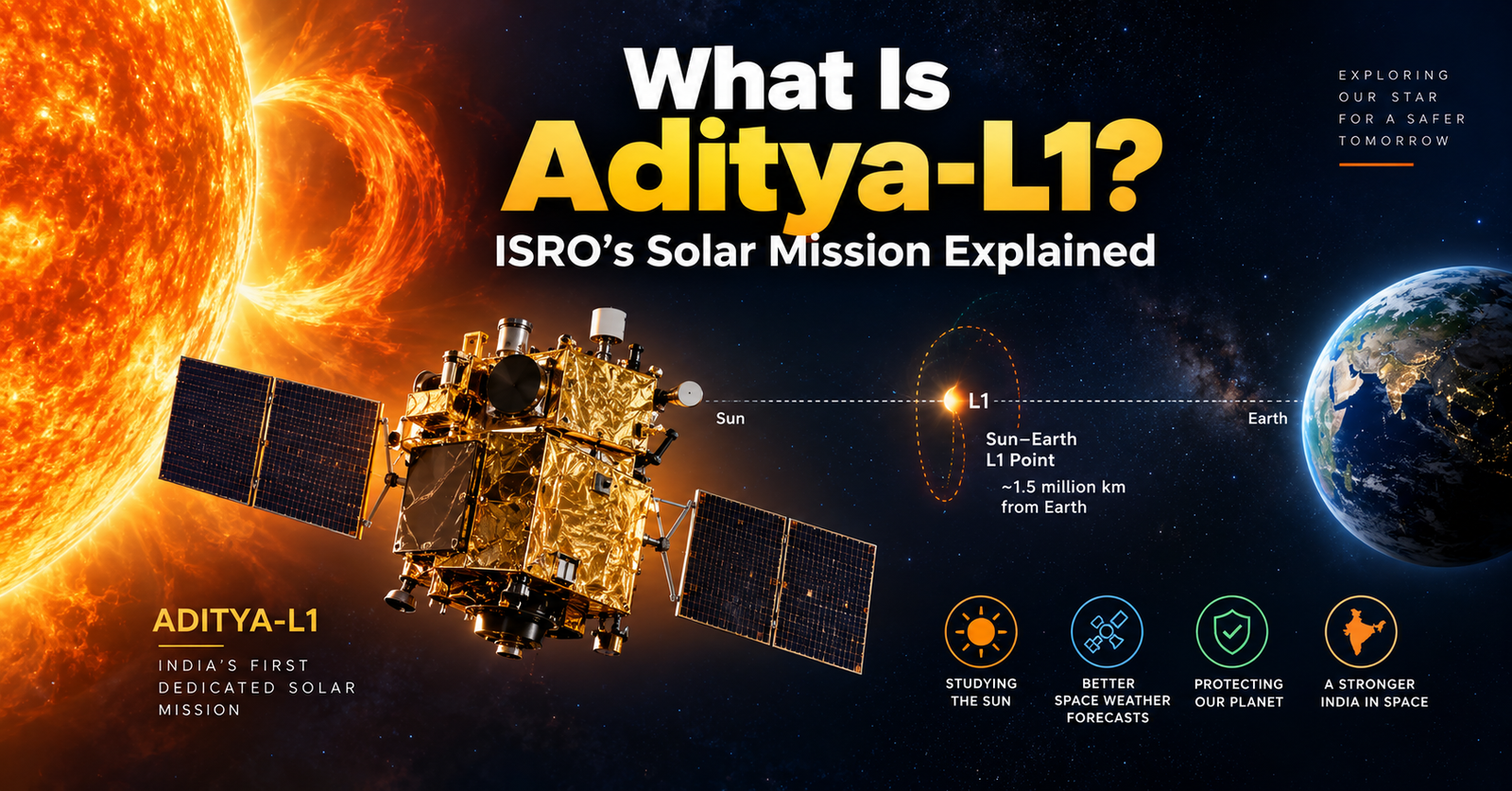
- Developed by
- ISRO
- Launched
- Sept 2, 2023
- Vehicle
- PSLV-C57
- Location
- Sun–Earth L1 point
- Distance
- ~1.5 million km
- Orbit
- Halo orbit (since Jan 2024)
- Payloads
- 7 instruments
- Mission life
- ~5 years
What Is Aditya-L1?
Aditya-L1 is India’s first dedicated space mission to study the Sun, launched by ISRO on September 2, 2023, aboard the PSLV-C57 rocket. “Aditya” means “Sun” in Sanskrit, and “L1” refers to Lagrange Point 1, the location in space where the spacecraft operates.
Rather than travelling toward the Sun, Aditya-L1 was placed in a halo orbit around the Sun-Earth L1 point, about 1.5 million km from Earth, roughly 1% of the total Earth-Sun distance. The spacecraft focuses on the Sun’s outer atmosphere, the corona and chromosphere, and the constant stream of charged particles it emits, rather than the Sun’s surface or interior.
Why Did ISRO Launch a Solar Mission?
The Sun continuously releases energy, particles and magnetic disturbances that travel through the solar system and can affect Earth. Solar flares and coronal mass ejections, sudden bursts of radiation and plasma, can disrupt satellites, GPS signals, power grids and communication systems on Earth.
Understanding these events requires continuous observation from a vantage point not blocked by Earth’s atmosphere or its day-night cycle. ISRO designed Aditya-L1 to study the solar corona, chromosphere, solar wind and the Sun’s magnetic field in ways ground-based telescopes cannot, since Earth’s atmosphere blocks much of the radiation these instruments are built to detect.
How Does Aditya-L1 Study the Sun?
Aditya-L1 orbits the L1 Lagrange point, a location where the gravitational pull of the Sun and Earth balance in a way that lets a spacecraft hold position with minimal fuel while keeping an uninterrupted view of the Sun. Reaching this point took a 16-day Earth-bound phase with five orbit-raising manoeuvres, followed by a 110-day cruise, before the spacecraft was inserted into its halo orbit on January 6, 2024. It completed its first full halo orbit around L1 in 178 days, on July 2, 2024, correcting its path with station-keeping manoeuvres along the way.
The spacecraft carries seven indigenously built instruments. The Visible Emission Line Coronagraph (VELC) is the primary payload, studying the solar corona and coronal mass ejections. The Solar Ultraviolet Imaging Telescope (SUIT) images the solar disk in near-ultraviolet light. Two X-ray spectrometers, SoLEXS and HEL1OS, track solar flares across different X-ray energy ranges. The Aditya Solar wind Particle Experiment (ASPEX) and the Plasma Analyser Package for Aditya (PAPA) measure the particles and composition of the solar wind, while a magnetometer (MAG) records the faint interplanetary magnetic field at L1.
Why Is Aditya-L1 Important?
Aditya-L1 gives ISRO a continuous, unobstructed view of the Sun that is not possible from Earth’s surface. That matters because solar storms can damage satellites, disrupt power grids and threaten astronauts on future missions, making early warning valuable for protecting both space and ground infrastructure. It also places India among a small group of nations running a dedicated space-based solar observatory, built entirely with indigenous instruments.
What Has Aditya-L1 Discovered So Far?
On August 28, 2026, ISRO announced that Aditya-L1 had detected small, short-lived brightenings occurring hours before major solar flares erupt, clustering at the exact location where the flare later occurs. The Solar Ultraviolet Imaging Telescope made the primary observation, with the SoLEXS and HEL1OS X-ray spectrometers confirming a matching release of magnetic energy.
ISRO said the finding suggests that repeated small-scale energy releases progressively destabilise a region’s magnetic field before it erupts as a major flare, a pattern that could move researchers closer to reliable flare forecasting and better protection for satellites and astronauts.
What Are the Challenges of Studying the Sun From L1?
Reaching and operating at L1 required precise trajectory planning; a small error during the 110-day cruise phase could have sent the spacecraft off course. Once in its halo orbit, Aditya-L1 needs periodic station-keeping manoeuvres to counter drift, since L1 is a point of unstable equilibrium rather than a fixed location in space.
The spacecraft’s instruments must also function reliably in a high-radiation environment while pointing continuously at the Sun, without the natural day-night breaks a spacecraft in low Earth orbit would experience.
What Happens Next for Aditya-L1?
Aditya-L1 has a planned mission life of about five years from launch, extending observations through the current rise toward solar maximum, when flares and coronal mass ejections become more frequent. ISRO and partner research institutions continue publishing findings from its instruments, and this data is expected to feed into space weather models used to protect satellites and infrastructure on Earth.
FAQ’s
What does “Aditya-L1” mean?
“Aditya” is the Sanskrit word for the Sun, and “L1” refers to Lagrange Point 1, the location between the Sun and Earth where the spacecraft orbits.
How far is Aditya-L1 from Earth?
It orbits roughly 1.5 million km from Earth, about 1% of the distance between Earth and the Sun.
Does Aditya-L1 look directly at the Sun?
No single instrument stares at the Sun the way a camera would. VELC uses an internal occulter to block the Sun’s bright disk so it can study the much fainter corona around it, while the other instruments observe specific wavelengths and particle types.