
- Founded
- December 2017
- Founders
- Srinath Ravichandran & Moin SPM
- Headquarters
- Chennai (IIT Madras campus)
- Rocket
- Agnibaan (modular, semi-cryogenic)
- Signature tech
- Single-piece 3D-printed engine
- Maiden flight
- Agnibaan SOrTeD — May 30, 2024
- Latest milestone
- 4-engine cluster fired, May 2026
- Bold ambition
- $500M+ valuation, ocean recovery next
- What Is Agnikul Cosmos?
- How Agnikul 3D-Prints an Entire Rocket Engine
- Meet the Agnibaan Rocket
- Agnibaan SOrTeD: The Flight That Made History
- The Four-Engine Cluster Test That Changed Everything
- Ocean Recovery: Agnikul’s Boldest Bet Yet
- Funding, Valuation and Government Backing
- Agnikul vs Skyroot: India’s Two Leading Rocket Startups Compared
- What’s Next for Agnikul Cosmos
- FAQs
What Is Agnikul Cosmos?
Agnikul Cosmos is a Chennai-based private rocket company building its own 3D-printed orbital launch vehicle, founded in December 2017 by Srinath Ravichandran and Moin SPM out of the National Centre for Combustion Research and Development at IIT Madras. It is one of only a handful of Indian private space startups — alongside Skyroot Aerospace — actually building and test-flying its own rocket, rather than just satellite hardware or ground services. Agnikul’s rocket, called Agnibaan, is designed to carry small satellites to low Earth orbit, and the company has built a manufacturing pipeline around 3D printing to produce flight-ready engines in days instead of months.
How Agnikul 3D-Prints an Entire Rocket Engine
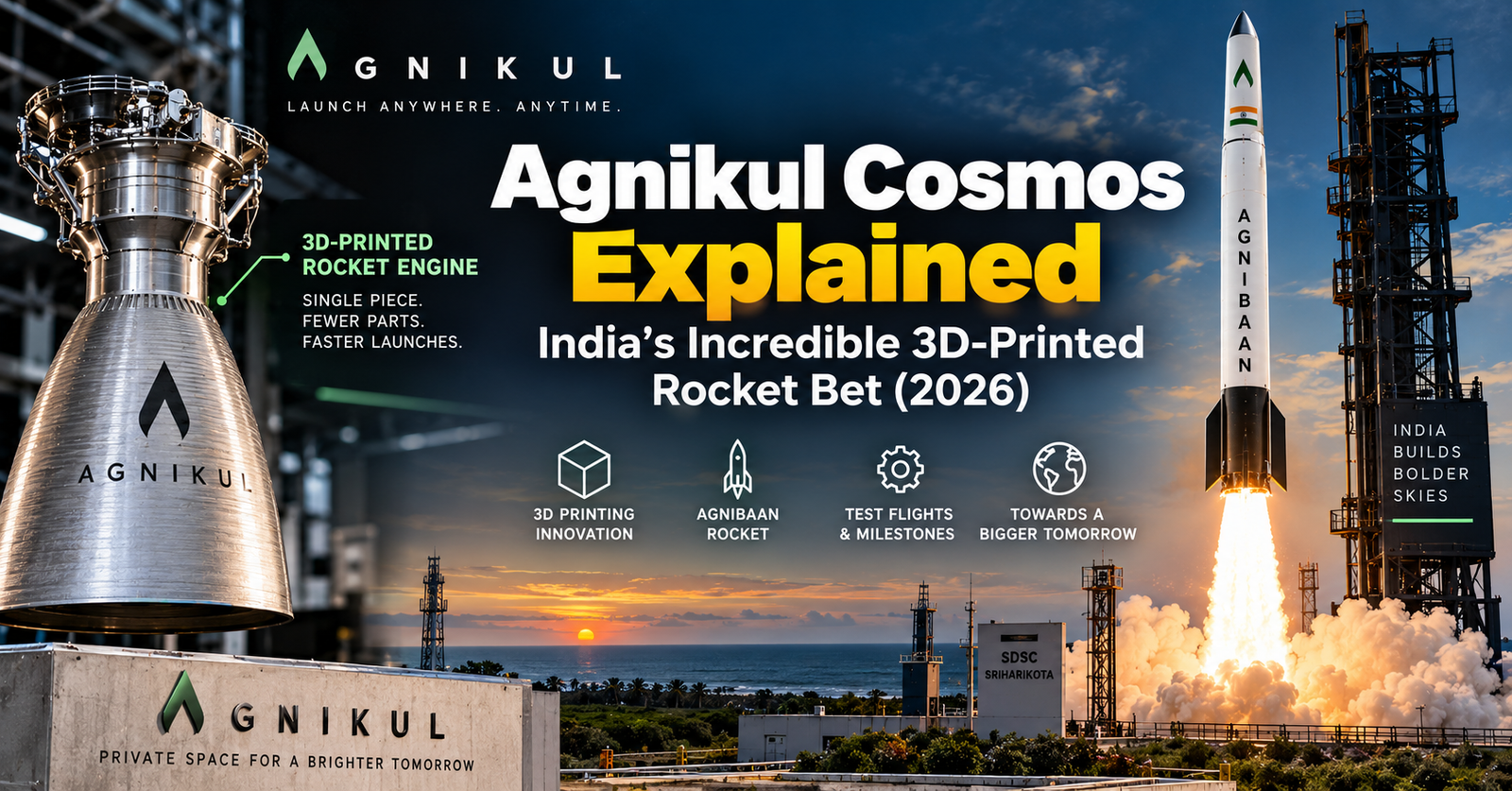
Agnikul’s core innovation is a single-piece, 3D-printed rocket engine machined from the nickel superalloy Inconel — a design the company says had never flown before its 2024 test. Conventional rocket engines are assembled from dozens of separately machined and welded parts; Agnikul instead prints the entire combustion chamber, injector head and cooling channels as one solid piece on an industrial metal printer. The company says this cuts engine production time from roughly six months down to as little as three to nine days, depending on the engine size.
Agnikul holds patents on this design and manufacturing process in India, the US and Europe. In 2025 it opened a Large Format Additive Metal Manufacturing (LFAMM) facility at its Chennai campus, which it describes as housing India’s largest 3D metal printer dedicated to rocket components — a capability profiled in detail by Manufacturing Today.
Meet the Agnibaan Rocket
Agnibaan is Agnikul’s modular small-satellite launch vehicle, built around two engine types: the Agnilet, a smaller engine powering the upper stage, and the larger Agnite booster engine for the first stage. Instead of traditional turbopumps, Agnibaan uses an electric pump-fed propulsion cycle — brushless DC motors drive the propellant pumps — which the company says enables precise, software-controlled throttling of the engines. The rocket burns a semi-cryogenic propellant combination of sub-cooled liquid oxygen and a kerosene-type fuel (Aviation Turbine Fuel). Agnikul has designed Agnibaan to be modular, meaning the number of first-stage engines can be scaled up or down depending on how much payload a customer needs to launch, targeting the small-satellite market of roughly 100–500 kg payloads to low Earth orbit.
Agnibaan SOrTeD: The Flight That Made History
On May 30, 2024, Agnikul launched the Agnibaan SOrTeD (Suborbital Technology Demonstrator) from its own launchpad at the Satish Dhawan Space Centre in Sriharikota — a single-stage suborbital flight that notched several Indian firsts in one shot: the world’s first flight powered by a single-piece 3D-printed engine, India’s first launch of a semi-cryogenic engine, and India’s first launch from a privately built and operated launchpad and mission control centre. The launchpad itself, inaugurated in November 2022, was built with support from ISRO and the Indian National Space Promotion and Authorisation Centre (IN-SPACe), which has backed several Indian private space companies since the sector opened up to private players.
The Four-Engine Cluster Test That Changed Everything
On May 26, 2026, Agnikul successfully test-fired four of its 3D-printed Agnilet engines simultaneously in a clustered configuration — a major milestone toward qualifying the full orbital version of Agnibaan for commercial missions. Because Agnibaan’s first stage relies on clustering multiple engines rather than building one large engine, proving that several 3D-printed engines can fire together reliably and in sync is one of the last big technical hurdles before an orbital launch attempt. It followed an earlier test in February 2025, when Agnikul successfully fired a three-engine Agnilet cluster stack, and a separate 2026 test-firing of the larger Agnite booster engine.
Ocean Recovery: Agnikul’s Boldest Bet Yet
Agnikul’s next flagship mission, referred to as Mission-02, aims to attempt India’s first-ever ocean recovery of an orbital-class rocket booster — a controlled descent that would bring the first stage of a two-stage Agnibaan rocket down for recovery at sea rather than letting it fall away and burn up or crash uncontrolled, as first detailed by Republic World. The plan also calls for the upper stage to double as a functional in-orbit platform once it reaches orbit, rather than becoming space debris.
Company leadership has framed the long-term goal around rapid reuse: recovering and eventually reflying hardware to make frequent, low-cost small-satellite launches economically viable, similar in spirit to how reusable boosters have reshaped launch economics elsewhere in the world.
Funding, Valuation and Government Backing
Agnikul started with about ₹3 crore in seed funding in 2017 and had raised roughly $4 million by the end of 2020. A Series B round in October 2023 brought in $26.7 million, taking total capital raised to around $40 million at the time, with backers including industrialist Anand Mahindra in a personal capacity. By March 2026, Agnikul’s valuation was reported to have crossed $500 million, per public company filings and reporting.
In early 2026, the Tamil Nadu government’s investment arm TIDCO put in ₹25 crore — reportedly the first time an Indian government body has taken a direct equity stake in a space startup, alongside a broader wave of state-level support for the sector. Former ISRO chairman Dr. S. Somanath has since joined Agnikul in a board observer capacity.
Agnikul vs Skyroot: India’s Two Leading Rocket Startups Compared
Agnikul and Skyroot Aerospace are widely seen as the two furthest-along private orbital rocket companies in India, but they’ve taken different technical paths to get there:
| Company | Agnikul Cosmos | Skyroot Aerospace |
|---|---|---|
| Founded | 2017 (IIT Madras) | 2018 (ex-ISRO engineers) |
| Signature tech | Single-piece 3D-printed engines | 3D-printed cryogenic & solid stages, carbon-fibre motors |
| Rocket | Agnibaan (modular, semi-cryogenic) | Vikram series (solid-fuel, orbital) |
| Notable first flight | Agnibaan SOrTeD, May 2024 | Vikram-S, November 2022 |
| Target payload class | ~100–500 kg to LEO | Small satellites, similar class |
Both companies operate from ISRO-linked or IN-SPACe-supported infrastructure, both have flown suborbital demonstration vehicles rather than a full orbital mission so far, and both are chasing the same prize: becoming India’s first private company to put a satellite into orbit on a fully home-built rocket.
What’s Next for Agnikul Cosmos
Agnikul has been building international relationships alongside its technical milestones — the company presented the Agnibaan rocket to French President Emmanuel Macron at the Bharat Innovates 2026 event in Nice, and has signed memoranda of understanding with Finland’s ICEYE and France’s Safran. It has also announced a partnership with Neevcloud to explore a space-based AI data centre concept targeting a 2027 launch aboard Agnibaan. The company’s stated long-term ambition is to scale toward dozens of launches a year, but the near-term milestone every space enthusiast in India is watching for is the same one: Agnibaan’s first full orbital launch attempt, which would make Agnikul one of the first Indian private companies to reach orbit on its own rocket.
FAQ’s
What does Agnikul Cosmos do?
Agnikul Cosmos is a Chennai-based private space company that designs, 3D-prints and test-flies its own small-satellite launch vehicle, called Agnibaan, using a patented single-piece 3D-printed rocket engine.
Has Agnikul Cosmos launched a rocket into orbit yet?
Not yet. Agnikul has flown a suborbital demonstration flight, Agnibaan SOrTeD, in May 2024, and has since test-fired multiple engine clusters on the ground. A full orbital launch attempt has not taken place as of this article.
How is Agnikul’s rocket engine different from a normal rocket engine?
Instead of assembling an engine from many separately machined and welded parts, Agnikul 3D-prints the entire combustion chamber, injector and cooling channels as a single piece of Inconel metal, which the company says cuts production time from around six months to a matter of days.
Who founded Agnikul Cosmos?
Agnikul Cosmos was founded in December 2017 by Srinath Ravichandran and Moin SPM, along with academic collaborators at IIT Madras’s National Centre for Combustion Research and Development.
How is Agnikul different from Skyroot Aerospace?
Both are Indian private rocket startups working toward orbital small-satellite launches, but Agnikul’s Agnibaan uses 3D-printed semi-cryogenic engines, while Skyroot’s Vikram rockets rely on solid-fuel propulsion and carbon-fibre motor casings.