
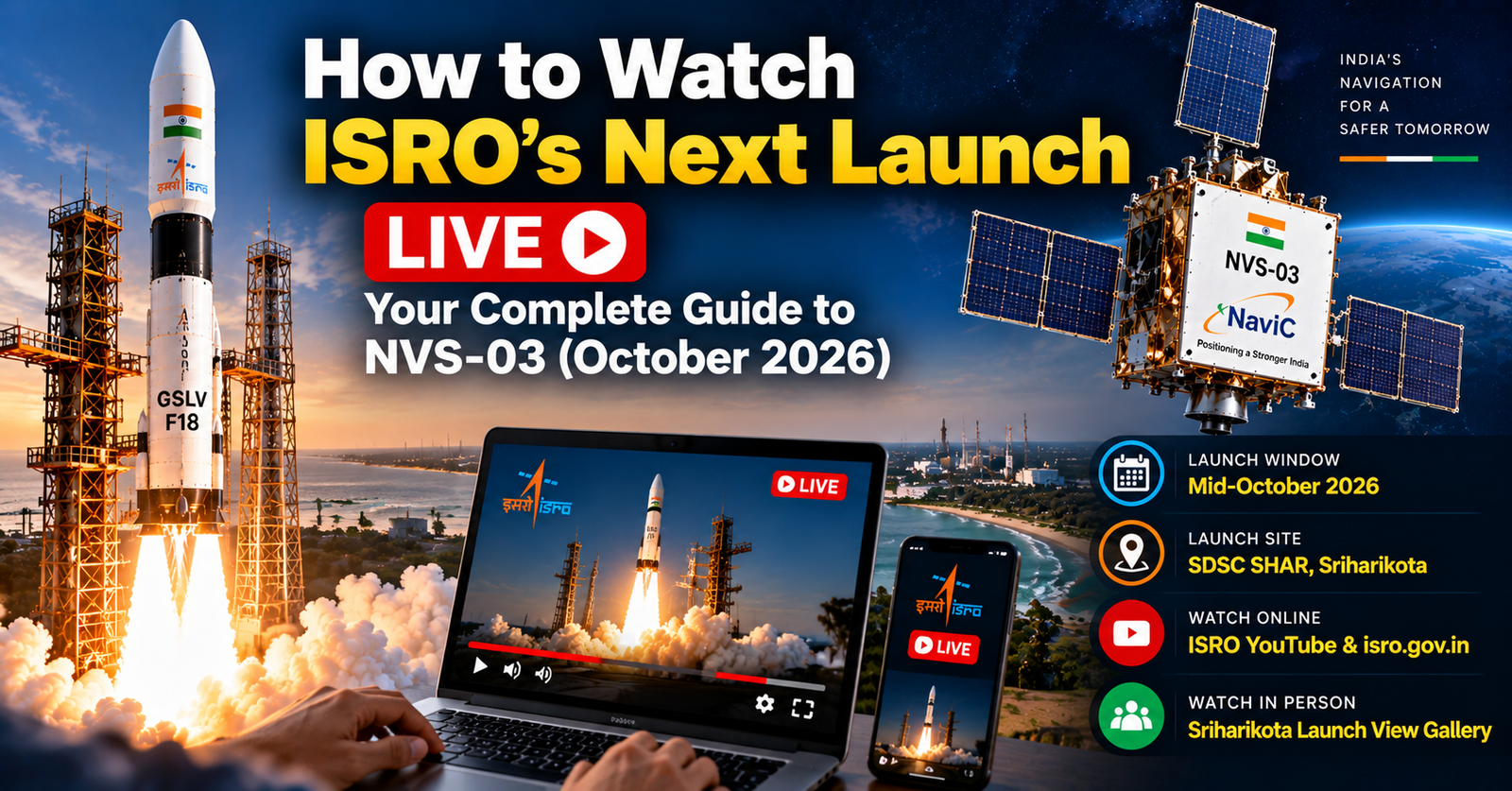
- Next Launch
- NVS-03 (IRNSS-1L)
- Vehicle
- GSLV Mk II F18
- Launch Site
- Satish Dhawan Space Centre, Sriharikota
- Expected Window
- Mid-October 2026
- Watch Online
- ISRO YouTube & isro.gov.in (free)
- Watch In Person
- Sriharikota Launch View Gallery (free)
- Coverage Typically Starts
- ~15–20 min before liftoff
- Why This Launch Matters
- When and Where NVS-03 Will Fly
- How to Watch ISRO Launch Live Online
- When Does Live Coverage Actually Start?
- Watching in Person: The Sriharikota Launch View Gallery
- No Gallery Pass? Here’s the Honest Answer
- What to Expect During the Countdown
- Keep Track Beyond Launch Day
- Frequently Asked Questions
- The Bottom Line
Why This Launch Matters
If you want to watch ISRO launch live in the next few weeks, you have picked a good moment. Sometime in mid-October 2026, the Geosynchronous Satellite Launch Vehicle Mk II is scheduled to lift off from Sriharikota carrying NVS-03 — a satellite India’s navigation network has effectively been waiting more than a year for. ISRO typically confirms the exact date and time only in the final few days before launch, which is exactly why knowing where to watch ISRO launch live matters: you don’t want to be scrambling for a link once the countdown clock actually starts.
This isn’t a routine satellite delivery. India’s NavIC regional navigation system is currently running on just three fully operational satellites, one short of the four needed for the network to fix a position entirely on its own, without leaning on other countries’ GPS signals. NVS-03 is built to restore that fourth working satellite. For more on why that gap opened up and what NVS-03 actually carries, our NavIC explainer covers the full backstory — this guide focuses purely on how to actually watch the launch happen.
NavIC isn’t only a defence tool, either. It’s built into a growing number of Indian smartphones, used for fishermen’s safety alerts along the coast, factored into aviation approach systems, and leaned on during disaster-response coordination. A fully restored four-satellite constellation means all of these everyday uses stop quietly depending on GPS as a fallback and start working the way NavIC was designed to in the first place.
When and Where NVS-03 Will Fly
NVS-03, also designated IRNSS-1L, is a roughly 2,232 kg satellite built by ISRO Satellite Centre and the Space Applications Centre. It will fly on a GSLV Mk II rocket, tail number F18, lifting off from the Satish Dhawan Space Centre (SDSC SHAR) on Sriharikota island off the Andhra Pradesh coast. The launch campaign — the weeks of vehicle stacking and satellite integration that happen before a rocket is ever rolled to the pad — got underway in mid-September 2026, with the flight itself expected in mid-October.
Once in orbit, NVS-03 will sit in a geosynchronous slot at 129.55°E and carry two payload types: a navigation payload broadcasting on the L1, L5 and S bands, built around an indigenous Rubidium atomic clock — the precise timing source every navigation satellite depends on — and a ranging payload for two-way distance measurements. You can track this and every other upcoming Indian mission on our own ISRO Launch Schedule 2026 page, which we update as dates firm up.
How to Watch ISRO Launch Live Online
The simplest way to watch ISRO launch live, wherever you are in the world, is online and free. ISRO streams every launch on its official YouTube channel, and the same feed is usually embedded directly on isro.gov.in‘s homepage once a countdown is underway. No sign-up, no subscription — just a link that goes live shortly before liftoff.
For India’s bigger, higher-profile missions, Doordarshan’s DD National has also simulcast the live telecast on regular television, alongside dedicated space-news channels picking up the same feed. Whether NVS-03 gets that broader TV treatment isn’t confirmed yet, but given how much attention the NavIC gap has drawn from defence and aviation circles, it’s a reasonable bet. Either way, the most reliable habit is simply to follow ISRO’s own X (formerly Twitter) account in the day or two before launch — that’s usually where the exact stream link and start time get posted first.
When Does Live Coverage Actually Start?
A launch countdown itself runs for many hours — sometimes more than a day, once you count fuelling and final system checks — but ISRO doesn’t stream all of it. Live coverage typically begins roughly 15 to 20 minutes before the scheduled liftoff time, once the fully automatic launch sequence has taken over from ground control. That’s the window to actually tune in if you just want to watch ISRO launch live rather than sit through hours of pre-launch commentary.
Launch windows also move. Weather over the Bay of Bengal, a last-minute technical check, or a range clearance issue can push a launch by hours or even days, and NVS-03’s “mid-October” window should be read as an estimate rather than a locked date until ISRO says otherwise. The safest habit is to check isro.gov.in or ISRO’s X account on the morning of the expected date rather than bookmarking a specific time weeks in advance.
If you’re watching from outside India, do the timezone math before you set an alarm. India Standard Time is 5 hours 30 minutes ahead of UTC, which works out to a very early morning for US East Coast viewers and a late-night stream for most of Europe. Most Sriharikota launches happen in the local morning or early afternoon, so it’s worth converting the actual announced time rather than assuming it lines up with your own evening news schedule.
Watching in Person: The Sriharikota Launch View Gallery
If a screen isn’t good enough and you want to actually feel a rocket launch, ISRO runs a free public viewing facility at Sriharikota called the Launch View Gallery. There’s no ticket price — SDSC SHAR is explicit that it “does not charge any amount to the visitors for witnessing the launch” — but seats are limited and registration is required in advance.
Registration happens online at lvg.shar.gov.in. You enter an email address, click a verification link, then fill in your visit details and a valid photo ID (Aadhaar or driving licence both work). One registration can cover up to five people, added within a three-hour window, and the whole process ends with a registration number you use to print or retrieve your visitor pass. The link only stays open until seats fill up for a given launch, so it pays to register as soon as ISRO confirms a date rather than waiting.
On the day itself, arrive at least two hours before the scheduled liftoff with your printed pass and the same photo ID you registered with for every visitor in your group. For early-morning launches, APSRTC runs buses from the Sullurpeta bus stand toward the gallery. If anything about the registration process is unclear, SDSC SHAR’s viewing gallery desk can be reached at +91-7382768500 or by emailing lvg[at]shar.gov.in.
No Gallery Pass? Here’s the Honest Answer
Sriharikota sits on a secured island-like stretch of coast, with the Bay of Bengal on one side and restricted space-centre land on the others — it isn’t the kind of place with a well-known public beach or overlook where crowds gather informally the way they might near Cape Canaveral. If registration closes before you can get a pass, the honest advice is not to chase a “secret” viewing spot near the gate. Access is genuinely limited, and an unofficial vantage point is unlikely to get you a meaningfully better view than what you’d get by simply choosing to watch ISRO launch live on the official stream instead.
In fact, for most people the broadcast is arguably the better experience: multiple camera angles, mission-control commentary explaining each milestone as it happens, and a replay you can go back to. Reserve the in-person trip for a launch where you’ve registered early and confirmed your seat — and treat the livestream as the reliable fallback, not a consolation prize.
What to Expect During the Countdown
Once live coverage begins, ISRO’s mission control commentary walks through each milestone in real time, so you don’t need to know the vehicle by heart to follow along. But knowing roughly what’s coming helps you understand what you’re watching rather than just seeing a bright light climb into the sky.
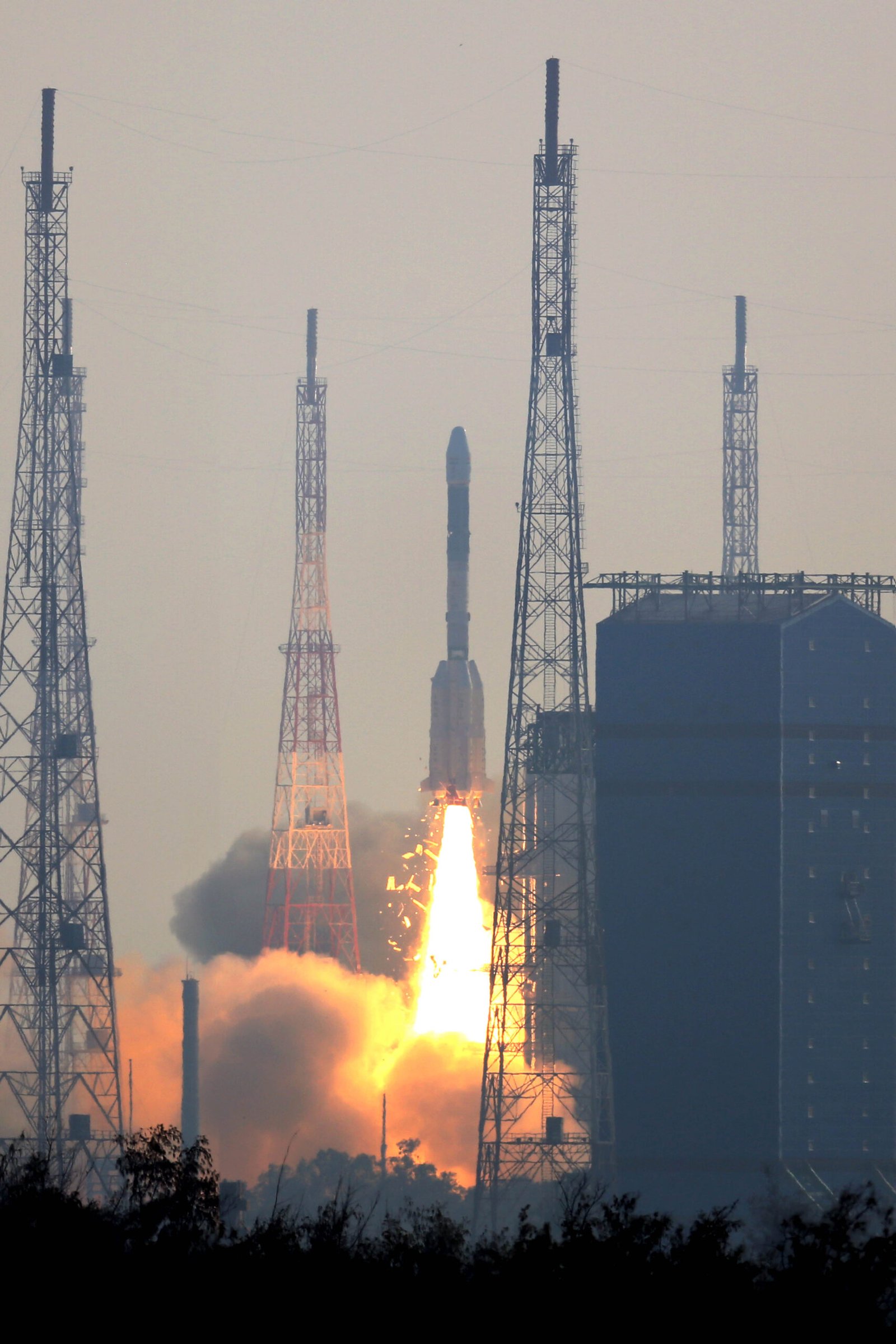
On a GSLV Mk II mission, the solid-fuel core stage and four liquid-fuelled strap-on boosters ignite together at liftoff. The boosters burn out and separate first, followed shortly after by the core stage itself. The second stage then takes over on a single Vikas engine for a little over two minutes, before separating to hand off to the indigenous cryogenic upper stage — the longest single burn of the flight. Satellite separation is typically confirmed a little under 20 minutes after liftoff, once that final stage finishes its job. The rough sequence looks like this:
| Flight Phase | Approx. Timing | What Happens |
|---|---|---|
| Liftoff | T+0 | Core stage and 4 strap-on boosters ignite together |
| Booster & core separation | ~T+100 to 160 sec | Strap-ons and the solid core stage burn out and fall away |
| Second stage burn | ~T+150 to 300 sec | Vikas engine powers the ascent through the upper atmosphere |
| Cryogenic stage burn | ~T+300 sec onward | Indigenous cryogenic upper stage takes over for the long final push |
| Satellite separation | ~T+18 to 20 min | NVS-03 releases into its transfer orbit — mission control confirms on the live stream |
These are approximate figures based on how GSLV Mk II missions typically fly — the commentary during the actual live stream will call out each real milestone as it happens, which is usually far more precise than any pre-launch estimate.
Keep Track Beyond Launch Day
ISRO’s own X account (@isro) remains the fastest place to catch schedule changes, confirmed dates and stream links as they’re announced. Independent trackers like ISRO Spaceflight are also worth following if you like watching the launch campaign itself unfold — vehicle rollout, fuelling milestones and range readiness — in the days before a mission rather than just on launch day. And if you’d rather have one page to check instead of several accounts, our own Launches page tracks every upcoming Indian mission, NVS-03 included, and gets refreshed as dates and details firm up.
Frequently Asked Questions
How can I watch ISRO launch live for free?
ISRO streams every launch live and free on its official YouTube channel, with the same feed usually embedded on isro.gov.in once the countdown reaches its final phase. No sign-up or payment is needed.
When exactly will NVS-03 launch?
ISRO is targeting mid-October 2026 for NVS-03 on a GSLV Mk II F18 rocket, but the exact date and time are usually confirmed only in the final few days before launch. Check isro.gov.in or ISRO’s X account close to the date for the firm schedule.
Can the public watch an ISRO launch in person?
Yes. ISRO runs a free public viewing facility, the Launch View Gallery, at the Satish Dhawan Space Centre in Sriharikota. Seats are limited and advance online registration is required.
How do I register for the Sriharikota Launch View Gallery?
Register at lvg.shar.gov.in with a valid email address and photo ID (Aadhaar or driving licence). One registration can cover up to five people. Registration closes once seats fill for a given launch, so it’s worth registering as soon as ISRO confirms a date.
Does Doordarshan (DD National) telecast ISRO launches?
DD National has simulcast the live feed for several of India’s higher-profile missions in the past, though it isn’t guaranteed for every launch. The ISRO YouTube stream is the one constant you can always rely on.
How long before liftoff does the live stream usually start?
ISRO’s live coverage typically begins roughly 15 to 20 minutes before the scheduled liftoff time, once the automatic launch sequence takes over. The full countdown runs much longer, but only the final phase is streamed.
What happens if the launch is delayed?
Launch delays are common and can happen for weather, technical or range-clearance reasons. ISRO announces the revised date and time on isro.gov.in and its X account, so it’s worth checking there rather than assuming the original slot still holds.
Will the NVS-03 launch be visible from cities like Chennai?
On a clear night launch, the rocket’s exhaust plume can sometimes be seen as a distant glow from parts of coastal Andhra Pradesh and northern Tamil Nadu, and Chennai residents have occasionally reported spotting past ISRO launches this way. But it isn’t reliable, and cities further inland like Bengaluru or Hyderabad won’t see anything with the naked eye. If seeing the launch matters to you, the livestream is still the dependable option.
The Bottom Line
You don’t need a press badge or a trip to the Andhra Pradesh coast to watch ISRO launch live — a free YouTube stream from wherever you are covers it. But if you can plan ahead and register in time, seeing a GSLV clear the tower from the Sriharikota Launch View Gallery is a genuinely different experience from watching it on a screen. For NVS-03 specifically, the stakes are real: this is the satellite that’s meant to give India’s navigation network its independence back. Mid-October is the window — keep an eye on ISRO’s own channels for the exact date, and either way, don’t miss it.
Also read: ISRO Launch Schedule 2026 • Why NavIC Needs This Launch • GSLV vs LVM3: The 2026 Handover • PSLV vs SSLV Compared • What is ISRO? A Complete Guide