
- Programme
- Bharatiya Antariksh Station (BAS)
- Announced
- 18 September 2024
- Lead agency
- ISRO, under the Gaganyaan Programme
- BAS-1 budget
- Rs 1,763 crore
- First module (BAS-1)
- Targeted late 2028
- Full station target
- 2035
- Orbit
- 400 to 450 km, about 51.5 degree inclination
- Crew capacity
- 3 to 4 (up to 6 for short stays)
- What Is the Bharatiya Antariksh Station?
- Why India Wants a Space Station of Its Own
- The Five Modules That Will Make Up BAS
- From SpaDeX to BAS: Why Docking Technology Matters
- How BAS Compares to the ISS and China’s Tiangong
- The Hurdles: Budget, Timelines and a Slipping Date
- Why the Bharatiya Antariksh Station Matters for India
- FAQ’s
What Is the Bharatiya Antariksh Station?
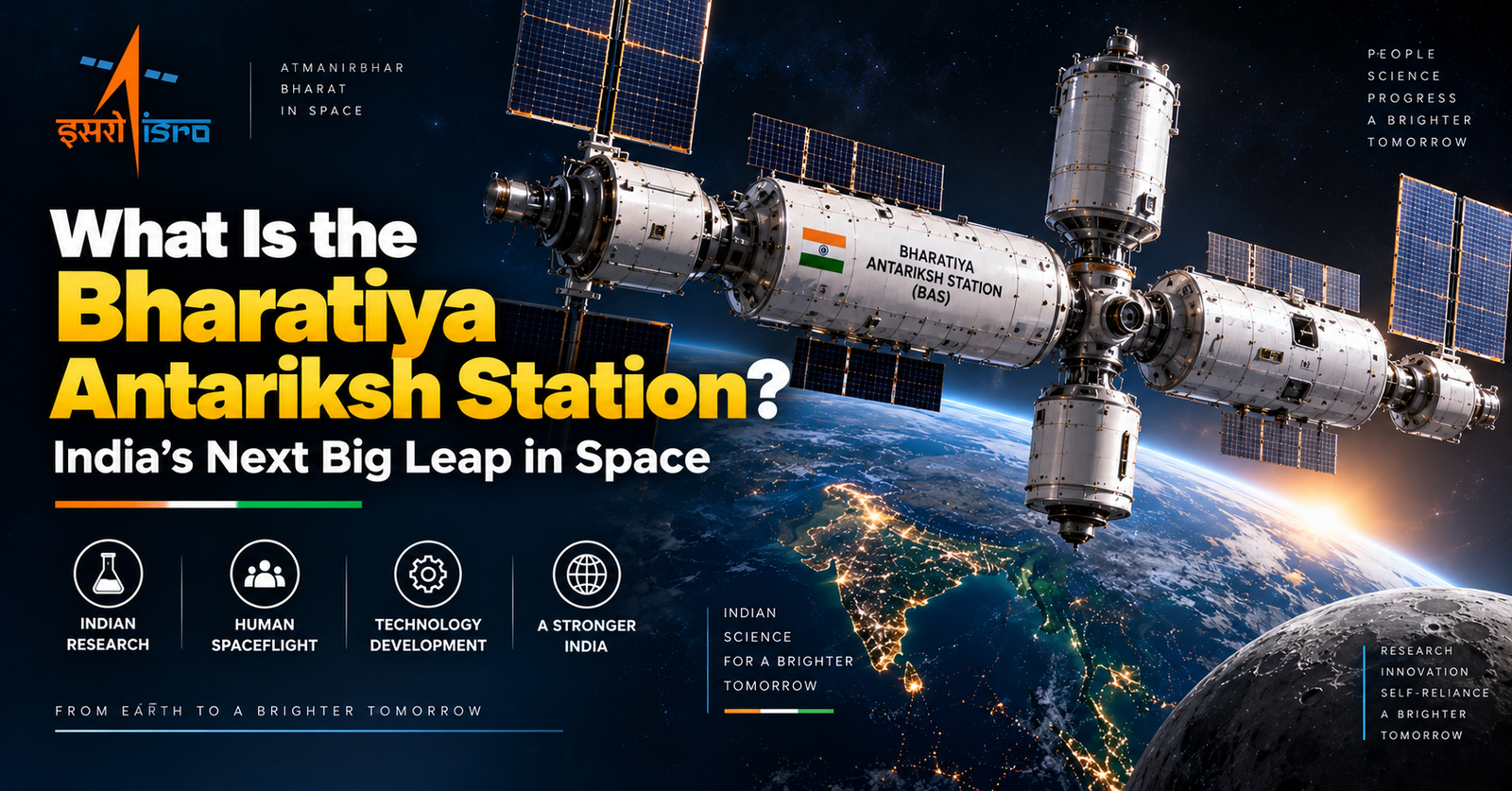
India’s space agency, ISRO, is not stopping at the Moon. Tucked inside an expanded human spaceflight programme is a much bigger ambition called the Bharatiya Antariksh Station, or BAS, a homegrown orbital outpost that India intends to build, launch and largely operate on its own. The name is simple Hindi for Indian Space Station, and unlike the International Space Station, which is a shared project between five space agencies, BAS is designed from the start to be a sovereign Indian facility.
The Union Cabinet formally approved development of the station’s first module on 18 September 2024, folding it into an already expanded and better funded Gaganyaan Programme worth Rs 20,193 crore. That approval turned BAS from a long standing ambition into a funded, scheduled engineering project, with ISRO’s Vikram Sarabhai Space Centre now leading system design and inviting Indian industry to help build it.
It will not appear overnight. ISRO’s plan treats BAS as a staged build, one module launched at a time and docked together in orbit, rather than a single spacecraft that goes up fully assembled. That is also why this article leans on numbers and dates: almost everything about BAS today is a target rather than a fact on orbit, and it is worth being upfront about which is which.
ISRO has also started putting real hardware in orbit to prove pieces of the Bharatiya Antariksh Station concept work, not just publishing renders of it. A humanoid robot called Vyommitra, built to test life support and crew station layouts before a human ever climbs in, is part of that same testing chain that ultimately feeds into how BAS itself gets designed.
Why India Wants a Space Station of Its Own
Only a handful of space programmes have ever operated a space station without leaning entirely on outside partners: the Soviet Union and Russia, going back to Salyut and Mir, the United States with Skylab, and China with Tiangong. The International Space Station itself is a coalition project between NASA, Roscosmos, ESA, JAXA and the Canadian Space Agency, none of whom own it alone. If BAS reaches orbit as planned, India joins that short list on its own terms.
The practical case is about what can only be done in microgravity over long stretches of time: pharmaceutical crystal growth, materials science, combustion studies and biology experiments that Indian researchers currently have almost no direct access to, short of buying limited slots on someone else’s station. A permanent Indian platform means Indian universities and companies can run their own experiment queue instead of waiting in line.
There is also a longer arc to it. Indian officials have repeatedly tied BAS to the country’s Space Vision 2047, the stated goal of a crewed Moon landing by 2040 and a sustained human presence in orbit by the time India marks a century of independence. A working space station is the obvious rehearsal ground for the docking, life support and crew endurance systems that a lunar mission and programmes like Chandrayaan-4 would eventually need.
Concretely, that means things like growing purer protein crystals for drug design, testing how metal alloys solidify without gravity pulling on them, and running combustion experiments that behave differently in microgravity than they do on the ground. Indian pharmaceutical and materials science labs currently have to partner with foreign space agencies or private stations to get even a few days of orbital time for this kind of work. A functioning Bharatiya Antariksh Station turns that into something Indian institutions can simply book.
The Five Modules That Will Make Up BAS
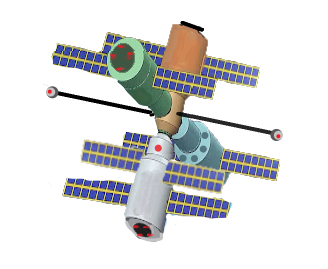
BAS is planned as five separate modules, each launched on its own rocket and joined together after reaching orbit. The line up, as currently published, runs from a Base module through a Core module, a Science module and a Lab module, ending with a Common Berthing Mechanism module that lets later modules and visiting spacecraft dock cleanly onto the station.
BAS-1, the Base module, is the one actually funded and in development right now, budgeted at roughly Rs 1,763 crore across a four year development and launch window running from 2025 to 2028. ISRO’s Vikram Sarabhai Space Centre has already put out an Expression of Interest inviting Indian industry to build structural components, a sign that the government wants private manufacturing capacity involved from the start rather than keeping the whole build in house.
The first two modules, BAS-1 and BAS-2, are expected to fly on the LVM3, the same heavy lift rocket that also carries Gaganyaan’s crewed missions and sent Chandrayaan-3 on its way to the Moon. The later three modules are currently slated for a solid core variant of the same rocket family. None of that launch manifest is locked in this far out, but it tells you BAS leans on rocket hardware India has already flown successfully rather than something brand new.
To put BAS-1’s own size in perspective, ISRO’s published design puts the Base module at about 3.8 metres in diameter and 8 metres long, with a launch mass close to 9,186 kg, roughly in the same weight class as a single Chandrayaan-3 style payload rather than anything exotic. The Core, Science and Lab modules that follow are each a little heavier, in the 10,000 to 11,000 kg range, which is why the later three modules move to the beefier solid core variant of the launch vehicle.
From SpaDeX to BAS: Why Docking Technology Matters
You cannot bolt five separately launched modules together in orbit without first proving you can dock two spacecraft reliably, and that is precisely what ISRO’s SpaDeX mission was built to demonstrate. SpaDeX’s two small satellites found each other in orbit and docked using an indigenous system in early 2025, and ISRO has been explicit that the mission exists to reduce the risk of exactly the kind of assembly BAS will need.
The docking hardware itself, referred to as the Bharat Docking System together with a Bharat Berthing Mechanism, is meant to be India’s own answer to the international docking standards used on the ISS. ISRO has also been quietly testing other pieces of the puzzle in orbit, including a fuel cell tested on a PSLV orbital platform in January 2024 and a robotic arm prototype flown on POEM-4 in January 2025, the kind of arm a station eventually needs to move cargo and assist astronauts outside the spacecraft.
None of this is as glamorous as a launch or a Moon landing, but it is the unglamorous plumbing that decides whether BAS actually comes together in orbit the way it looks in ISRO’s renders.
How BAS Compares to the ISS and China’s Tiangong
It helps to see BAS next to the two space stations currently in orbit. Here is how the numbers line up, using NASA’s own published figures for the ISS and Chinese state figures for Tiangong.
| Station | Mass | Modules | Crew capacity | Status |
|---|---|---|---|---|
| International Space Station | About 420,000 kg | 16 pressurised modules | 7 (nominal) | Continuously crewed since November 2000 |
| Tiangong (China) | About 100,000 kg | 3 modules | 3 (nominal), up to 6 briefly | Construction completed November 2022 |
| Bharatiya Antariksh Station (planned) | About 52,000 kg | 5 modules | 3 to 4 (nominal), up to 6 briefly | BAS-1 targeted late 2028, full station by 2035 |
BAS is a noticeably smaller and lighter station than either of the two currently flying, closer in ambition to Tiangong’s original three module configuration than to an ISS that has been growing for more than two decades. That is by design rather than a limitation. ISRO’s stated goal is a station that supports a rotating crew of three to four astronauts doing focused microgravity research, not a permanent multinational outpost the size of a football field.
The smaller footprint also shapes what kind of research BAS is actually built for. A crew of three to four on the Bharatiya Antariksh Station is enough to run a steady queue of microgravity experiments in materials science, biology and pharmaceuticals, the same categories Indian researchers currently have almost no direct access to, without needing the sprawling multi nation logistics that keep the ISS running.
The Hurdles: Budget, Timelines and a Slipping Date
It is worth saying plainly that BAS has already slipped once. Earlier public statements around the programme pointed to 2030 as the target for a fully operational station, a date that has since moved to 2035 as the programme was reorganised into eight separate missions inside the expanded Gaganyaan Programme.
That kind of slippage is not unusual for a space agency flying its first crewed missions, and it lines up with a pattern seen elsewhere on this site. Gaganyaan’s own first uncrewed test flight, Gaganyaan G1, has moved from an earlier “14 September, confirmed” listing to a softer “second half of 2026, scheduled” listing, with ISRO’s own chairman sticking to describing it only as targeted within the calendar year rather than naming a fixed date. Because BAS-1’s construction and testing timeline now sits inside that same programme, a further slip on Gaganyaan’s crewed milestones would likely push BAS-1 as well.
International cooperation is the other open question. ISRO has signed a statement of intent with the European Space Agency on low Earth orbit operations, cargo delivery and astronaut training, and officials have said both NASA and Russia’s Roscosmos have expressed interest in cooperating. None of that has yet turned into a signed, funded agreement of the kind that would let an astronaut from outside India fly to BAS, so any headlines about an international crew joining soon are worth reading carefully until an actual mission is booked.
Parliament has also kept a close eye on the numbers. Union ministers have fielded repeated questions in the Lok Sabha and Rajya Sabha about BAS-1’s cost and schedule, and the government’s own answers have stuck to the same line: system engineering and subsystem work are progressing, and the 2028 target for the Bharatiya Antariksh Station’s first module still holds, at least officially. Whether that holds once BAS-1 moves from paper design into actual hardware testing is the detail worth watching over the next couple of years.
Why the Bharatiya Antariksh Station Matters for India
Strip away the module diagrams and mission patches, and BAS is really a bet that India’s space programme is ready to graduate from flying missions to living and working in orbit on a sustained basis. Everything the country has demonstrated since Chandrayaan-3, SpaDeX and the early Gaganyaan test flights points toward that same destination.
The honest read is that 2028 for the first module and 2035 for a complete station are both dates worth watching rather than dates worth banking on. This programme has already been re planned once, it depends on Gaganyaan clearing its own crewed flight milestones first, and its international partnerships are still preliminary. None of that makes BAS less real or less worth covering. It just means the sensible way to follow this story is module by module and test by test, rather than waiting for a single launch day.
FAQ’s
What is the Bharatiya Antariksh Station?
The Bharatiya Antariksh Station, or BAS, is India’s planned indigenous space station, a five module orbital facility that ISRO intends to assemble in low Earth orbit starting with the BAS-1 base module.
When will the first BAS module launch?
ISRO and the Indian government have targeted late 2028 for the launch of BAS-1, the station’s first module, with the full five module station planned to be complete by 2035.
How much does the Bharatiya Antariksh Station cost?
The first module, BAS-1, is budgeted at approximately Rs 1,763 crore across its four year development and launch cycle, funded within the wider Rs 20,193 crore Gaganyaan Programme.
How many modules will BAS have, and how big is it?
BAS is planned to have five modules, a Base, Core, Science, Lab and Common Berthing Mechanism module, with a combined mass of around 52,000 kg once complete, considerably smaller than the International Space Station.
How does BAS compare to the ISS and Tiangong?
BAS is designed to be smaller than both existing stations, with a planned mass of about 52,000 kg against roughly 420,000 kg for the ISS and about 100,000 kg for China’s Tiangong, and a nominal crew of three to four astronauts compared to seven on the ISS.
Is the Bharatiya Antariksh Station connected to Gaganyaan?
Yes. BAS-1 is formally one of eight missions inside India’s expanded Gaganyaan Programme, and its construction timeline depends on the same human spaceflight systems, including docking technology proven by the SpaDeX mission, that Gaganyaan is also developing.
Which countries are helping India build BAS?
India has signed a statement of intent with the European Space Agency covering low Earth orbit operations and astronaut training, and both NASA and Russia’s Roscosmos have expressed interest in cooperating, though none of these discussions have yet become a signed, funded partnership.