
- Full name
- Chandrayaan-4 (Lunar Sample Return Mission)
- Agency
- ISRO
- Mission type
- Lunar sample return
- Approved
- 18 Sep 2024 (Union Cabinet)
- Budget
- ₹2,104.06 crore (~$220 million)
- Target launch
- 2028
- Launch vehicle
- 2 × LVM3
- Spacecraft modules
- 5 (Propulsion, Descender, Ascender, Transfer, Re-entry)
- Target zone
- Moon’s south pole region
- What Is Chandrayaan-4?
- Why Bring Moon Rocks Back to Earth?
- The Mission Architecture: Five Modules, Two Launches
- How SpaDeX Already De-Risked the Hardest Part
- Chandrayaan-3 vs Chandrayaan-4: What’s Different
- Budget, Timeline and Where Things Stand Today
- What Could Go Wrong
- Why This Matters for India
- Frequently Asked Questions About Chandrayaan-4
- The Bottom Line
What Is Chandrayaan-4?
Chandrayaan-4 is ISRO’s next Moon mission after Chandrayaan-3’s historic 2023 landing, and it is a very different kind of undertaking. Chandrayaan-3 sent a lander and rover to the Moon’s south pole region, ran its experiments, and stayed there. Chandrayaan-4 is built to do something no Indian mission has ever done: collect actual pieces of the Moon and bring them home.
Officially the Lunar Sample Return Mission, it’s been described by ISRO Chairman V Narayanan as India’s most complex lunar mission to date. The Union Cabinet approved it on 18 September 2024 with a budget of ₹2,104.06 crore (roughly $220 million) and an original 36-month development window. That timeline has since slipped, as first-of-kind missions often do — ISRO’s own 2026 statements now point to a 2028 launch.
Calling it “Chandrayaan-4” undersells how big a jump this is. It isn’t a slightly upgraded lander. It’s two rockets, an orbital docking, a launch off the lunar surface, and a return trip, four things India has never done, stacked into one mission.
Why Bring Moon Rocks Back to Earth?
Landers and rovers carry instruments, but they’re limited by what can survive the trip and fit inside a spacecraft. A sample sitting in a lab on Earth can be studied with equipment far too large, too delicate, or too new to ever launch, electron microscopes, mass spectrometers, isotope-dating labs that get more precise every year. Scientists can also keep going back to the same sample for decades, testing new questions that hadn’t even been asked when it was collected. Apollo-era Moon rocks, brought back over 50 years ago, are still being re-analysed today with instruments that didn’t exist when they landed.
That’s why sample return is treated as a different tier of space mission entirely. Only three space programs have ever pulled it off: the United States (Apollo, and now the robotic Artemis-era efforts), the Soviet Union (the Luna program, in the 1970s), and China (Chang’e-5 and Chang’e-6, in 2020 and 2024). If Chandrayaan-4 succeeds, it would make India the fourth country to bring lunar material back to Earth under its own program and the first to attempt it from the Moon’s south pole region specifically, an area of intense scientific interest because of the water-ice deposits Chandrayaan-1 helped confirm there in 2009.
The Mission Architecture: Five Modules, Two Launches
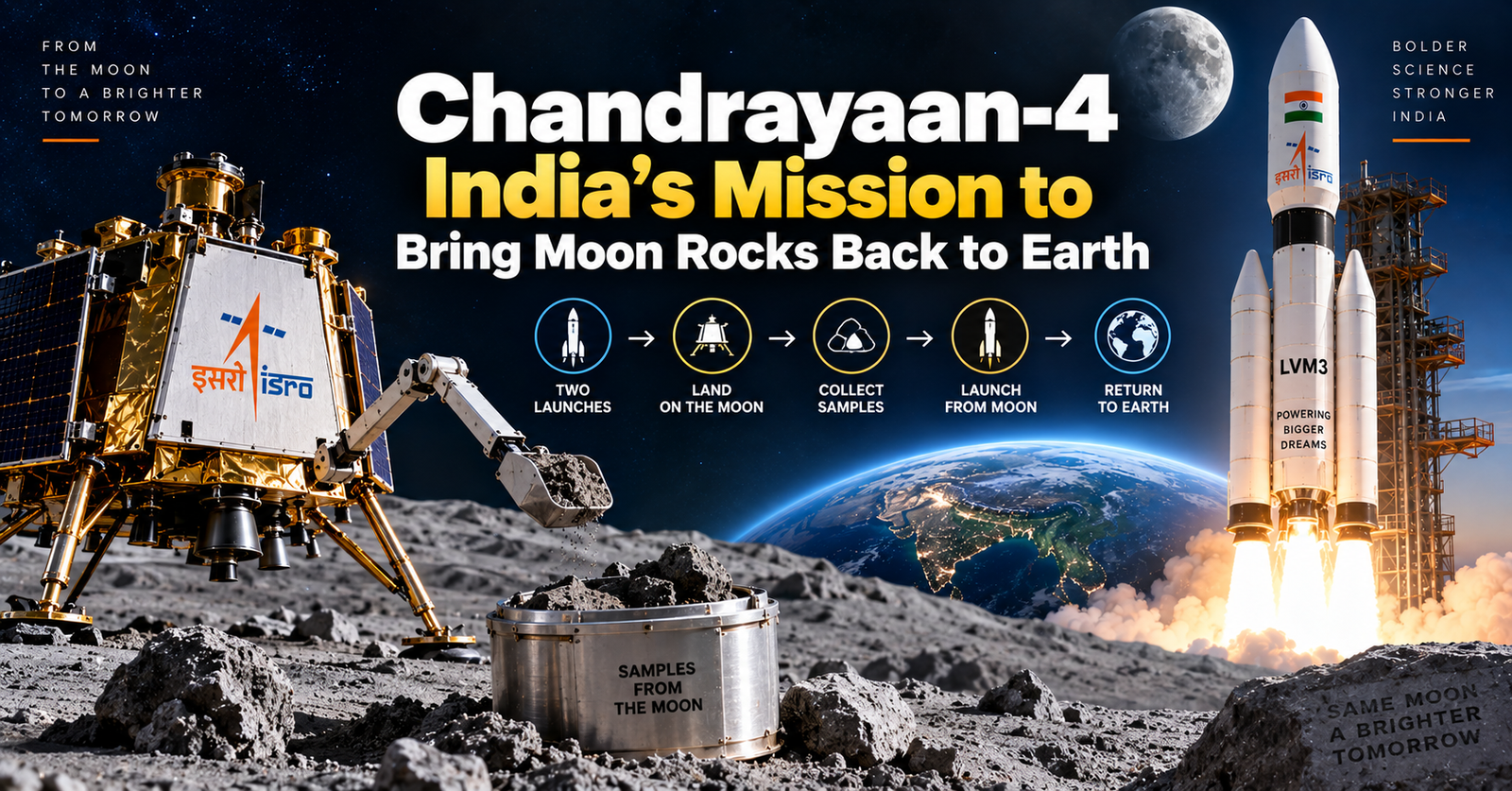
A single LVM3 — ISRO’s most powerful rocket can’t lift everything Chandrayaan-4 needs in one go. The fully assembled spacecraft weighs roughly 9,200 kg, well beyond what one launch can carry to the Moon. ISRO’s answer is to split the mission across five separate modules and two LVM3 launches, then assemble the pieces in space:
- Propulsion Module — carries the stack from Earth orbit toward the Moon
- Descender Module — the lander that touches down on the lunar surface
- Ascender Module — carries the collected samples and launches back off the Moon
- Transfer Module — waits in lunar orbit and carries the samples back toward Earth
- Re-entry Module — separates near Earth and brings the sealed samples down to the surface
The sequence: the two LVM3 launches send up separate parts of the stack, which dock and assemble in Earth orbit before heading to the Moon together. Once there, the Descender and Ascender separate and land near the south pole region, where a robotic arm and drill collect an estimated 2–3 kg of lunar regolith and rock. The Ascender then does something India has never attempted: it launches itself off the Moon’s surface, climbs into lunar orbit, and docks with the waiting Transfer Module. The Transfer Module carries the sample container back toward Earth, where the Re-entry Module separates and lands, delivering the first pieces of the Moon ISRO will have ever held.
How SpaDeX Already De-Risked the Hardest Part
That “dock in orbit” step isn’t a minor detail, it’s arguably the single hardest thing in the entire mission. Which is exactly why ISRO didn’t leave it untested. The SpaDeX mission launched on 30 December 2024 specifically to prove India could dock two spacecraft in orbit before betting a lunar sample-return mission on it. It worked: SpaDeX achieved its first docking on 16 January 2025, de-docked on 13 March 2025, and completed a second, fully autonomous docking on 20 April 2025.
ISRO has been explicit that SpaDeX exists as “a demonstrator and forerunner” for Chandrayaan-4’s docking requirement, and the same Bharatiya Docking System is expected to carry over. That’s genuinely good news for Chandrayaan-4’s odds, but worth being precise about what was actually proven. SpaDeX docked two small, 220 kg satellites a few hundred kilometres above Earth, with near-instant communication back to ground control. Chandrayaan-4 has to repeat that same maneuver in lunar orbit, at roughly 1,000 times the distance, with a communication delay of over a second each way, using a much heavier spacecraft. SpaDeX proved the concept works. It didn’t prove it works at lunar distance under lunar conditions that part is still ahead.
Chandrayaan-3 vs Chandrayaan-4: What’s Different
| Chandrayaan-3 | Chandrayaan-4 | |
|---|---|---|
| Mission type | Lander + rover | Lunar sample return |
| Launches required | 1 | 2 (docked in Earth orbit) |
| Rocket | LVM3-M4 | 2 × LVM3 |
| Modules | 2 (Propulsion, Lander) | 5 (Propulsion, Descender, Ascender, Transfer, Re-entry) |
| Orbital docking needed | No | Yes, twice (Earth orbit and lunar orbit) |
| Launch from the Moon’s surface | No | Yes |
| Sample returned to Earth | No, mission ended on the Moon | Yes, an estimated 2–3 kg |
| Outcome | Successful landing, 23 Aug 2023 | Planned for 2028 |
Budget, Timeline and Where Things Stand Today
The Union Cabinet cleared Chandrayaan-4 on 18 September 2024 with a budget of ₹2,104.06 crore and an original target of launching within 36 months of approval, which would have meant late 2027. That has since moved: speaking in 2026, ISRO Chairman V Narayanan has repeatedly confirmed 2028 as the mission’s target year, India’s most complex lunar mission yet needing the extra runway to get right.
As of early 2026, ISRO’s public statements have stayed high-level. Speaking at a university convocation in Pune on 5 February 2026, Narayanan said that “following the historic success of Chandrayaan-3, India has accelerated its space missions and preparations are underway for the ambitious Chandrayaan-4 and Chandrayaan-5 projects” without disclosing further technical specifics. Through 2025, ISRO’s public design work has focused on the robotic arm and drill for sample collection, the high-capacity propulsion needed to carry the docked stack to the Moon and back, and validating the docking system through SpaDeX. Don’t expect a fixed launch date before ISRO has flown at least one more docking demonstration closer to what Chandrayaan-4 actually needs.
What Could Go Wrong
It’s worth being honest about the risk here, because Chandrayaan-4 is not a mission with one point of failure, it’s a mission with several, stacked end to end. Two separate LVM3 launches both have to succeed. The two spacecraft have to find and dock with each other in Earth orbit. The lander has to touch down safely in the same unforgiving south pole terrain that nearly ended Chandrayaan-2. The Ascender has to launch itself off the lunar surface, something no Indian rocket has ever done, and something only the US, Soviet Union and China have ever pulled off. It then has to dock again, this time in lunar orbit, over a second of communication delay from ground control. A failure at any single step and the samples don’t come home.
ISRO’s own recent track record is a useful reality check here rather than a reason for false confidence. The PSLV-C62 failure in January 2026 was a reminder that even ISRO’s most flight-proven rockets can still fail, and that was on a comparatively simple mission with a single launch and no docking at all. None of this means Chandrayaan-4 won’t work, ISRO has a strong record of eventually succeeding at things it commits to, Chandrayaan-3 itself being the clearest example after Chandrayaan-2’s partial failure. But a slipping timeline between now and 2028 should be read as normal caution on a genuinely hard mission, not as a warning sign.
Why This Matters for India
Beyond the science, Chandrayaan-4 is a capability-building mission as much as an exploration one. Orbital docking, launching off another world, and a controlled Earth re-entry are the same underlying skills India needs for its own Gaganyaan crewed spaceflight program and its longer-term ambition to build the Bharatiya Antariksh Station. Every one of those technologies gets tested here first, uncrewed, before India ever puts an astronaut through the same maneuvers.
There’s also the plain matter of standing: joining the US, Russia and China as the only nations to have retrieved lunar material under their own program would be a significant marker of where India’s space program has landed, less than two decades after Chandrayaan-1 first confirmed water on the Moon.
Frequently Asked Questions About Chandrayaan-4
What is Chandrayaan-4?
Chandrayaan-4 is ISRO’s planned Lunar Sample Return Mission, a mission to land near the Moon’s south pole region, collect 2–3 kg of lunar rock and soil, and bring it back to Earth. It was approved by the Union Cabinet on 18 September 2024 with a budget of ₹2,104.06 crore.
When will Chandrayaan-4 launch?
ISRO is currently targeting 2028. The mission was originally approved with a 36-month development window from September 2024, but ISRO Chairman V Narayanan has since confirmed 2028 as the target launch year given the mission’s complexity.
How is Chandrayaan-4 different from Chandrayaan-3?
Chandrayaan-3 was a single-launch lander-and-rover mission that stayed on the Moon. Chandrayaan-4 needs two LVM3 launches, an orbital docking in Earth orbit, a launch off the lunar surface, a second docking in lunar orbit, and a return trip to Earth, it is designed to bring physical samples home, which Chandrayaan-3 did not attempt.
Why does Chandrayaan-4 need two rocket launches?
The fully assembled Chandrayaan-4 spacecraft weighs roughly 9,200 kg, more than a single LVM3, ISRO’s most powerful rocket, can carry to the Moon in one launch. ISRO splits the mission into two launches, then docks the pieces together in Earth orbit before heading to the Moon.
Has India ever launched a rocket from the Moon’s surface before?
No. Chandrayaan-4’s Ascender module launching off the lunar surface to return to orbit would be a first for India. Only the United States, the Soviet Union, and China have ever launched a vehicle off the Moon and returned it to orbit.
How does SpaDeX relate to Chandrayaan-4?
SpaDeX (Space Docking Experiment) was ISRO’s 2024‑2025 mission to prove India could dock two spacecraft in orbit, a capability Chandrayaan-4 depends on. ISRO has described SpaDeX as a demonstrator and forerunner for Chandrayaan-4’s docking system, though Chandrayaan-4 will need to repeat the maneuver at lunar distance rather than in Earth orbit.
What is the budget for Chandrayaan-4?
The Union Cabinet approved ₹2,104.06 crore (roughly $220 million) for Chandrayaan-4 on 18 September 2024.
The Bottom Line
Chandrayaan-4 is the most ambitious thing ISRO has committed to since Gaganyaan, and arguably the harder engineering problem of the two — it asks India to succeed at four things it has never done before, in a single uninterrupted sequence, roughly 384,000 km from the nearest repair shop. SpaDeX genuinely proved the docking concept works, and that matters. But proving a concept in Earth orbit and executing it flawlessly at the Moon, on the far side of a communication delay, are different challenges, and it’s fair to expect the 2028 target to move again before this mission actually flies. That’s not a criticism — it’s what an honest first-of-kind mission timeline usually looks like. If it works, India joins a club of exactly three other space programs. If it slips a year or two, that will be entirely normal, and worth watching rather than worrying about.
Also Read:
- What is ISRO? A Complete Beginner’s Guide to India’s Space Agency
- SpaDeX Mission: How India Mastered Space Docking, And Why It Changes Everything
- Why Chandrayaan-3 Landed Near the Moon’s South Pole
- Gaganyaan Mission 2026: India’s First Human Spaceflight Explained
- PSLV-C62 Failure: What Went Wrong With ISRO’s Rocket Launch