
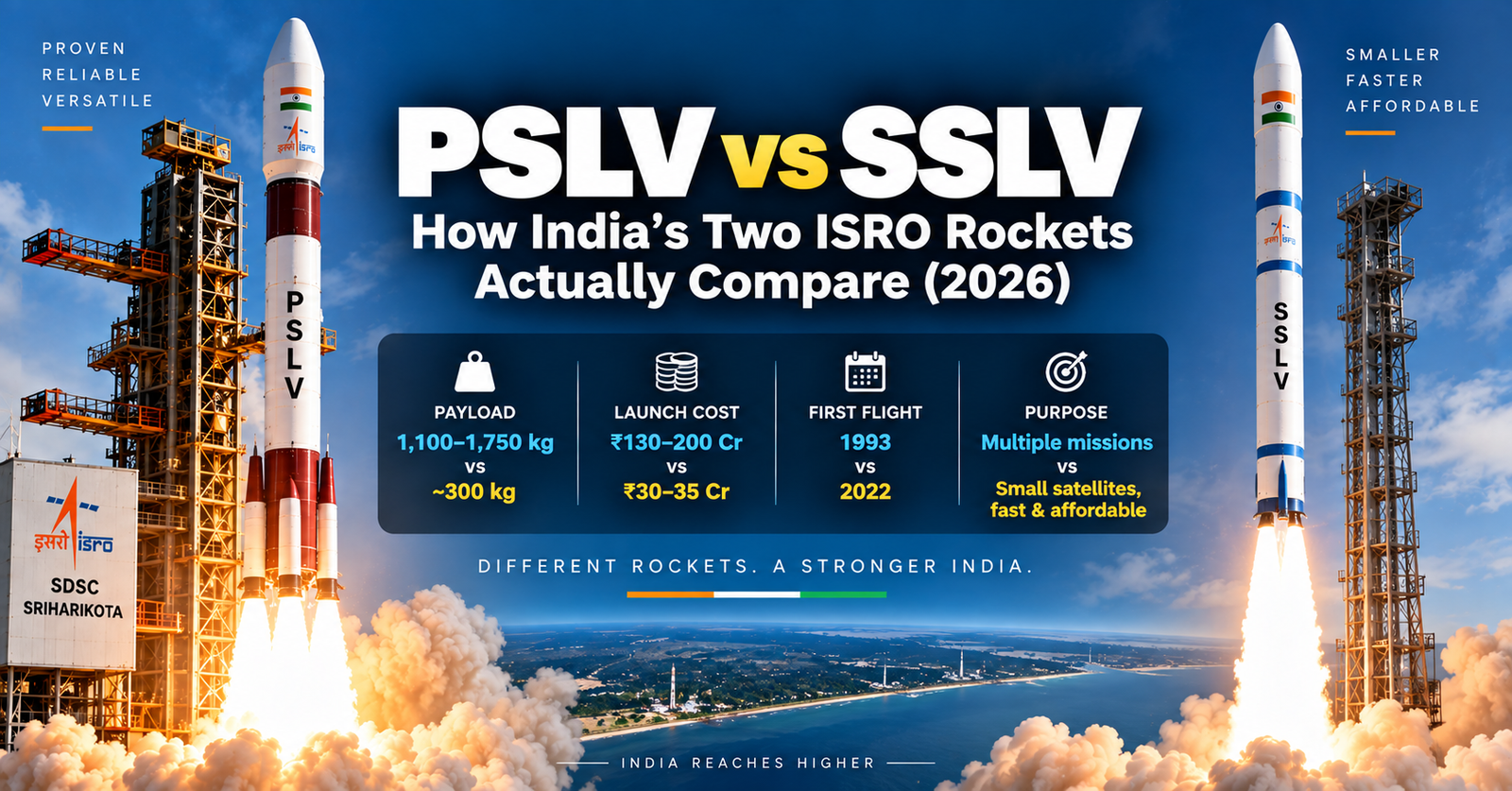
- PSLV payload (Sun synchronous orbit)
- 1,100 to 1,750 kg, depending on variant
- SSLV payload (Sun synchronous orbit)
- About 300 kg, rising to near 390 kg after its 2025 upgrade
- PSLV cost per launch
- Roughly Rs 130 to 200 crore
- SSLV cost per launch
- Roughly Rs 30 to 35 crore
- PSLV first flight
- 1993
- SSLV first flight
- 2022
- PSLV flights so far
- 63, with 58 fully successful
- SSLV flights so far
- 3, with 2 fully successful
- Now moving to
- Both rockets are being handed to private Indian industry from 2026 onward
- PSLV vs SSLV: What Is the Real Difference?
- PSLV: The Workhorse With Three Decades of Flight
- SSLV: Built for Speed, Not Size
- PSLV vs SSLV: Payload and Cost, Side by Side
- Track Record: Who Actually Delivers
- Why ISRO Built Two Different Rockets
- 2026 Update: Both Rockets Are Going Private
- PSLV vs SSLV: Which Rocket Should You Actually Follow?
- FAQ’s
PSLV vs SSLV: What Is the Real Difference?
This PSLV vs SSLV comparison starts with a simple search bar test. Type PSLV or SSLV into one and you will find plenty of pages explaining each rocket on its own, but far fewer that put them side by side and answer the question most people are really asking: what is the point of having two different rockets, and which one should you actually pay attention to?
The short version is that PSLV and SSLV were never meant to compete with each other. PSLV is ISRO’s senior workhorse, flying since 1993 and built to carry almost anything into almost any orbit. SSLV is a much newer, much smaller rocket built for one job only, getting a small satellite into orbit fast and cheap.
That difference in purpose explains almost everything else about them, from how tall they are to how they are put together to who is now being trusted to build them. This article walks through both rockets honestly, including where SSLV has struggled, and lays out where each one actually fits into India’s launch plans through the rest of this decade.
PSLV: The Workhorse With Three Decades of Flight
The Polar Satellite Launch Vehicle first flew in 1993, and its debut flight actually failed. ISRO fixed what went wrong and PSLV has spent the three decades since becoming one of the most trusted rockets in the world.
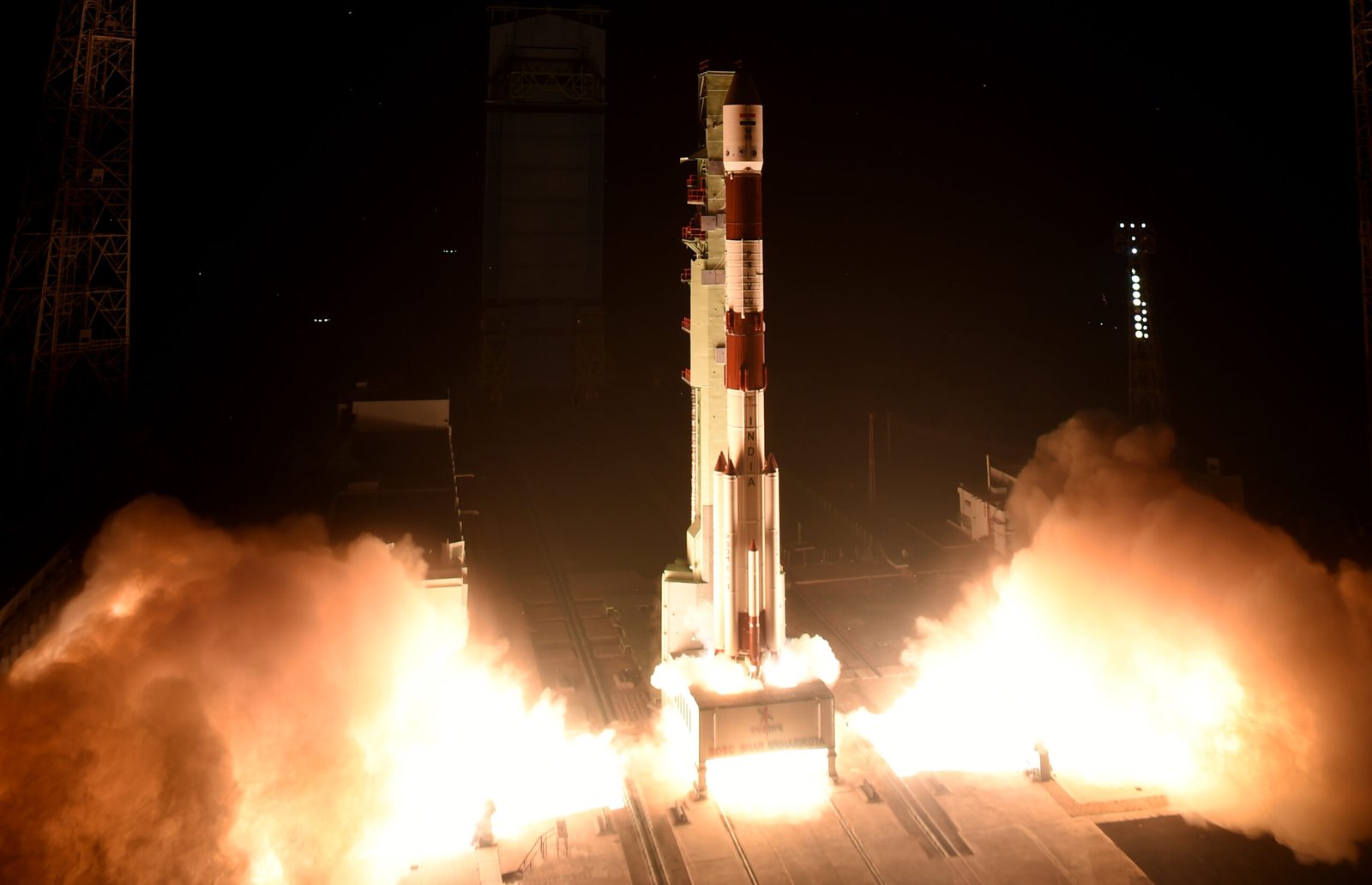
It stands 44 metres tall and flies in three main variants, the standard PSLV-G, the lighter PSLV-CA with no strap on boosters, and the PSLV-XL with six larger strap on boosters for its heaviest missions. Depending on the variant, it can carry between roughly 1,100 and 1,750 kilograms to Sun synchronous orbit, and up to about 3,800 kilograms to a lower altitude orbit close to the equator.
PSLV is the rocket behind some of India’s proudest space moments. It sent Chandrayaan-1 to the Moon in 2008, carried the Mars Orbiter Mission to Mars in 2013 on India’s first attempt, and put the AstroSat space telescope into orbit. In February 2017 it set a world record by deploying 104 satellites on a single flight, a record that stood for years.
As of early 2026, PSLV has flown 63 times, with 58 missions reaching their planned orbit successfully, four outright failures and one partial failure, a success rate around 92 percent that few rockets anywhere can match over such a long career. That record is not spotless even now. Earlier this year, PSLV-C62 failed after a roll disturbance in its third stage, a reminder that even a veteran rocket can still have a bad day. A single PSLV launch typically costs somewhere between Rs 130 and 200 crore and takes weeks of integration work by a large ground team before it is ready to fly.
SSLV: Built for Speed, Not Size
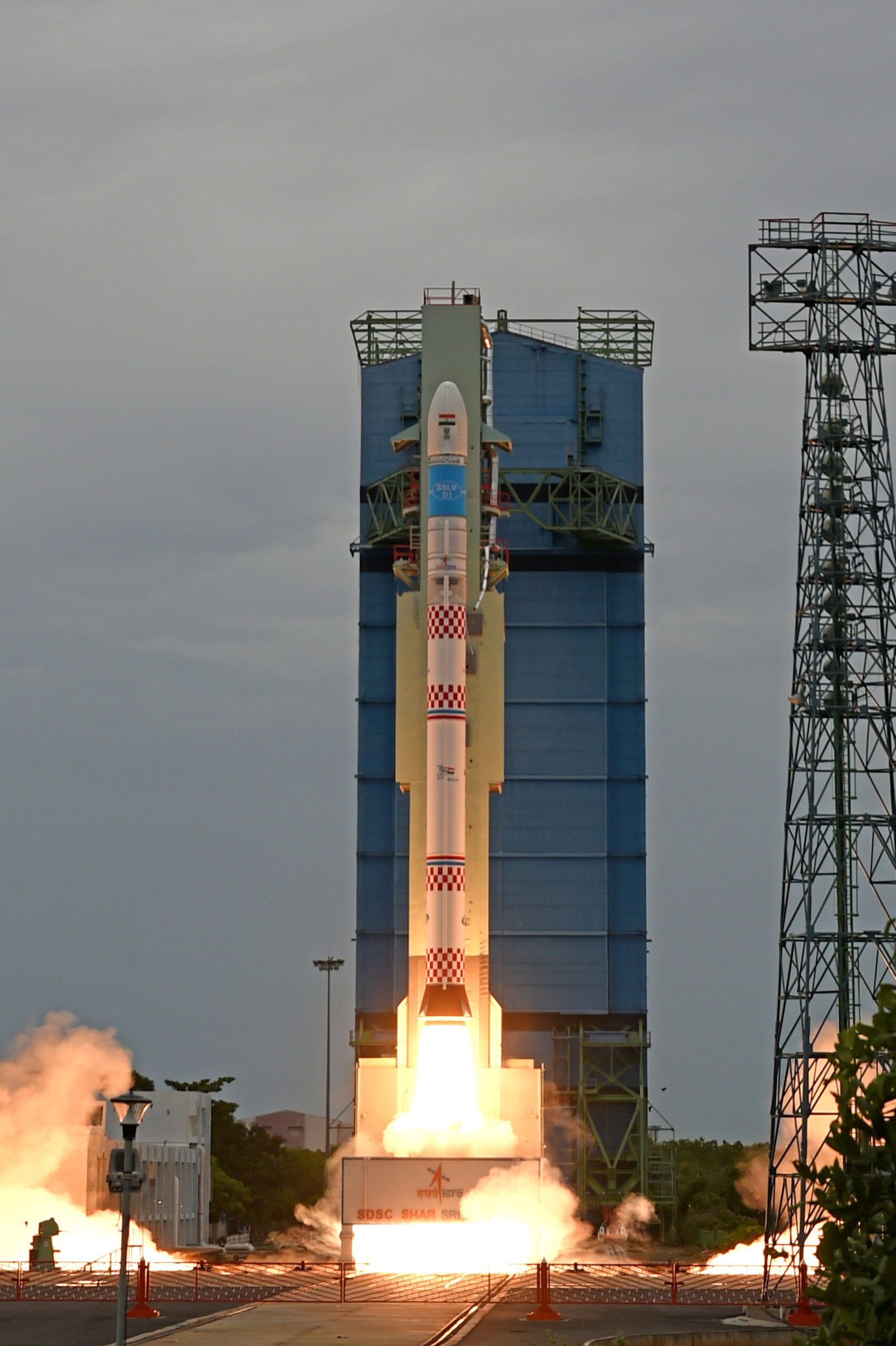
The Small Satellite Launch Vehicle takes a completely different approach. It stands 34 metres tall, noticeably shorter than PSLV, and uses three solid fuel stages topped by a small liquid engine called the Velocity Trimming Module, which fine tunes the final orbit after the solid stages burn out. SSLV can carry roughly 300 kilograms to Sun synchronous orbit and up to about 500 kilograms to a lower inclination orbit close to the equator.
In December 2025, ISRO ground tested an upgraded SSLV motor with a carbon epoxy casing and a redesigned nozzle that together add about 90 extra kilograms of payload capacity, a meaningful jump for a rocket this size, where every kilogram genuinely counts.
SSLV has flown only three times. SSLV-D1 in August 2022 failed when the Velocity Trimming Module misfired for a fraction of a second instead of the planned 20 seconds, leaving its satellites stranded in the wrong orbit. ISRO fixed the fault and came back with SSLV-D2 in February 2023, which placed its satellites in a clean 450 kilometre orbit, followed by a second success with SSLV-D3 in August 2024, carrying the EOS-08 satellite.
The whole point of SSLV is speed. ISRO designed it to be integrated and readied for launch in under three days, using a team of around six people, compared with the weeks of work and hundreds of engineers a PSLV campaign needs. That shows up directly in the price too, at roughly Rs 30 to 35 crore per launch, less than a quarter of what a PSLV flight costs.
PSLV vs SSLV: Payload and Cost, Side by Side
Numbers make the split between these two rockets clearer than words can. Here is how the PSLV vs SSLV comparison actually looks on the specifications that matter most.
| Metric | PSLV | SSLV |
|---|---|---|
| Height | 44 metres | 34 metres |
| Stages | 4, alternating solid and liquid | 3 solid stages plus a liquid Velocity Trimming Module |
| Payload to Sun synchronous orbit | 1,100 to 1,750 kg | About 300 kg, rising toward 390 kg |
| Payload to Low Earth Orbit | 2,100 to 3,800 kg | 375 to 525 kg |
| Cost per launch | Roughly Rs 130 to 200 crore | Roughly Rs 30 to 35 crore |
| Typical campaign time | Several weeks | Under 3 days |
| First flight | 1993 | 2022 |
| Flights as of 2026 | 63, with 58 successful | 3, with 2 successful |
The gap in cost is the number worth sitting with. SSLV works out to somewhere around a sixth of what a PSLV flight costs, which only makes sense once you remember it is also carrying a small fraction of the payload. Per kilogram, the two rockets end up closer than the headline prices suggest, but for a startup with one small satellite and a tight budget, SSLV’s lower absolute price and faster booking are what actually matter.
Track Record: Who Actually Delivers
PSLV’s 92 percent success rate across 63 flights is a genuinely elite record, built up mission by mission since 1994. That history is exactly why ISRO trusted it with Chandrayaan-1, the Mars Orbiter Mission and AstroSat, spacecraft that cost too much and take too long to build to risk on an unproven rocket. Even a workhorse can stumble, though, and this year’s PSLV-C62 failure was a useful reminder that a long track record lowers risk, it does not remove it.
SSLV’s numbers look shakier only because there are so few of them. Two successes out of three flights is not a statistically meaningful success rate yet, it is simply too early to say. What matters more is that ISRO diagnosed exactly what went wrong on SSLV-D1, fixed it, and flew two clean missions afterward, and the motor upgrade tested in December 2025 shows the programme is still actively being refined rather than left alone after a good result. A rocket this young earns trust the same way PSLV once did, one flight at a time.
None of this makes the PSLV vs SSLV comparison a simple case of one rocket being better than the other. A satellite operator with one 200 kilogram Earth observation payload and a tight schedule has a very different answer than a space agency planning a multi tonne interplanetary probe. The right comparison is less about which rocket wins and more about which one actually fits the mission in front of it.
Why ISRO Built Two Different Rockets
Building a second, smaller rocket only makes sense if the first one cannot serve everyone, and PSLV genuinely cannot. It is built for payloads that need real capability, heavy Earth observation satellites, interplanetary probes, national security payloads, and it gets booked out correspondingly far in advance. That is a fine arrangement for ISRO’s own flagship missions, but it is a poor fit for the wave of Indian space startups building small, relatively cheap satellites who need to fly on a schedule measured in months, not years.
Companies like Pixxel and Dhruva Space represent exactly the kind of customer SSLV was designed around, satellite builders who would rather book a dedicated, quick turnaround launch for one payload than wait in line for a shared slot on a much bigger rocket. SSLV exists so that India has a genuine answer for that end of the market instead of losing that business to launch providers overseas.
The broader picture explains why this PSLV vs SSLV split matters beyond ISRO’s own missions. India’s small satellite sector has grown fast, from a handful of experimental cubesats a decade ago to a steady pipeline of Earth observation, communication and technology demonstration satellites from companies chasing global contracts. Every one of those satellites needs a ride to orbit, and until SSLV matured, many of them queued for a shared slot on PSLV or looked at launch providers outside India entirely. A rocket built specifically for that market, priced and scheduled for it, keeps more of that business inside India rather than losing it overseas, which is really what the PSLV vs SSLV divide is meant to prevent.
2026 Update: Both Rockets Are Going Private
The most important thing happening in the PSLV vs SSLV story right now has nothing to do with either rocket’s design. In September 2025, ISRO signed a technology transfer agreement for SSLV with a consortium including NewSpace India Limited, Hindustan Aeronautics Limited and IN-SPACe, handing over the rocket’s manufacturing so it can be produced at industrial scale for commercial small satellite demand rather than built one at a time inside ISRO.
PSLV is following the same path. ISRO plans to transfer half of all future PSLV development work to an Indian industry consortium once that consortium completes two successful launches, part of a stated national goal of reaching 50 rocket launches a year instead of today’s 10 to 12.
ISRO chairman V Narayanan has pointed out that Indian industry already builds somewhere between 80 and 85 percent of the hardware that goes into ISRO’s missions, so handing over final assembly of PSLV and SSLV is less of a leap than it might sound. For SpaceCraft India readers, the practical takeaway is this: within a few years, the PSLV and SSLV flying missions may be built by private Indian companies under license rather than by ISRO itself, with ISRO shifting its own attention toward research, the Bharatiya Antariksh Station and deeper space missions.
PSLV vs SSLV: Which Rocket Should You Actually Follow?
If you are following India’s big, headline missions, deep space probes, human spaceflight support craft, heavy Earth observation satellites and eventually the modules of the Bharatiya Antariksh Station, PSLV and its heavier sibling LVM3 are the rockets to watch, and the full 2026 launch schedule is the best place to track them. If what interests you is the fast growing world of Indian space startups building their own satellites, SSLV is the rocket that will actually carry their hardware, and it is worth watching closely as private manufacturing ramps up over the next few years.
Neither side of the PSLV vs SSLV comparison makes the other obsolete. PSLV proved what a capable Indian rocket looks like over three decades, and SSLV is now trying to prove what a fast, affordable one looks like, with its more recent record still being written one flight at a time.
FAQ’s
What is the main difference between PSLV and SSLV?
PSLV is ISRO’s larger, four stage rocket built since 1993 to carry heavy and complex payloads to a wide range of orbits. SSLV is a smaller, three stage rocket built since 2022 specifically to launch small satellites quickly and at lower cost.
Can SSLV replace PSLV?
No. SSLV carries only about 300 kilograms to Sun synchronous orbit, far less than PSLV’s 1,100 to 1,750 kilograms, so it cannot handle PSLV’s heavier missions such as interplanetary probes or large Earth observation satellites. The two rockets serve different parts of the market rather than competing directly.
Why did SSLV’s first flight fail?
SSLV-D1 failed in August 2022 because its Velocity Trimming Module, the small liquid engine that fine tunes the final orbit, fired for only a fraction of a second instead of the planned 20 seconds, leaving its satellites in the wrong orbit. ISRO fixed the fault and SSLV has flown successfully twice since.
How much does it cost to launch on PSLV versus SSLV?
A PSLV launch typically costs between Rs 130 and 200 crore, while an SSLV launch costs roughly Rs 30 to 35 crore, less than a quarter as much, reflecting SSLV’s much smaller payload capacity and simpler, faster integration process.
Is PSLV being retired?
No. PSLV is still actively flying and remains ISRO’s most experienced rocket, with 63 flights and a 92 percent success rate as of early 2026. What is changing is who builds it, with ISRO transferring half of future PSLV development work to a private Indian industry consortium.
Who is taking over production of PSLV and SSLV?
SSLV’s manufacturing has been transferred to a consortium including NewSpace India Limited, Hindustan Aeronautics Limited and IN-SPACe under a September 2025 agreement. PSLV is set to follow a similar path, with ISRO handing half of future development work to a separate private industry consortium once it completes two successful launches.
Which rocket has flown more successfully, PSLV or SSLV?
PSLV has the far stronger record by volume, with 58 of its 63 flights reaching their planned orbit successfully since 1993. SSLV has flown only three times, with two successes, which is too small a sample to draw a reliable success rate from yet.