
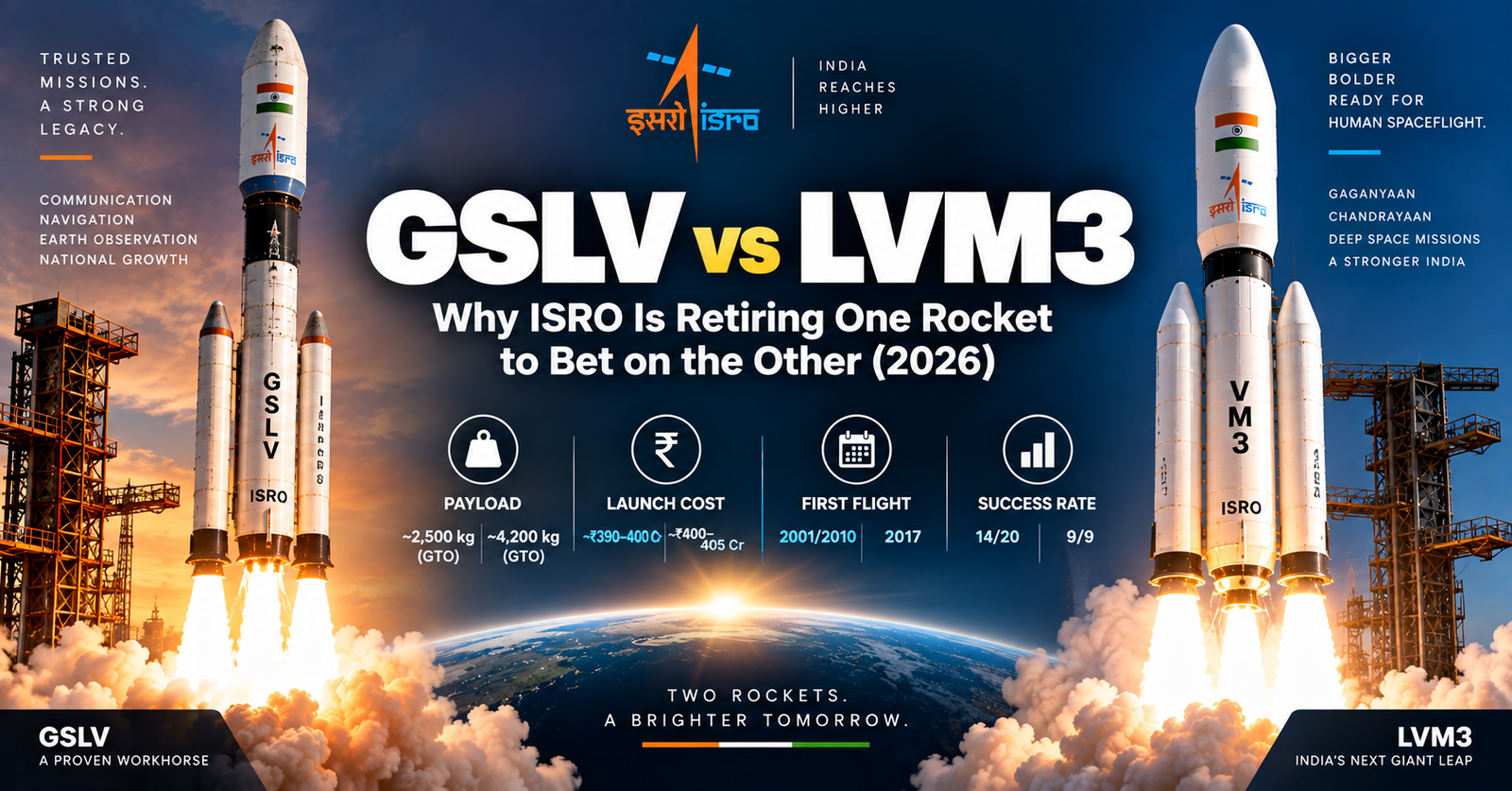
- GSLV payload (GTO)
- About 2,500 kg
- LVM3 payload (GTO)
- About 4,200 kg
- GSLV cost per launch
- Roughly Rs 390 to 400 crore
- LVM3 cost per launch
- Roughly Rs 400 to 405 crore
- GSLV first flight
- 2001 (Mk I), 2010 (Mk II)
- LVM3 first flight
- 2017
- GSLV flights so far
- 20, with 14 fully successful
- LVM3 flights so far
- 9, all fully successful
- Now moving to
- GSLV is being retired by 2027, LVM3 is being human rated for Gaganyaan
- GSLV vs LVM3: What Is the Real Difference?
- GSLV Mk II: The Rocket ISRO Is Retiring
- LVM3: The Rocket ISRO Is Betting Everything On
- GSLV vs LVM3: Payload and Cost, Side by Side
- Track Record: Who Has Actually Delivered
- Why ISRO Is Retiring a Rocket That Still Works
- 2026 Update: LVM3 Gets Ready to Carry Astronauts
- GSLV vs LVM3: Which Rocket Should You Actually Follow?
- FAQ’s
GSLV vs LVM3: What Is the Real Difference?
On September 3, 2026, a GSLV Mk II lifted off from Sriharikota carrying EOS-05, ISRO’s replacement for an earth observation satellite that had failed to reach orbit years earlier. It was a clean, textbook launch, the kind GSLV has quietly delivered dozens of times since 2001. Yet that same rocket is now on a retirement countdown, with only a handful of missions left before ISRO stops flying it altogether. One launch pad over, LVM3, the newer and far more powerful rocket, is being rebuilt for the most important job any Indian launch vehicle has ever had: carrying a human crew.
That is the real story behind GSLV vs LVM3. These are not simply two rockets competing for the same missions, they are two chapters in ISRO’s launch vehicle story, one closing and one just beginning. GSLV Mk II has been India’s dependable, if occasionally troubled, ride to geostationary orbit for a decade and a half. LVM3 is the rocket that put an Indian lander on the Moon in 2023, and is now being modified, quite literally, to be trusted with astronauts’ lives.
This GSLV vs LVM3 comparison looks at both rockets honestly: what each one can actually lift, what it costs, how reliable it has been, and what 2026 means for each of their futures. If you have ever wondered why India seems to be retiring a rocket that still works fine, or what makes LVM3 different enough to carry a crew, this is that comparison.
GSLV Mk II: The Rocket ISRO Is Retiring
GSLV Mk II first flew in April 2010, the second attempt at a rocket that had a genuinely rough start. Its Mk I predecessor failed twice and suffered two partial failures across just six flights, largely because of an imported Russian cryogenic stage ISRO struggled to fully master. Mk II fixed the worst of those problems by switching to an indigenous cryogenic engine, and has since become a steady, if unglamorous, part of India’s launch fleet. It stands about 49 metres tall, combines a solid first stage with liquid strap on boosters and a cryogenic third stage, and can lift roughly 2,500 kg to geostationary transfer orbit or 6,000 kg to low Earth orbit.
Across both variants, GSLV has now flown roughly 20 times since 2001, with 14 fully successful missions, 4 outright failures, and 2 partial failures, most of that early turbulence concentrated in the retired Mk I era. Mk II alone has been considerably steadier, and its most recent flights, including NVS-02 in January 2025, the NASA-ISRO NISAR mission in July 2025, and EOS-05 in September 2026, all went off without a hitch. Each launch costs roughly Rs 390 to 400 crore.
None of that recent reliability is saving it. ISRO’s own launch manifests show only a handful of GSLV Mk II missions left, mostly navigation satellites for the NVS constellation and spacecraft for India’s IDRSS data relay system, stretching into 2027. After that, ISRO has indicated it will stop flying the rocket entirely. It is an unusual kind of retirement: not because GSLV broke, but because India’s launch needs, and its own bigger, better rocket, moved past it.

LVM3: The Rocket ISRO Is Betting Everything On
In the GSLV vs LVM3 comparison, LVM3 is a different class of rocket altogether. It first reached orbit in June 2017, stands about 43.5 metres tall, and is built around two large solid boosters, a liquid core stage, and an indigenous cryogenic upper stage, giving it nearly double GSLV’s lifting power: roughly 10,000 kg to low Earth orbit and 4,200 kg to geostationary transfer orbit. It is best known as the rocket that carried Chandrayaan-3 to the Moon in 2023, and it has not lost a single mission since its very first orbital flight, a perfect record across nine launches as of late 2025.
What makes that record more striking is the price. A GSLV vs LVM3 cost comparison should, on paper, heavily favour the smaller rocket, but it does not. LVM3 costs roughly Rs 400 to 405 crore per launch, only slightly more than GSLV’s Rs 390 to 400 crore, despite carrying close to double the payload. That is the quiet economic case behind retiring GSLV: LVM3 simply does more for barely more money.
LVM3 is no longer just a heavy lift cargo rocket, either. Over the past two years ISRO has been building a human rated version, called HLVM3, adding a crew escape system and multiple safety redundancies specifically so it can be trusted to carry people. That single fact, more than any number on a spec sheet, is what really separates these two rockets right now.
GSLV vs LVM3: Payload and Cost, Side by Side
Put the real GSLV vs LVM3 numbers next to each other and the gap becomes obvious. LVM3 is not a marginal upgrade over GSLV, it is close to a different category of rocket, built for a different job.
| Specification | GSLV Mk II | LVM3 |
|---|---|---|
| Height | 49 metres | 43.5 metres |
| Stages | Solid + liquid strap-ons, liquid core, cryogenic upper stage | Two solid boosters, liquid core, cryogenic upper stage |
| Payload to GTO | About 2,500 kg | About 4,200 kg |
| Payload to LEO | About 6,000 kg | About 10,000 kg |
| Cost per launch | Roughly Rs 390 to 400 crore | Roughly Rs 400 to 405 crore |
| First flight | 2001 (Mk I), 2010 (Mk II) | 2017 |
| Flights so far | 20, with 14 fully successful | 9, all fully successful |
| Current status | Being retired after a handful of final missions | Being human rated for Gaganyaan |
The one place GSLV still technically wins is cost per kilogram to LEO on paper thinness, but even that edge mostly disappears once you account for how much more reliably LVM3 has flown. A rocket that costs a little more but has never failed is, in practical terms, cheaper than one that occasionally does not reach orbit at all.

Track Record: Who Has Actually Delivered
Numbers on a spec sheet only tell half of the GSLV vs LVM3 story, so it is worth looking at what each rocket has actually done. GSLV‘s overall record, 14 successes out of 20 flights, looks shaky next to LVM3’s perfect 9 for 9, but that combined figure hides an important detail: almost all of GSLV’s failures happened under the retired Mk I configuration, in the rocket’s first decade. Mk II alone has been considerably more consistent, and has strung together a run of clean flights through 2025 and 2026.
LVM3‘s record is simply exceptional by any standard. Since its first orbital flight in 2017 it has carried Chandrayaan-3 to the Moon, launched India’s heaviest communication satellites, and flown the NASA partnered NISAR-class missions without a single failure. That perfect run is exactly why ISRO feels comfortable building a human rated version of it, reliability like that is rare for any launch vehicle this early in its life, and it is the single biggest reason LVM3 rather than GSLV was chosen to eventually carry Indian astronauts.
Why ISRO Is Retiring a Rocket That Still Works
It is a fair question in any GSLV vs LVM3 discussion: if GSLV Mk II is still flying cleanly, why stop? The honest answer is that running two separate medium lift rockets, GSLV and LVM3, means maintaining two separate production lines, two sets of ground infrastructure, and two supply chains for a country that is trying to fly more missions, faster, with limited engineering manpower. LVM3 already covers GSLV’s entire job and then some, so keeping GSLV flying stops making financial sense once LVM3’s launch cadence can absorb the extra missions.
This mirrors a pattern already playing out elsewhere in India’s launch fleet. The PSLV and SSLV are both being handed over to private Indian industry consortiums from 2026 onward, part of a broader push to get ISRO out of routine production and into research and exploration. GSLV’s retirement fits the same logic from a different angle: rather than privatising an older design, ISRO is simply retiring it once its newer, more capable sibling can take over completely.
Looking further out in this GSLV vs LVM3 story, both rockets will eventually be succeeded by India’s Next Generation Launch Vehicle, a partially reusable rocket ISRO approved in September 2024 with a roughly Rs 8,240 crore budget. NGLV is not expected to fly before the early 2030s, though, so for the rest of this decade the real story is a straightforward two horse race, and GSLV is the one being pulled off the track early.
2026 Update: LVM3 Gets Ready to Carry Astronauts
The biggest GSLV vs LVM3 story in 2026 has nothing to do with satellites at all. ISRO has been assembling a human rated variant of LVM3, called HLVM3, for the uncrewed Gaganyaan-G1 test flight, the mission that has to succeed before any Indian astronaut is cleared to fly. The launch campaign formally began in December 2024 with the stacking of the solid booster segments at Sriharikota, and by 2026 the vehicle’s major stages were already positioned at the launch complex.
HLVM3 keeps the same three stage layout, roughly 43.5 metre height, and 640 tonne mass as the standard LVM3, but adds a crew escape system capable of pulling the crew module away from the rocket during an emergency, from the launch pad all the way through the atmospheric phase of flight, along with extra structural and avionics redundancy throughout. None of that changes what the rocket can lift, but it changes everything about how much ISRO has to trust it.
This is also why the Gaganyaan programme leans so heavily on LVM3 specifically rather than GSLV. A human rated rocket needs an exceptionally clean flight history before anyone will sign off on putting a crew module on top of it, and LVM3’s perfect nine for nine record is exactly that kind of evidence. ISRO has also been testing its cryogenic engine at higher thrust levels as part of this preparation, including a sea level test of the CE-20 engine at 22 tonnes of thrust in March 2026.
GSLV vs LVM3: Which Rocket Should You Actually Follow?
In this GSLV vs LVM3 matchup, if you only have time to track one of these two rockets, the honest answer depends on what you care about. GSLV Mk II is still worth watching through its final handful of missions in 2026 and 2027, mostly quiet but essential navigation satellite launches for the NVS constellation that keeps India’s own GPS system, ISRO‘s NavIC, running. It is a rocket finishing its career on a genuine win streak, which is a better sendoff than most retiring machinery gets.
In the GSLV vs LVM3 comparison, LVM3 is where the bigger story is. Every LVM3 flight from here forward edges closer to Gaganyaan’s first crewed launch, and this rocket is also expected to carry hardware for India’s planned Bharatiya Antariksh Station later this decade. Check the site’s own ISRO Launch Schedule 2026 page for exact upcoming dates, but if you are picking one rocket to follow closely for the rest of the decade, LVM3 is genuinely the one carrying India’s biggest ambitions.
FAQ’s
What is the main difference between GSLV and LVM3?
In the GSLV vs LVM3 matchup, GSLV Mk II is ISRO’s older, three stage medium lift rocket, active since 2010, that can carry about 2,500 kg to geostationary transfer orbit. LVM3 is a newer, more powerful rocket, active since 2017, that can carry about 4,200 kg to the same orbit and is now being human rated to carry astronauts.
Why is ISRO retiring GSLV Mk II if it still works?
GSLV Mk II’s most recent flights have been successful, but ISRO is retiring it because LVM3 already covers its job and can lift nearly double the payload for only slightly more money. Running two separate medium lift rockets no longer makes financial or operational sense once one can do both jobs.
How much does a GSLV launch cost compared to LVM3?
A GSLV Mk II launch costs roughly Rs 390 to 400 crore, while an LVM3 launch costs roughly Rs 400 to 405 crore. The two are close in price, which is exactly why LVM3, with its much higher payload capacity, is considered the better long term investment.
Has LVM3 ever failed?
No. As of late 2025, LVM3 has flown nine times since its first orbital launch in 2017 and has a perfect success record, including carrying Chandrayaan-3 to the Moon in 2023.
What is HLVM3?
HLVM3 is the human rated version of LVM3 that ISRO is preparing for the Gaganyaan programme. It adds a crew escape system and extra structural and avionics redundancy so the rocket can be trusted to carry astronauts, without changing its basic payload capacity.
Will LVM3 completely replace GSLV?
For the medium to heavy lift role, yes. GSLV Mk II is scheduled to fly only a handful of final missions through 2027, mostly navigation satellites, after which ISRO plans to retire it and rely on LVM3 for these kinds of payloads.
What will eventually replace both GSLV and LVM3?
India’s Next Generation Launch Vehicle, or NGLV, a partially reusable rocket ISRO approved in September 2024. NGLV is not expected to fly before the early 2030s, so LVM3 will remain ISRO’s primary heavy lift and crewed launch vehicle for the rest of this decade.